


Summary:
Behavior is a function of a child’s ability to self-regulate within a given environment
Psychology calls the relationship between a child’s temperament and the environment the goodness of fit
Parents play an important role in moderating the environment and helping children modify skills to succeed within the environment
We were moving at a snail’s pace, and my frustration was mounting. “Let’s gooooooo…” I shouted up the stairs for the third time.
Yes. I broke 3 of my own parenting principles with that one move. But they had been the ones so insistent on this new family Bible Study format, and my patience was wearing thin.
“Get your Bibles. Get your journals. Come on.”
As we settled in, I impatiently doled out assigned passages. The Mover wailed. “But Mom, that’s not fair! It was my turn to lead tonight!” Too late. In fact, I was planning to cut study time 10 minutes short. Then came the exaggerated complaints of the Connector: “We can’t cut off 10 minutes. We have to do the full time, or I won’t get sleepy, and then I can’t sleep, and then I’ll be up all night.” Next came the Analyzer’s resentment for being rushed: “Bible study was ruined before it started because I didn’t get to finish the outline I was preparing.” The Keeper just shrugged: “I’ll read whatever.” So I gave her a passage, to which she complained it was too short.
Suffice it to say, we didn’t bring our best to Bible study that night.
This pattern kept showing up at dinner, at the grocery store, and during game night. It was tempting to see it as four behaviors needed fixing.
But one essential element is missing from this equation: something the psychology literature calls goodness of fit.
Think of it like trying to force four different kids to wear the same size and style of shoe, no matter their age (perhaps even one of Mom’s high-heeled shoes). They stumble and fall. Something starts to rub. A blister forms, and with it comes a limp.
Behavior is the limp. The foot is their temperament. The shoe is the environment that was created around them. Walking well requires a shoe adjustment and practice.
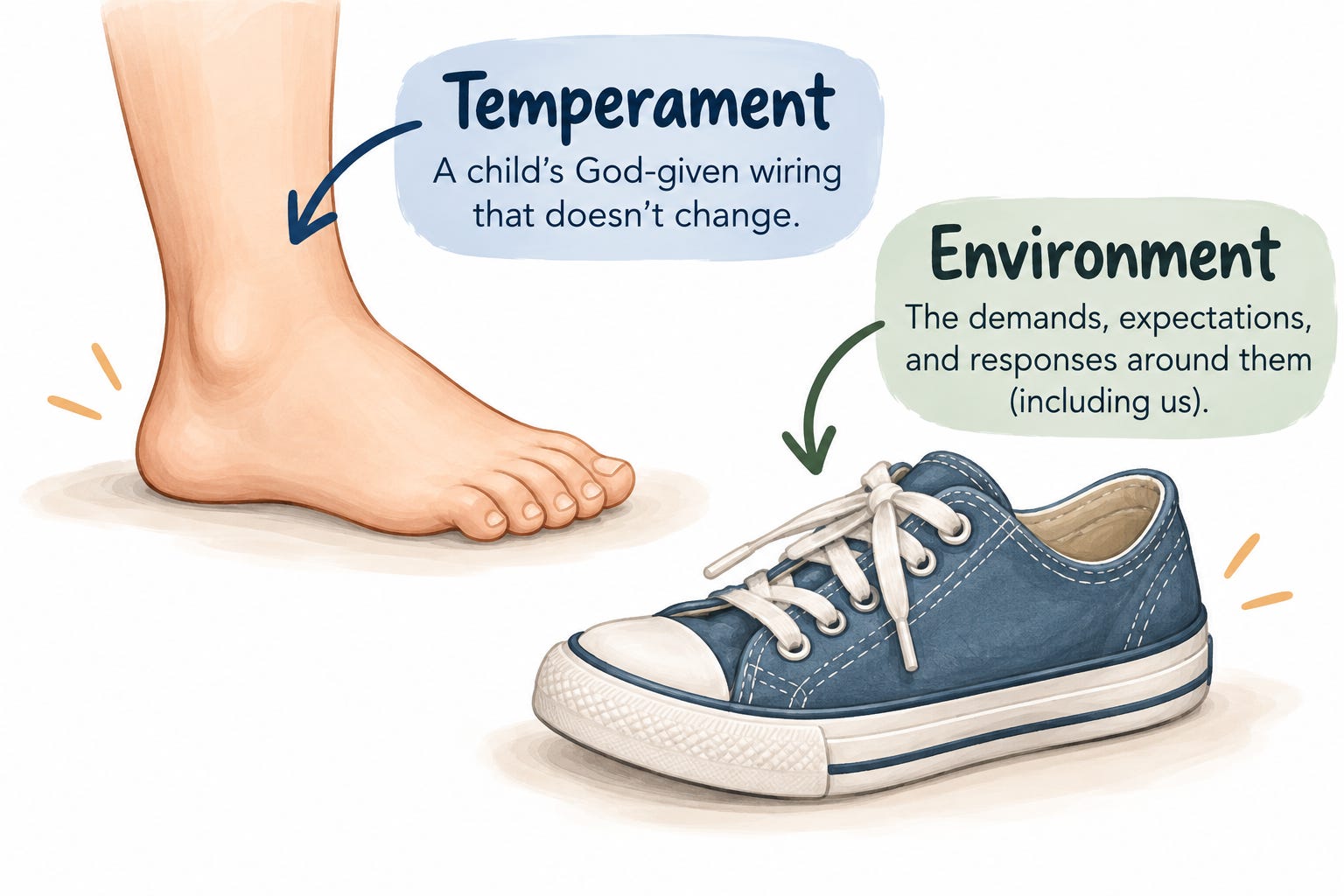
When Behavior Starts to Limp
We don’t buy a random pair of shoes and expect the child to walk in them. We size them, try them on, tie the laces, adjust the socks, and let them practice walking in them (especially with a complicated shoe like cleats, ice skates, or high heels!)
These limp-along behaviors often look like the weakness signals we covered in this article two weeks ago.

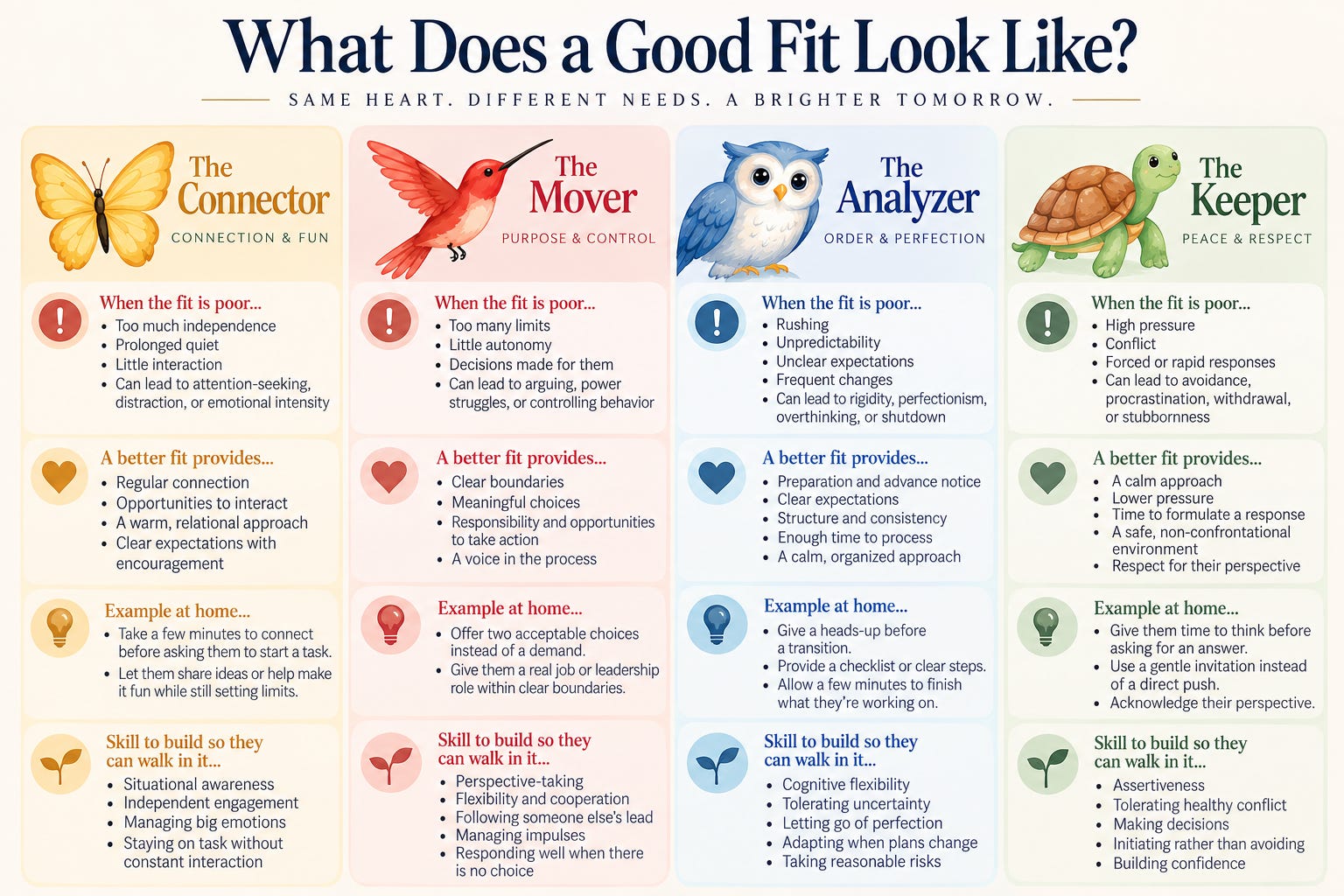
Put a Connector in an environment that requires prolonged independence, quiet, or little interaction, and you may see the attention-seeking turn up.
Put a Mover in an environment where every decision has already been made for them, and you may see more arguing, controlling, or bossiness.
Put an Analyzer into a rushed, unpredictable environment where the plan keeps changing, and you may see rigidity, perfectionism, or shutdown.
Put a Keeper into an environment filled with conflict, pressure, or rapid transitions, and you may see avoidance, procrastination, or stubbornness.
The behavior still needs to be addressed, but not by changing the foot (temperament); instead, change the shoe (environment) or the skills to adapt (self-regulation).
Goodness of fit is about whether the demands, expectations, and responses of the environment match the child's capacities and characteristics
Sometimes You Adjust the Shoe
Here's where goodness of fit gets personal: we are part of our child's environment.
The shoe is us. We are the shoe.
The rubbing is between a child's temperament and school, church, sports, and often us! Our temperament demands, expectations and responses bumping up against theirs!
A fast-moving, decisive Mover parent may experience an Analyzer child's need for time as dawdling. So the parent pushes harder, making the Analyzer feel rushed.
A harmony-seeking Keeper parent may experience a Mover child's directness as disrespect. The parent tries to quiet the intensity; the Mover pushes harder to feel heard; and suddenly both are responding less to the original problem and more to each other.
No temperament is right or wrong. The shoe is simply rubbing, and we need to make some adjustments.
Psychiatrists and researchers Alexander Thomas and Stella Chess laid the foundation for understanding how the bidirectional interaction between parent and child affected one another’s behavior and the child’s development.
A good fit supports academically strong, emotionally intelligent, and socially capable child development, whereas a poor fit is linked to depression, anxiety, behavior challenges, aggression, defiance, addiction, and academic challenges.
Temperament-informed/strengths-based parenting helps parents understand the fit and adjust the environment to help children develop the skills needed for lifelong success.
Sometimes You Teach Them to Walk In It
Sometimes the environment can't or shouldn’t be adapted to the child, That's when we help them learn to walk in the shoes they have. Maybe we add thicker socks for a while. Maybe we loosen the laces. Maybe we hold their hand while they find their balance. But eventually, they have to do some of the walking.
After we’ve made environmental adjustments to our parenting style or household warmth, structure and authomoy, we focus our attention on helping them build skills.
With the Holy Spirit as our guide in all wisdom, knowledge and understanding, we can begin to notice areas of poor fit, name what needs to change, and nurture that growth.
That’s scaffolding. We lend them regulation while they’re developing their own.
The goal isn't to create a world that always fits their temperament. It's to provide enough fit and support while they're young that they can develop the skills to navigate environments that won't.
If you’re asking, “But are we babying them?” the answer is no. Psychology literature says so, and Scripture even gives an example of God doing the same for His people.
When God Fixed the Fit to Protect From Failure
In Exodus 13:17, right before the Israelites crossed the Red Sea, we’re told that God did not lead the people through the Philistine country, even though it was the shorter route. God said, “If they face war, they might change their minds and return to Egypt.” So God changed the route.
He didn’t say, “Well, they’ll eventually have to face hard battles in Canaan anyway, so they might as well toughen up now.” He adjusted the environment to meet their present needs, then set aside time in the wilderness to teach the skills they’d need to reach their destination.
That’s God changing an environment to fit people’s present needs, while still holding them accountable for developing those skillful behaviors.
Practical Parenting for Today
Notice the Rub. Adjust the Shoe. Practice Walking.
· Notice It ·
Where does the same behavior keep appearing? The Connector may get louder or more attention-seeking when connection is scarce. The Mover may become controlling when there is no room for appropriate choice. The Analyzer may become rigid or shut down when things feel rushed or unpredictable. The Keeper may withdraw or become quietly stubborn when the environment feels pressured or conflict-heavy.
Don't stop at What is my child doing? Ask: Where is the shoe rubbing?
· Name It ·
Name the mismatch. What is this environment asking of my child that is rubbing against their natural temperament right now?
Then ask what could change for now to make success more possible. Give the Connector appropriate moments for connection before asking for independence. Give the Mover bounded choices and meaningful responsibility. Give the Analyzer preparation, predictability, and enough processing time to get started. Give the Keeper a little space, a lower-pressure invitation, and time to formulate what they want to say.
We're not removing the expectation. We're adjusting how the child gets there.
· Nurture It ·
Don't remove the support all at once. Gradually ask your child to carry more of what you've been carrying for them.
If you've been preparing your Analyzer ten minutes before every transition, teach them to check the schedule and prepare themselves. If you've been offering your Mover choices, begin practicing what to do when there isn't a choice. If you've been helping your Connector settle into independent work, teach them how to recognize when it's time to quiet their social energy. If you've been speaking for your Keeper, start giving them the words, and then let them do the speaking.
First we do it for them. Then we do it with them. Eventually, they learn to do it for themselves.
Adjust the shoe. Practice the walk. They gradually need less adjustment. That's the goal.
Changing the Environment and Building the Skills
Here’s what I eventually realized about my role in my children's temperament-based behavior on nights like that Bible study: if I insisted on my Mover tendencies setting the stage for the environment, I could expect outbursts from three of my four kiddos. The fourth? Oh, we’d butt heads from now till Kingdom come over who got to be the Mover.
So now, I take a new approach. I adjust my parenting to open the environment where all temperaments can thrive. Where everyone has a chance to demonstrate their strengths. And I pay attention when weakness signals show up because those are the skill gaps. So I use golden words to help build those skills in developmentally healthy ways.
You can too! Just remember. I am the shoe. The shoe is me. What environment and skill set do they need?
Helpful Tools
If you’d like a useful guide to help you understand your child’s temperament, you can access it here: Use the Temperament Assessment Tool

We are weeks away from the launch of our 365 Day Golden Words Inspiration Calendar. Subscribers will receive launch details & 50% off, coming soon!

And don’t miss the upcoming Wired This Way game, which is also available 50% off to subscribers.



References:
McClowry, S. G., Rodriguez, E. T., & Koslowitz, R. (2008). Temperament-Based Intervention: Re-examining Goodness of Fit. *European journal of developmental science*, *2*(1-2), 120–135.
Ganiban, J. M., Liu, C., Zappaterra, L., An, S., Natsuaki, M. N., Neiderhiser, J. M., Reiss, D., Shaw, D. S., & Leve, L. D. (2021). Gene × Environment Interactions in the Development of Preschool Effortful Control, and Its Implications for Childhood Externalizing Behavior. *Behavior genetics*, *51*(5), 448–462. <https://doi.org/10.1007/s10519-021-10073-9>
Baer, J., Schreck, M., Althoff, R. R., Rettew, D. C., Harder, V. S., Ayer, L., Albaugh, M. D., Crehan, E. T., Kuny-Slock, A. V., & Hudziak, J. J. (2015). Child Temperament, Maternal Parenting Behavior, and Child Social Functioning. *Journal of child and family studies*, *24*(4), 1152–1162. <https://doi.org/10.1007/s10826-014-9924-5>
Cipriano, E. A., & Stifter, C. A. (2010). Predicting preschool effortful control from toddler temperament and parenting behavior. *Journal of applied developmental psychology*, *31*(3), 221–230. <https://doi.org/10.1016/j.appdev.2010.02.004>
I love this perspective - As a parent, grandparent, and teacher.
This is wonderful stuff, Bethany! In fact, I laughed out loud at your family Bible study adventure... or maybe misadventure! 😄 But what a grand object lesson in the foot as temperament and the shoe as environment. I love that!! Thank you for your amazing work to support parents in raising psychosocially healthy children inside a spiritual framework.