


Summary:
Discover what’s behind teenage defiance and changing behavior.
Learn how adolescent identity development shapes independence, beliefs, and decision-making
Tomorrow: learn how parents can guide teens with wisdom instead of control.
“Why do you have to question everything I say?” Amara hadn’t meant to raise her voice, but after twenty minutes of going back and forth with Selah, she’d had enough.
“I’m not questioning everything, Mom. I just don’t agree with you!”
“Well, you certainly didn’t have a problem agreeing with me six months ago.”
“That’s because six months ago, I didn’t know what I thought!”
Amara stared at her fourteen-year-old daughter. When had every conversation become a debate?
Two evenings later, Amara settled into a comfy armchair at a local coffee shop, balancing her latte and notebook. She’d almost skipped the parent meet-up, but lately she had more questions than answers.
Across the room, another mother was describing how she’d discovered her daughter deleting messages from her phone.
“You might be surprised by what motivates teens to hide things,” the facilitator said. “We’ll explore that next week. This week, start by asking your daughter which apps she loves and why. Just listen. No judgment.”
Amara jotted down the suggestion.
Then the facilitator asked, “What’s the most important developmental work of the teen years?”
Parents offered answers. Independence. Responsibility. Making good decisions.
“All important. But the foundation for all that is something bigger: their identity. They’ve spent years learning your beliefs, values, and expectations. Now they’re beginning to figure out which ones they believe for themselves. They wonder, Who am I?”
That’s because six months ago, I didn’t know what I thought! Selah’s words echoed in Amara’s mind.
“Your teenager isn’t necessarily questioning your beliefs because they want to reject them,” the facilitator continued. “Sometimes they’re questioning because they need to understand why they believe them.”
Amara stopped writing. She’d interpreted Selah’s constant questioning as resistance, even defiance. But what if Selah wasn’t simply pushing against her? What if she was trying to discover something about herself?

Don’t miss next week’s article on Teens, Technology & Navigating the Digital World
The Question Behind a Developing Teen’s Behavior
The teen years are a wild time of emotional storms, hormonal flooding, and waves of social uncertainty. The brain is trying to make sense of life.
Psychologist Erik Erikson identified this developmental stage as “Identity vs. Role Confusion”. After years of learning from parents, teens begin asking which beliefs, values, and expectations they want to adopt as their own.
It’s like riding a bike: at first we let them ride in the seat behind us, then tandem, then with training wheels, but now it’s time to take the training wheels off and let them try. We may still run beside or behind them to offer support if they wobble, but our role is more about guidance and influence than directing or demanding.
They’re exploring everything you gave them in early childhood now, through relationships, experiences, reflections, and opportunities to make their own choices.
Four Paths Through Identity Formation
James Marcia’s explanation of four statuses of adolescent identity formation helps us understand where teens are in the process: diffusion, foreclosure, moratorium, and achievement. To determine which one your child is in, answer two questions:
Are they exploring?
Have they committed?
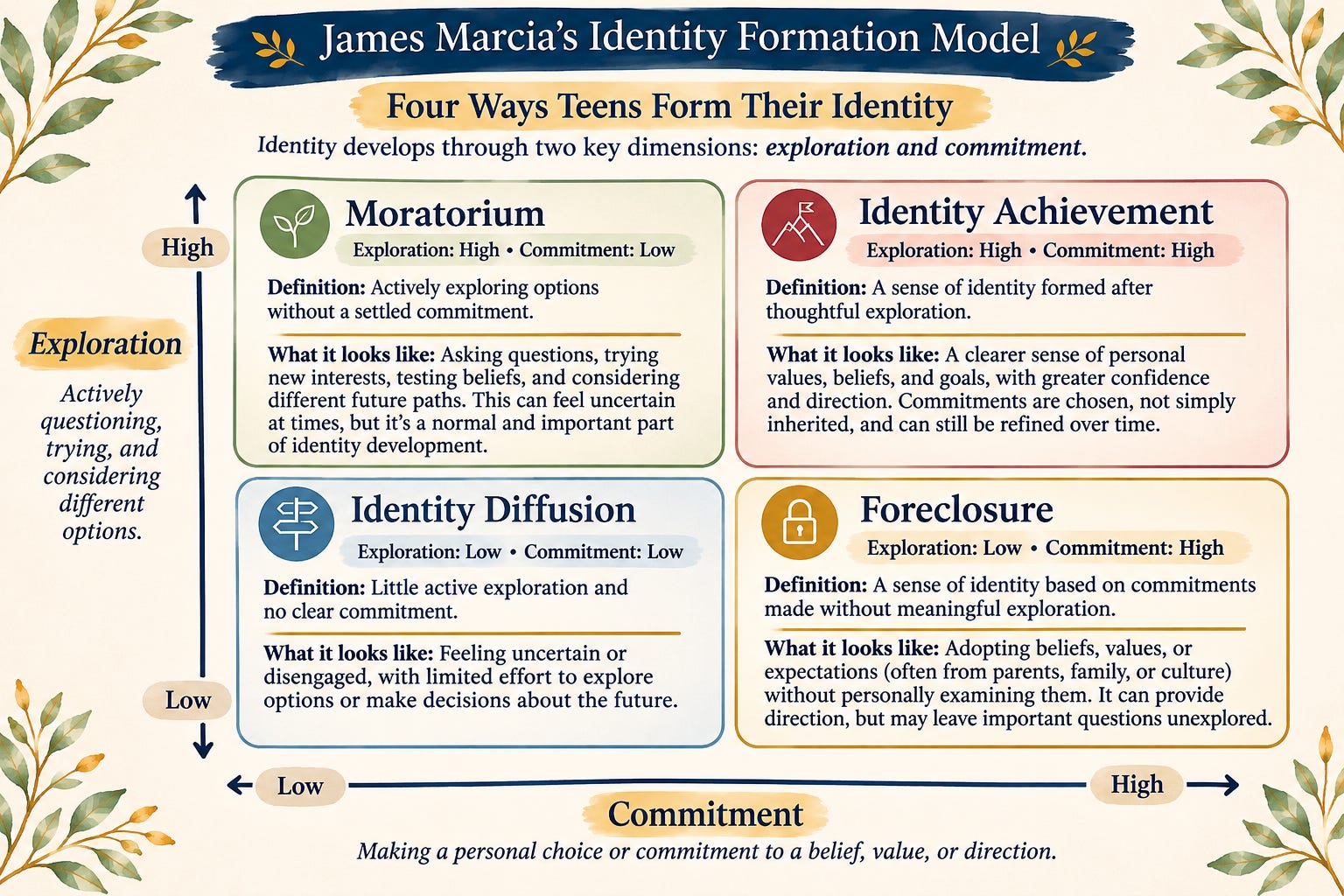
A teen in identity diffusion hasn’t explored what they believe or made any commitments. You might hear, “I don’t know what I believe, and I don’t really care.” They may seem uninterested in thinking about their future or figuring out what matters to them.
A teen in identity foreclosure has made commitments without exploring alternatives. You might hear, “I believe it because that’s what our family believes.” This can feel reassuring to parents, but adopting beliefs without examining them doesn’t necessarily mean those convictions have become their own.
A teen in identity moratorium is actively exploring but hasn’t settled on a commitment. You might hear, “I’m not sure I believe that anymore. I need to figure it out for myself.” This is often the stage that makes parents most uncomfortable. What looks like rebellion may actually be a teenager working through important questions.
Finally, a teen who has reached identity achievement has explored their options and made meaningful commitments. You might hear, “I’ve thought about it, and here’s what I believe and why.” Their conclusions may not always match ours, but they’ve begun developing a clearer sense of who they are.
These aren’t permanent labels or stages every teenager moves through in order. A teen might have achieved a strong sense of identity in their faith while still exploring friendships, career interests, or personal values.
Our job isn’t to rush them toward commitment simply because uncertainty makes us uncomfortable. It’s to help them develop the wisdom to explore thoughtfully and form convictions they genuinely understand.
The Father Who Let His Son Leave
The story in Luke 15:11-32 is about a son who asks his father for his inheritance and leaves home. The details of his departure are not explicitly given, but the story suggests the son had better ideas for how to live his life and use the inheritance. Ideas that seemed in direct opposition to the plans the father had for him.
But the father didn’t stop him. He allowed him to go, despite the potential consequences. In verse 17, we actually see that the consequences are what brought the son to the end of himself and into full realization of the error of his ways.
The story continues in a show of great mercy and grace as the father, symbolic of our own heavenly Father, welcomes the son back with open arms.
But I often wonder what would have happened if the father hadn't allowed the son to leave?
Why the Teen Years Matter
Modern psychology offers some insight here:
Research on psychologically controlling/coercive, rejecting, or chaotic parenting has found associations with greater emotional difficulties, including anxiety and depressive symptoms, as well as behavioral problems such as aggression and rule-breaking.
In contrast, parental warmth, appropriate structure, and autonomy support are associated with healthier adjustment.
The important question becomes: how do we set boundaries with warmth, structure, and autonomy support without coercive control of their every move and belief?
Adolescence offers the opportunity to practice decision-making while parents can still provide support. But if our strategy is to prevent every mistake before it happens, it limits the natural consequences that create opportunities to develop better judgment.
The caveat is that we must distinguish manageable mistakes from serious risks that require intervention.
The goal isn’t to raise a teenager who simply knows what we believe and accepts it at face value. It’s to help raise a young adult who understands what they believe, why they believe it, and how to live accordingly.
Doing that requires a delicate balance of warmth versus rejection, structure versus chaos, and autonomy support versus coercion. That’s where we'll focus in tomorrow’s article, now that we understand the stage our child is in.
It’s not too late to join Parenting with Purpose, and as a Subscriber, you get in for Free (use code HSLM2026).
Sign up at https://www.thekairosbridge.com/service-page/6-weeks-of-parenting-with-purpose
Tuesdays · 6 - 7 pm CT

References
Erikson, E. H. (1968). Identity: Youth and crisis. W. W. Norton & Company.
Gross, J. J. (1998). The emerging field of emotion regulation: An integrative review. Review of General Psychology, 2(3), 271–299. https://doi.org/10.1037/1089-2680.2.3.271
Kroger, J. (2000). Identity development: Adolescence through adulthood. International Journal of Behavioral Development, 24(1), 1–10. https://doi.org/10.1080/016502500383250
Marcia, J. E. (1966). Development and validation of ego-identity status. Journal of Personality and Social Psychology, 3(5), 551–558. https://doi.org/10.1037/h0023281
Meeus, W. (2011). The study of adolescent identity formation 2000–2010: A review of longitudinal research. Journal of Research on Adolescence, 21(1), 75–94. https://doi.org/10.1111/j.1532-7795.2010.00716.x
Pinquart, M. (2017). Associations of parenting dimensions and styles with externalizing problems of children and adolescents: An updated meta-analysis. Developmental Psychology, 53(5), 873–932. https://doi.org/10.1037/dev0000295
Pinquart, M. (2017). Associations of parenting dimensions and styles with internalizing symptoms in children and adolescents: A meta-analysis. Marriage & Family Review, 53(7), 613–640. https://doi.org/10.1080/01494929.2016.1247761
Ross, L. (1977). The intuitive psychologist and his shortcomings: Distortions in the attribution process. In L. Berkowitz (Ed.), Advances in experimental social psychology (Vol. 10, pp. 173–220). Academic Press. https://doi.org/10.1016/S0065-2601(08)60357-3
Soenens, B., & Vansteenkiste, M. (2010). A theoretical upgrade of the concept of parental psychological control: Proposing new insights on the basis of self-determination theory. Developmental Review, 30(1), 74–99. https://doi.org/10.1016/j.dr.2009.11.001