

Summary:
A day in the life of Amara, mother of four, from THE LOST WAY
Technology and digital media can trigger various behavioral responses from children
The American Academy of Pediatrics (AAP) and the American Psychology Association (APA) recently updated guidance on screen time, tech access, and digital use
Understanding the developmental needs Behind Behavior is essential to knowing how to Parent with Purpose
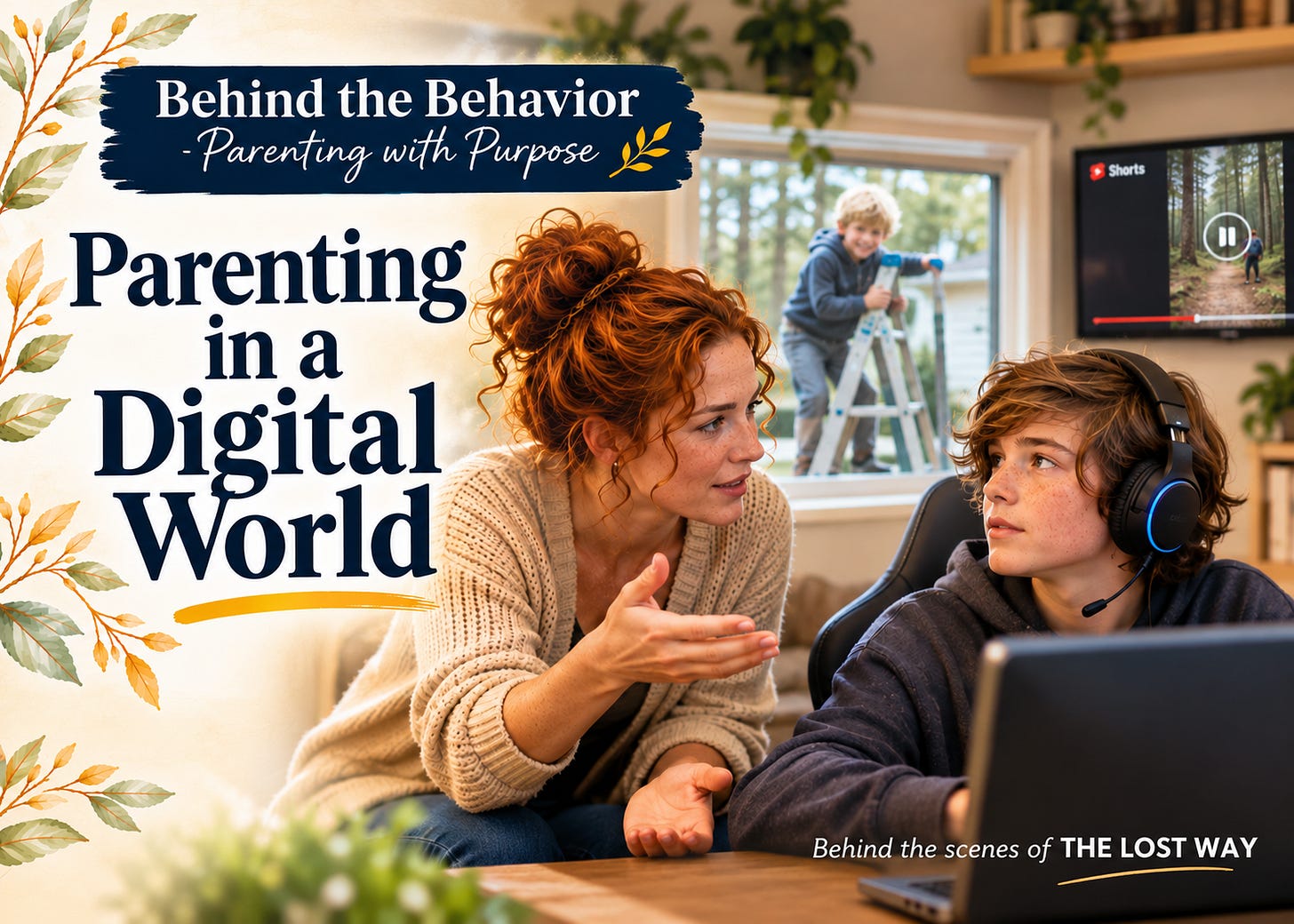
“Time’s up, Asher.”
“Just five more minutes, Mom!”
Amara sighed. Five minutes inevitably became ten, then fifteen. Screen-time limits had become more of a suggestion than a rule.
“Mom, I can’t just quit! My team needs me! We’re almost done!”
“Then why did you start another game?”
Walking over to the computer to help him wrap things up is when she noticed the chat request in the upper right corner caught her attention.
“Asher, who’s that?”
He glanced at the notification. “I don’t know. I’ve just been ignoring it.”
She was proud of Asher, but had she become so focused on screen time that she’d overlooked other important considerations: What was happening in these games? Who was he interacting with? What decisions was he already making wisely, and where did he still need guidance?
The screen-time boundary still mattered, so she set the disciplinary consequence: “You can turn it off, or I will, but every extra minute spent playing video games means 2 extra minutes added to your reading goal for the day.”
Asher voiced a quick message to his friends before shutting off the game.
On her way back to the kitchen, Amara noticed the YouTube clip paused on the television. Then she saw Micah in the driveway, perched on a ladder with a rope, in what she suspected was his attempt to replicate the AI-modified YouTube clip on the screen. Yikes! Outside play? Good. Death-defying attempts? Not good.
It’s more than she could say for little Liora, whose two-year-old toddler brain was triggered into tantrum mode anytime Amara or Jonah took the tablet from her.
And then there was fifteen-year-old Selah, who had been hiding apps and messages.
Amara sighed again. She’d just as well throw all the devices away, but she realized avoidance wasn’t a good long-term strategy.
But why did every child react so differently to technology, and how could she address it?
What’s Really Happening Behind the Screen?
Each child’s behavior clues us into an important developmentally based need.
Liora, as a toddler, is still developing the emotional regulation skills needed to manage disappointment.
Micah’s can navigate YouTube but doesn’t yet have the cognitive skills to reliably distinguish realistic-looking digital content from reality
Asher is struggling with time management and transitions, yet demonstrating good judgment about online strangers.
And Selah, navigating adolescence, may be more concerned about avoiding punishment than considering whether her online choices are wise.
These struggles are developmentally normal, and even predictable, which is why the AAP and APA have updated their guidance to consider the individual needs of each child and family.
Technology: The devices, tools, and platforms we use to access information, communicate, learn, create, and interact
Digital Media: The content and experiences we engage with through technology, including videos, games, social media, messaging, websites, and online communities.
Technology is the tool. Digital media is what we experience through it.
Why the Screen Time Recommendations Have Changed
For years, parents have searched for a straightforward answer. Two hours? One hour? No phones until middle school? No social media until sixteen?
Numbers feel manageable. They give us something to measure, enforce, and feel confident about. But two children can spend the same amount of time on a screen and have entirely different experiences. It’s not just about screen time; it’s about the quality and type of content being consumed and the effect it has on a child’s life.
In January 2026, the American Academy of Pediatrics released updated guidance moving away from the long-recognized two-hour screen-time limit to now emphasizing the quality of digital experiences, children’s developmental needs, platform design, and what technology use may be displacing in their everyday lives.
The American Psychological Association similarly emphasizes adolescents’ maturity, self-regulation skills, understanding of risks, and family environment when considering social media use rather than an arbitrary (non-evidence-based) appropriate age for a first smartphone.
That doesn’t mean screen-time limits are unnecessary. It means time is only one piece of the picture to consider.
What Children Need at Different Ages and Stages
Developmental psychology helps explain why Amara’s four children respond so differently.
It starts with shifting our focus from screen time to the quality of the content being viewed and the effect it is having on each child’s sleep, exercise, emotions, academic performance, relationships, and thought processing.
The next time one of these behaviors shows up, here are some helpful ways to respond:
Toddlers like Liora: Trust, Exploration, and Emotional Regulation
Toddlers are developing autonomy but still depend heavily on adults to help regulate their emotions. Liora’s tantrum doesn’t necessarily mean she’s addicted to her tablet. She may simply lack the skills to manage the disappointment of losing something enjoyable.
At this age, responsive relationships, language, movement, and hands-on exploration are especially important.
Notice It: What is the pattern of behavior? When does it happen? Is it a particular device or app that triggers it? Is she getting enough sleep, adequate nutrition, and physical activity?
Name It: Use this to help develop emotional awareness and self-regulation. Get on eye-level. “You seem sad/mad. It’s hard to stop something you enjoy. Let’s put the tablet away and find something we can play together.”
Nurture It: Build in transition times. Use co-viewing: pause and discuss what they saw and what they thought. Encourage more educational content than passive watching. Give time-transition warnings (“Five more minutes. What’s the last thing to watch or play?”) and support cognitive flexibility (“What fun thing do you want to do when time’s up?”).
Micah (age 6): Initiative, Imagination, and Emerging Judgment
Early childhood is a season of exploration and initiative. Children are eager to try things independently, but their ability to evaluate information and anticipate consequences is still developing.
Micah may know how to find a video without recognizing that what he’s watching is digitally manipulated, or that attempting to recreate it could be dangerous.
Notice It: What is the pattern of behavior? What triggers his creative ideas? When does he tend to do them? What excites him?
Name It: Use this to support cognitive development of cause-and-effect and critical thinking. “Wow! That looks pretty amazing, doesn’t it? But do you think that really happened, or could someone have used a computer to make it look real? Let’s figure it out together.”
Nurture It: Set age limits and privacy on apps. Continue co-viewing, with preference toward more interactive apps for physical activity, cooking, arts, and creativity. Play “Spot the Fake/AI/Ad/Click-Bait” and set aside time for creative play, including adaptation of things he may see online that he wants to try with adult supervision.
Asher (age 11): Competence, Belonging, and Executive Function
During middle childhood, children increasingly seek opportunities to feel capable, successful, and included.
Asher’s gaming may provide meaningful friendships and a sense of accomplishment, but he gets lost in the world without time management. He did well to ignore the unfamiliar chat but needs help with other executive function skills like planning, prioritization, task initiation, sustained attention, and self-monitoring.
Notice It: What’s going well and can be praised? What areas still need maturing? Are devices interfering with schoolwork? Is screen time supporting or stressing social connections?
Name It: Help kids recognize areas they may be blind to. “I’m proud of you for ignoring that message. That was good judgment! Now, let’s talk about planning ahead. How can you make sure you have enough time to finish a game before starting one?”
Nurture It: Task kids between 6 and 11 with setting their own timer and tracking time limits. When they adhere to it, reward that behavior. When they miss the mark, dial in the boundaries and consequences. Consequences should be fair and related. Role-play how to respond to chats from strangers, requests for private information, and pressure to share photos. Discuss social comparison, bullying, and attention/approval-seeking behavior from friends.
Selah (age 15): Identity, Independence, and Moral Reasoning
Adolescence brings growing independence, social influence, and questions about identity and personal beliefs.
Selah may understand that hiding apps violates family rules without fully appreciating why particular online interactions or content could be harmful. Or she may recognize the risks but fear losing privileges more than she values being honest.
Understanding what motivates her secrecy matters because that must be addressed in order to help her consider her own personal convictions about right and wrong.
Notice It: What types of apps/messages is she deleting? Are there opportunities for open communication? What’s missing from parental warmth, structure, and autonomy support?
Name It: Invite teens into curious conversations. “Were you hiding these because you knew something was wrong, or because you were afraid of how I’d respond? Let’s talk about what was happening and why we have these boundaries.”
Nurture It: Applaud honesty, but maintain boundaries and consequences. Confirm appropriate age limits and privacy settings on apps. When boundaries are broken, establish closer monitoring until they demonstrate better choices. Create an environment where communication is safe, discussing behaviors without judgment, shame, or humiliation. Discuss the real risks associated with secrecy, with consideration for local news reports of teen abduction or human trafficking.
Notice the behavior. Name the need or temptation. Nurture the skill or wisdom that needs to grow.
An Ancient Pattern of Temptation Shows Up in Today’s Technology
Technology is not all bad. It presents opportunities for learning, connection, and creativity. We all recognize the central role technology plays in life.
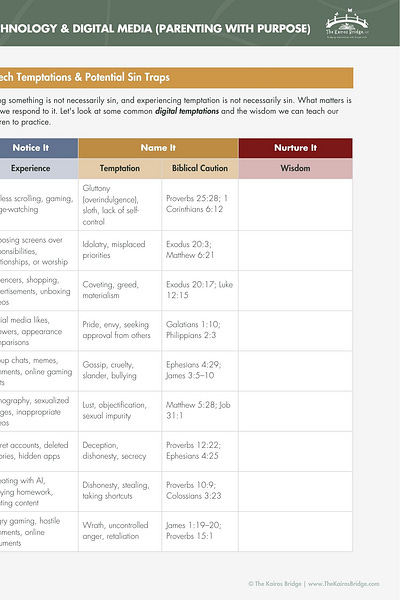
But technology and media can present temptation, which can become a sin pattern if we don’t teach children how to navigate it.
We’re all pretty familiar with the scene in the Garden of Eden (Genesis 3), where Eve sees the fruit of the single tree she’s forbidden to eat. She desires it. She takes it. Then she hides her sin. But not really. Because sin is always found out, and there are consequences for everyone.

Guess what! That same pattern shows up again in Joshua 7 after the defeat of Jericho. The city was dedicated for destruction, but Achan saw the devoted things and desired them. So he took them. And hid them. And the consequences affected the entire tribe of Israel.
We see it again in 2 Samuel 11 when David sees Bathsheba, wants her, takes her, and then hides his sin! (Only not really, because El Roi, the God who sees, saw; and there were consequences: death and destruction).
It happens over and over: Cain and Abel. Jacob and Esau. Joseph’s brothers. Potiphar’s wife. Ahab and Jezebel.
Now consider the digital world our children encounter every day. An influencer promotes something they suddenly feel they need. A group chat invites them to participate in gossip. A social media post stirs jealousy or insecurity.
But it’s not just media. It’s technology, too. The algorithm auto-feeds the next thing, and if we aren’t careful, two hours have passed, and with it, our failed responsibilities like homework, chores, and exercise.
It’s all very tempting: social comparison, peer approval, dopamine feedback loops. What begins with exposure can become desire, then action, and sometimes secrecy.
But then comes JESUS! In Matthew 4, when Jesus faced temptation in the wilderness, He responded with God’s Word rather than giving in. He overcame flesh by relying on the Spirit.
Our children won’t always be able to avoid temptation, but they can learn to recognize it and respond wisely. That’s why digital parenting involves more than controlling what children see. It’s also about nurturing the discernment, self-control, and honesty they’ll need when we’re not watching.
Download the free Parenting with Purpose: Technology & Digital Media guide to create your family’s plan together.
And watch the accompanying YouTube video, where we’ll walk through more everyday digital parenting scenarios, including the exact conversations and responses that help children grow in wisdom, responsibility, and self-control.