


Led By Emotion (from THE LOST HEART SONG)
Evie was grateful to be home, curled up in her cozy armchair after a long and defeating day. She wanted to open her laptop and start damage control on her dissertation, but something Noa had said at dinner had stuck with her.
God never asks us to suppress emotion, but He also never tells us to blindly follow them.
Is that what her mom had done 10 years ago? Blindly followed her emotions straight into death’s grasp?
Evie’s father would say so, but Evie was struggling to clearly remember what her mother always said. It wasn’t “follow your heart”, but something close.
Evie stared down at the cup of tea in her hands, annoyed that she’d let it go cold.
Suddenly, her phone rang. She answered flatly, “Hi, Sadie.” She loved her sister, but she didn’t have the energy tonight.
Surprisingly, Evie found herself relaxing at the sound of her sister’s voice. She even felt better as she vented to Sadie about the Dean’s decision on her final semester abroad and Samantha’s rights to her dissertation topic.
But as they hung up, Sadie’s parting words lodged in Evie’s chest the way a half-true platitude always does: “I know you’ll figure this out, Evie. Just do whatever feels right. I’m praying for you.”
The irony of her family’s emotional spectrum was not lost on her: her emotion disapproving father, her emotion laissez-faire sister, and her own emotion dismissive self. Her mother’s death really did a number on them.

Where Emotion Laissez-Faire Comes From
Many of us, in resolving not to end up on either end of the emotion socialization spectrum of emotion-disapproving (“Feelings lie”) or emotion-dismissing (“You’ll get over it”), strive for something in the middle. But here’s where it gets tricky.
Feel your feelings. Yes. But don’t stop there.
Emotions were never meant to be ignored, but they were also never meant to become our directional compass.
When feelings are left unprocessed, unreconciled, and unregulated, they begin to shape our reactions, relationships, identity, and decisions without wisdom, healing, or discernment.
It’s called emotion laissez-faire, and it’s the third of the four types of emotion socialization we’ve been covering in this series. Emotion laissez-faire sounds compassionate, understanding, and even supportive. But underneath it is a quiet belief that feelings should lead the way while we simply follow their direction.
At first, emotion-laissez-faire sounds like:
“You can feel however you want.” (no boundaries)
“I just want you to be happy.” (emotion as the goal)
“Do whatever feels right.” (emotion as decision-maker)
“Follow your heart.” (emotion as authority)
It can sound validating, but it lacks direction:
“That makes sense, so go with it.” (validation without guidance)
“If that’s how you feel, then that’s what you should do.” (feeling = action)
“I don’t want to upset you.” (avoiding structure)
“It’s fine, we don’t need to deal with it right now.” (passive avoidance disguised as grace)
And internally, we tell ourselves:
“This is how I feel, so it must be true.”
“I can’t help it. I just feel this way.”
“I need to honor my feelings.”
“If I don’t follow this feeling, I’m being inauthentic.”
Over time, this creates a different kind of problem. Not disconnection from emotion, but over-identification with it.
It looks like and sounds like emotional awareness, when it’s actually emotional abdication, as feelings stop being a barometer that merely informs decisions, but becomes a dangerous compass that directs decisions.

How This Shows Up In Our Parenting
When emotions are fully expressed but left unguided, something important is still missing.
A child may be allowed to feel their feelings, to name their emotions, even to express them freely, but without support for what to do with those feelings, the brain defaults to its most immediate response: act.
Suddenly, emotions morph from something that is experienced to something that drives behavior.
In an emotion laissez-faire environment, the parent validates the emotion but does not help the child regulate or redirect it. So it sounds like:
“I get why you’re upset.”
“You can feel however you feel.”
“That makes sense.”
All of which are true but incomplete, leaving the child asking, “What do I do with this?”
The brain strengthens the pathways it uses most. So if emotion is consistently followed by immediate expression or action without pause, reflection, or guidance, then the child learns a powerful association: “When I feel something strongly, I act on it.”

In the short term, this often looks like:
intense emotional reactions that escalate quickly
difficulty calming without external changes
reliance on getting needs met immediately to resolve distress
Over time, these patterns shape child development.
Research beginning with Diana Baumrind’s work on permissive parenting and supported by decades of developmental research has shown that children raised without consistent emotional and behavioral boundaries are more likely to struggle with self-regulation, impulse control, and frustration tolerance.
Not because their emotions were wrong, but because they were never taught how to move through them with guidance.
Emotional expression alone does not create emotional maturity. It is the combination of feeling, understanding, and guiding that leads to regulation.
What Does Feeling, Understanding, and Guiding Look Like
God never asks us to suppress emotion, but He also never tells us to follow it blindly.
One of the clearest examples of emotion laissez-faire in Scripture is Samson.
Throughout Samson’s life, we see a pattern emerge: if he desired something strongly enough, he pursued it. Attraction became action. Anger became revenge. Impulse became decision-making.
When his parents questioned his desire for the Philistine woman in Judges 14, Samson responded: “Get her for me. She’s the right one for me.” (Judges 14:3)
The deeper issue was not that Samson had emotions, desires, or strong reactions. The problem was that his emotions increasingly became his compass.
Over time, this lack of emotional guidance cost Samson his discernment, relationships, freedom, and eventually nearly his entire calling.
Emotion laissez-faire often sounds compassionate because it validates feelings. But without wisdom, truth, discernment, and surrender to God, feelings slowly begin taking the place of authority in our lives.
Scripture gives us a very different picture through David.
In Psalm 42, we can see David fully expressing his emotions, but he doesn’t submit to them as his authority.
He describes his utter sadness and negative thoughts (v3), then thinks of happier things (v4), before falling back into despair (v5).
But what’s equally important is that David does not leave his emotions unanswered. He doesn’t allow despair to become the final voice speaking over his identity, hope, or future. That would be emotion laissez-faire.
Instead, David brings his honest emotions to God, speaks truth to his soul, and turns again toward prayer, worship, and remembrance of God’s goodness. David listened to his feelings, but he didn’t let them to become the final authority over his thoughts, choices, or direction.
Jesus followed a similar pattern in the Garden of Gethsemane, but rather than sitting in despair, saying, “God, I’m sad. Take this sadness away,” he yielded to God’s will, moving his heart, mind, soul, and strength toward what the Lord asks of him.
Jesus didn’t deny His feelings, but he also didn’t follow them.
We cannot abdicate our emotions, nor can we enthrone them. We must bring them into submission to God.

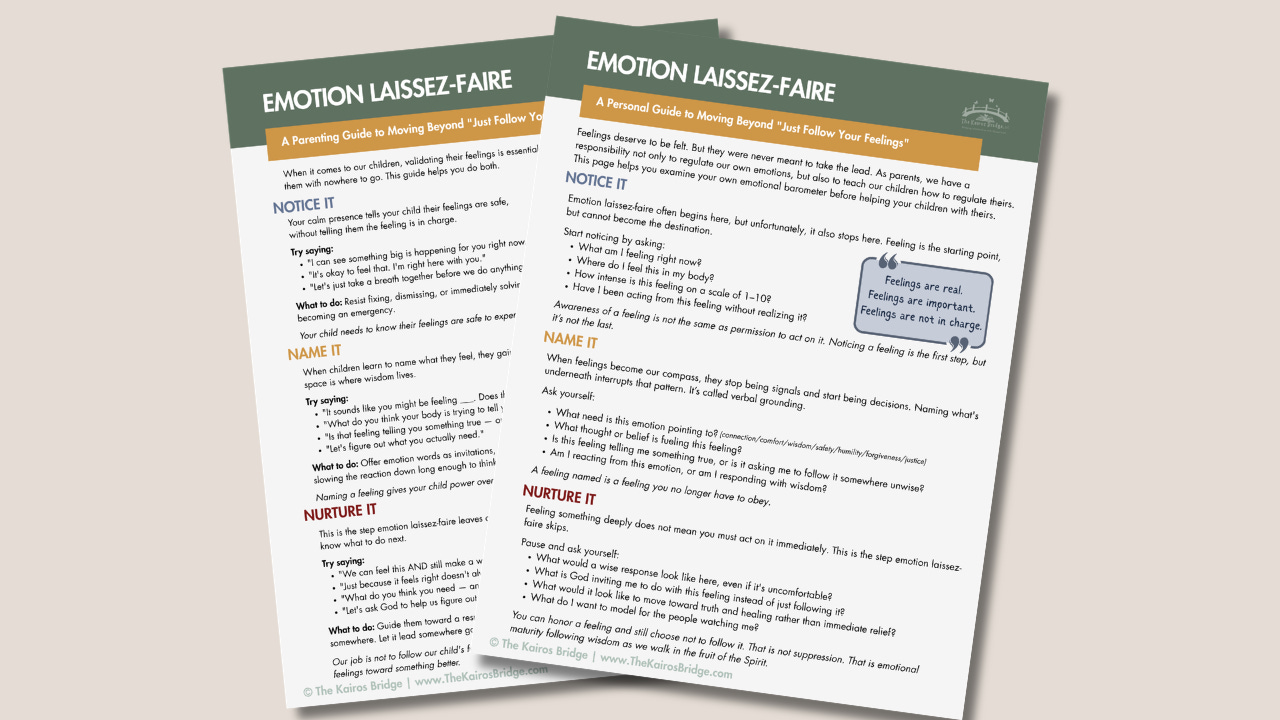
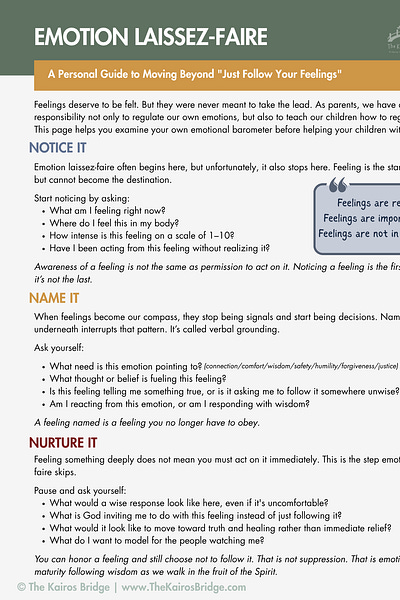
Notice It · Name It · Nurture It ™ This Week
One of the most effective ways I’ve found to help parents move beyond emotion disapproving, dismissing, and laissez-faire, is to slow down long enough to ask three questions:
What am I feeling?
What is this emotion pointing to?
What is God inviting me to grow in through this?
Emotions are not enemies to suppress or masters to obey. They are signals inviting us to pay attention.
Notice It: Pay attention to the moment your feelings begin shaping your reactions, assumptions, or decisions. Ask yourself:
“What am I feeling right now?”
“Where do I feel this in my body?”
“Am I reacting from emotion…or responding with wisdom?”
Why this matters: It brings awareness. Without awareness, we cannot seek understanding. And without understanding, we struggle to regulate.
Name It: Instead of treating emotions like commands, begin asking what they may be revealing. Ask:
“What need is this emotion pointing to?”
“What expectation, desire, thought, or belief may be fueling this emotional need?”
“What is true, even in the middle of this feeling?”
Emotions often reveal important signals. But signals are not always instructions to follow.
Nurture It: Bring both the emotion and your response before God. Ask:
“What would growth with God look like here?”
“What is God inviting me to do with this feeling?”
“What would it look like to move toward truth, wisdom, and connection instead of impulsive reaction?”
Just because you feel something deeply does not mean you must immediately act on it. Healthy emotional processing means learning how to feel honestly while still moving toward wisdom, obedience, healing, and love.
If you find yourself stuck swirling in emotions, your next step is to find a forward path. That’s exactly why I created A Free Guide to Processing Emotions.
If emotion-disapproving and emotion-dismissing disconnect us from our emotions, and emotion-laissez-faire leaves us ruled by them, then what does it look like to engage with emotions the way they were actually designed?
That’s where we’re headed next week, as we explore what it means to coach both our own emotions and our children’s with wisdom, truth, and connection. Don’t miss it!
References:
Baumrind, D. (1971). Current patterns of parental authority. Developmental Psychology Monograph, 4(1, Pt. 2), 1–103. https://doi.org/10.1037/h0030372
Kuppens, S., & Ceulemans, E. (2019). Parenting styles: A closer look at a well-known concept. Journal of Child and Family Studies, 28(1), 168–181. https://doi.org/10.1007/s10826-018-1242-x
Still love the PDFs!!