


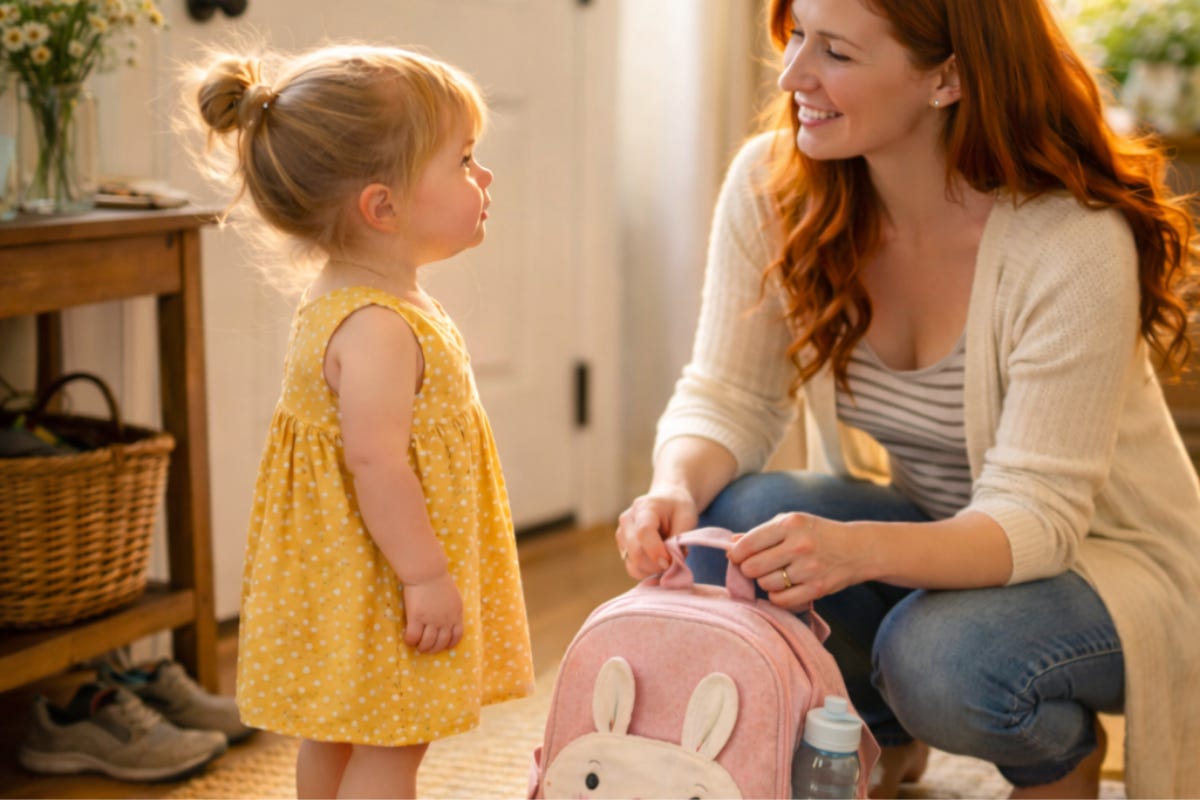
Amara grabbed the bag, ready to toss it into the stroller for coffee in the park with friends — then lurched backward.
“Sweetie, why is your bag so heavy?”
She peeked inside—stuffed lamb, coloring book, water bottle.
Two-year-old Liora beamed. “My invisible stones.”
Amara smiled. “What do you need invisible stones for?”
“I want to be like you,” she said. “But mine have questions. Yours have answers.”
Amara stilled. “What do yours say?”
Liora counted on her fingers. “Can I try it myself? What if I mess up? Are my ideas good?”
Amara swallowed. “And mine?”
Liora grinned. “You know. I am smart. I can do hard things.”
Then her voice softened. “But some I don’t like… I need to try harder as a mom. My anger makes me unlovable. I have to prove myself.”
The words landed with the thump of a heavy stone in a pool of water.
Because Amara knew those stones. Not because she could see them—but because she had carried them.
“Do you have any good answers yet?” she asked.
Liora lit up. “Yes! This one says I am safe. Remember the bumblebee? You said it’s okay to be scared—I just have to ask for help.”
Amara pulled her close.
Then the moment faded as she woke from the dream.
The Stones We All Carry
We don’t go looking for stones.
They’re handed to us in ordinary moments.
Some are beautifully written, born of the warmth, love, encouragement, and support from the people around us.
Other stones are heavier as a result of a terse tone, a correction, or a silence where help was needed.
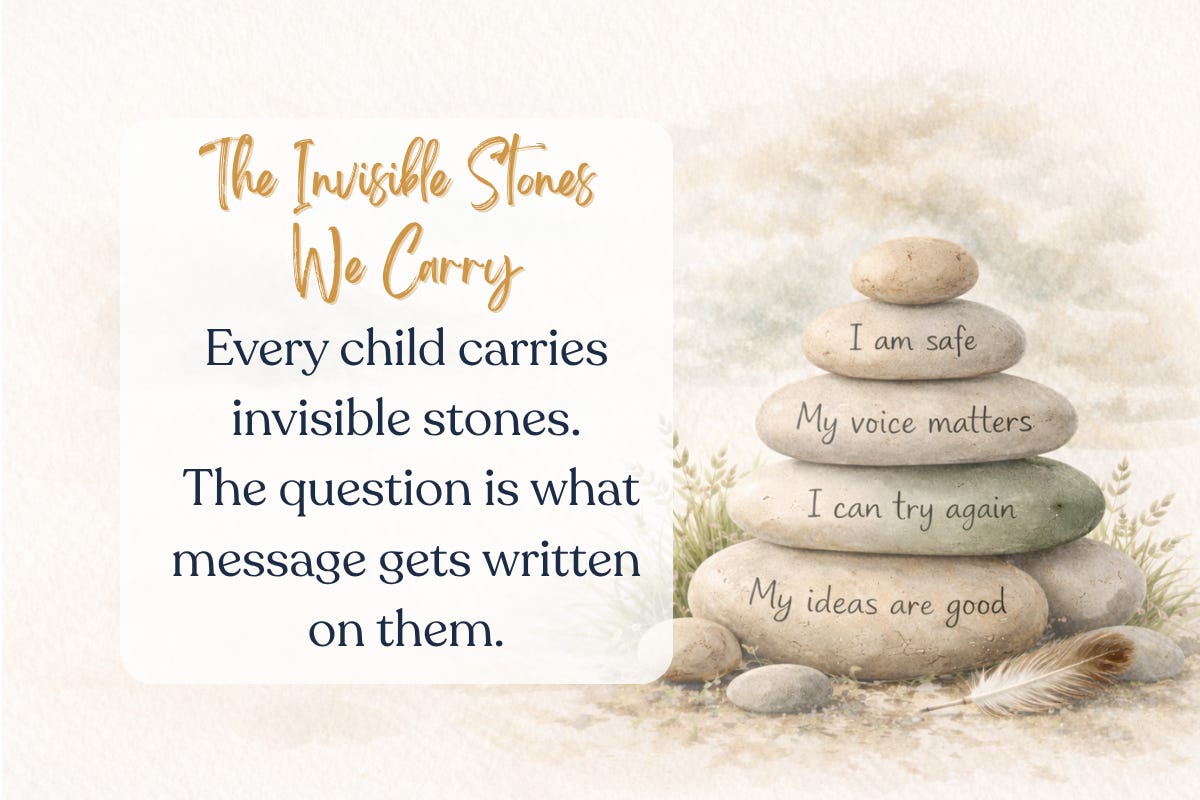
I’m not enough.
My voice doesn’t matter.
I have to prove myself.
These messages don’t announce themselves.
Perhaps your creative ideas in childhood were peppered with questions that felt like bullet holes. You began to believe your ideas weren’t good enough, and now you work quietly, not sharing them with others for fear they’ll find faults.
Perhaps well-meaning grandparents always asked about grades. Their attempt to encourage hard work began to feel like performance approval, and now you walk into every room ready to prove yourself.
Perhaps a parent rushed you through chores, only to double back for “finishing touches”. You began to believe your efforts weren’t good enough, and now you dread any group project, fearing it’ll be redone by someone else.
Perhaps a teacher rushed you through assignments so you wouldn’t fall behind. Help never felt accessible, so now you struggle with resilience, as any small setback feels like it defines your abilities.
No matter how well-intending the adult was, how we interpreted these messages quietly shaped how we show up today: in work, in love, and in parenting.
(But it doesn’t have to stay that way! Keep reading)
Now, our children are collecting stones, converting developmental questions into identity-forming answers.
The Science of Development
Our sense of self is built in small, repeated moments. Though seemingly trivial, they carry great significance.
Trying to tie our shoes, pack our own lunch, build our own lemonade stand, or choose our own clothing.
But these moments hold key questions that inform development.
The questions follow a clear pattern identified in child development research.
Infancy: Am I safe?
Toddlerhood: Can I try?
Early Childhood: Do my ideas matter?
Middle Childhood: Am I capable?
Adolescence: Who am I?
Children don’t answer these questions on their own.
They collect answers through small, repeated interactions—what research calls micro-interactions.
A look. A tone. A response.
Over time, those moments become beliefs.
I am safe. I can try. I can figure things out.
—or—
I’m on my own. I shouldn’t try. I’m not enough.
Every behavior you see in your child is connected to one of these questions.
And every response you give is helping write an answer.
But the answers — beliefs — can always be rewritten. That’s the beauty of evolving neuroscience.
What Scripture Has Always Said
Long before psychology named it, Scripture pointed to it.
Formation doesn’t happen in big moments—but in everyday ones:
“Talk about them when you sit at home and when you walk along the road, when you lie down and when you get up.” (Deuteronomy 6:6–7)
Not perfect moments.
Just ordinary ones.
And here’s the hope we hold onto: “I will restore to you the years the locust has eaten.” (Joel 2:25)
The stones we carry are not the end of the story. God is still writing.
Scripture is full of people who had to have their stones rewritten.
Moses. Gideon. Peter. Joseph. Rahab. Ruth. Esther.
God does not abandon our unfinished stories. He is the one who keeps writing them. (Philippians 1:6)
A Practice for This Week
For your child:
This week, pause long enough to notice the question underneath the behavior. You don’t need the perfect response. Just a present and supportive one.
Try:
“I’m right here.”
“I love how hard you tried.”
“Tell me more about your idea.”
“You can try again.”
Small words. But they become healthy stones that your child will carry.
For yourself:
Take a quiet moment this week and ask:
What questions did I carry as a child?
What answers were written on my stones?
Which ones am I still living from?
Which ones am I ready to rewrite as Jesus transforms me?
Don’t rush past them. Bring them to God honestly.
Because the work you do on your own stones is not separate from your parenting.
It is the work that shapes your life and theirs
Next Issue:
Now that you can see the questions beneath behavior, we’ll begin exploring how to nurture them well—in the small, everyday moments that shape everything.
Paid Subscribers: Be sure to grab your copy of this week’s Stones & Stories and Behavior Resource Guide
Fun fact for readers: In each issue, I follow a character from my in-progress fiction series, The Lost Heart Song, as she navigates real parenting and real healing. Today, you got a glimpse into the life of Amara from The Lost Way.