


Rushing was my first mistake. Dismissing it as “not that big of a deal” was my second.
Proverbial fuel on the fire.
Our long-awaited poolside playtime was coming to an abrupt end, thanks to a pop-up thunderstorm, Texas style. Lightning, strong winds, and hail were nothing to mess with.

Of course, I tried reasoning with him. “We’ll come back another day. For now, we just need to get home safely.”
Sure, I was disappointed. I was looking forward to catching up on my reading. But I’d processed that and moved on to the logical element of safety.
He hadn’t. All he felt was the disappointment of an abrupt and unexpected end to playtime. He wasn’t thinking logically; he was thinking emotionally. “My entire world just shifted. This was unexpected. I have no fun, no freedom, and no power to hold onto. I am unmoored.”
We’ve talked about emotional regulation in this series. This week is about teaching cognitive flexibility before emotions ever have a chance to come online. Because then, cognitive flexibility actually stands a chance.
What Is Cognitive Flexibility
Cognitive flexibility is one of the most complex of the eleven elements of executive function, which is why it has to be practiced before it’s needed.
By definition, it’s the ability to adjust when circumstances change. To switch ideas and strategies. To recover after disappointment. To see another perspective. To let go of one expectation and embrace another. (Even adults struggle with that one.)
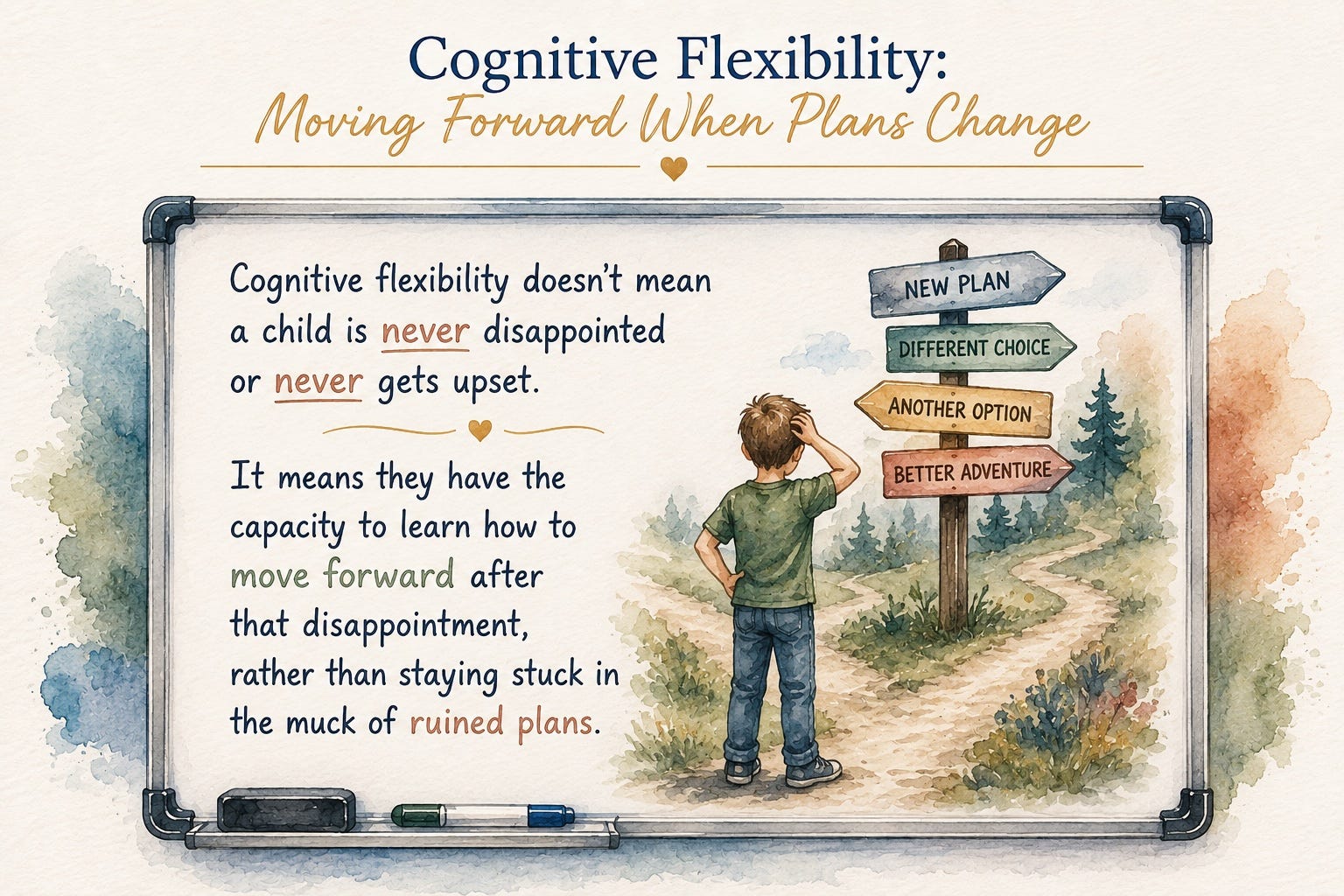
Cognitive flexibility doesn’t mean a child is never disappointed or never gets upset. It means they have the capacity to learn how to move forward after that disappointment, rather than staying stuck in the muck of ruined plans.
It means the 3-year-old can be sad about the sandwich cut into squares, or the wrong pajamas at bedtime, and still land on an acceptable alternative. The 8-year-old can be apprehensive about a new kid in class or a rained-out soccer game, and still see the other options as workable rather than catastrophic. The teenager whose friends swap the concert for shopping or who doesn’t get into their top-choice college can grieve it without setting up camp at Self-Pity.
What the Brain Is Doing
Our brains thrive on predictability to conserve energy. When novel situations arrive, they activate our emotional stress response, which requires emotional regulation and inhibition, so the prefrontal cortex has space to come online with working memory, cognitive flexibility, and planning.
That’s hard work for the brain. That’s why change feels exhausting before we ever get to the difficult task of making a new plan.
Cognitive flexibility isn’t something we are born with, though. It’s built through repeated experience and nurtured by a supportive parent or caregiver.
When teaching kids cognitive flexibility, I like to start with Scripture as a model of hope for what can come when plans change.
How God Teaches Us to Pivot
Almost every major story in Scripture begins with
“This isn’t what I planned.”
Abraham didn’t plan to climb that mountain with his son. Joseph didn’t plan the pit, the prison, or the brothers he’d have to forgive. Ruth didn’t plan to bury her husband in a foreign land. None of them chose the disruption. All of them were asked to release one plan and trust another.
That’s the same invitation we’re extending to our kids every time we say “let’s make a new plan” — we’re just doing it on a much smaller scale, with much smaller stakes.
In addition to helping kids look up to our Biblical Forefathers & Mothers, you can also offer Scriptural encouragement.
When Plans Change: “See, I am doing a new thing! Now it springs up; do you not perceive it?” (Isaiah 43:19)
When disappointment feels overwhelming: “And we know that in all things God works for the good of those who love Him...” (Romans 8:28)
When life feels hard: “Because you know that the testing of your faith produces perseverance.” (James 1:3–4)
When fearing the unknown: “Be strong and courageous...for the Lord your God will be with you wherever you go.” (Joshua 1:9)
When tempted to worry: “Do not be anxious about anything…” — Philippians 4:6-7
When they don’t understand why: “Trust in the Lord with all your heart and lean not on your own understanding.” (Proverbs 3:5–6)
When they need hope: “’For I know the plans I have for you,’ declares the Lord...” (Jeremiah 29:11)
When they feel alone: “Never will I leave you; never will I forsake you.” (Hebrews 13:5)
When they need courage to try again: “Forget the former things; do not dwell on the past.” (Isaiah 43:18)
When they need wisdom for the next step: “If any of you lacks wisdom, you should ask God...” (James 1:5)
When they need a reminder that God is Soverign: “In their hearts humans plan their course, but the Lord establishes their steps.” (Proverbs 16:9)
Psychology calls it cognitive flexibility. Scripture calls it faith, hope, and trust.
It’s about learning to trust God’s redirection, even in the small things. And doing it in the small moments helps you rehearse for the big moments to come in life.
Everyday Parenting
The beauty of executive function is that we have an opportunity to respond well in moments of chaos, but we also have the chance to practice the skills in calm before the chaos hits. That’s where the greatest growth often happens.
Notice It
In the moment of chaos...
Notice that your child isn’t just upset about the canceled plan. They’re grieving the gap between what they expected and what actually happened. Ask yourself, “What expectation just changed?” Curiosity helps you respond to the need beneath the behavior: the need for restored freedom, power, safety, and fun.
Practice in the calm...
Normalize flexibility before it’s ever needed. Instead of saying, “After school we’re going to the park,” try, “Today’s plan is the park. If plans change, we have lots of other fun options like baking cookies, building a fort, riding bikes, or playing a game.” Children begin learning that plans can change without their world falling apart.
Name It
In the moment of chaos...
Put words to both the emotion and the thinking challenge.
“You were really looking forward to that. It’s disappointing when plans change.”
Naming the experience helps organize the brain and reduces emotional overwhelm.
Practice in the calm...
Make flexibility part of your family’s everyday language. Celebrate it when you see it.
“You changed your plan without getting upset—that was being flexible!” or “Looks like we needed a Plan B, and you handled that really well.”
Nurture It
In the moment of chaos...
Resist the urge to immediately fix the disappointment. Instead, help your child build the skill.
“We can’t change what happened, but we can make a new plan. I have some ideas. Do you want to share yours? Then we can choose what sounds best.”
The goal isn’t eliminating disappointment; it’s helping children discover they can move through it
Practice in the calm...
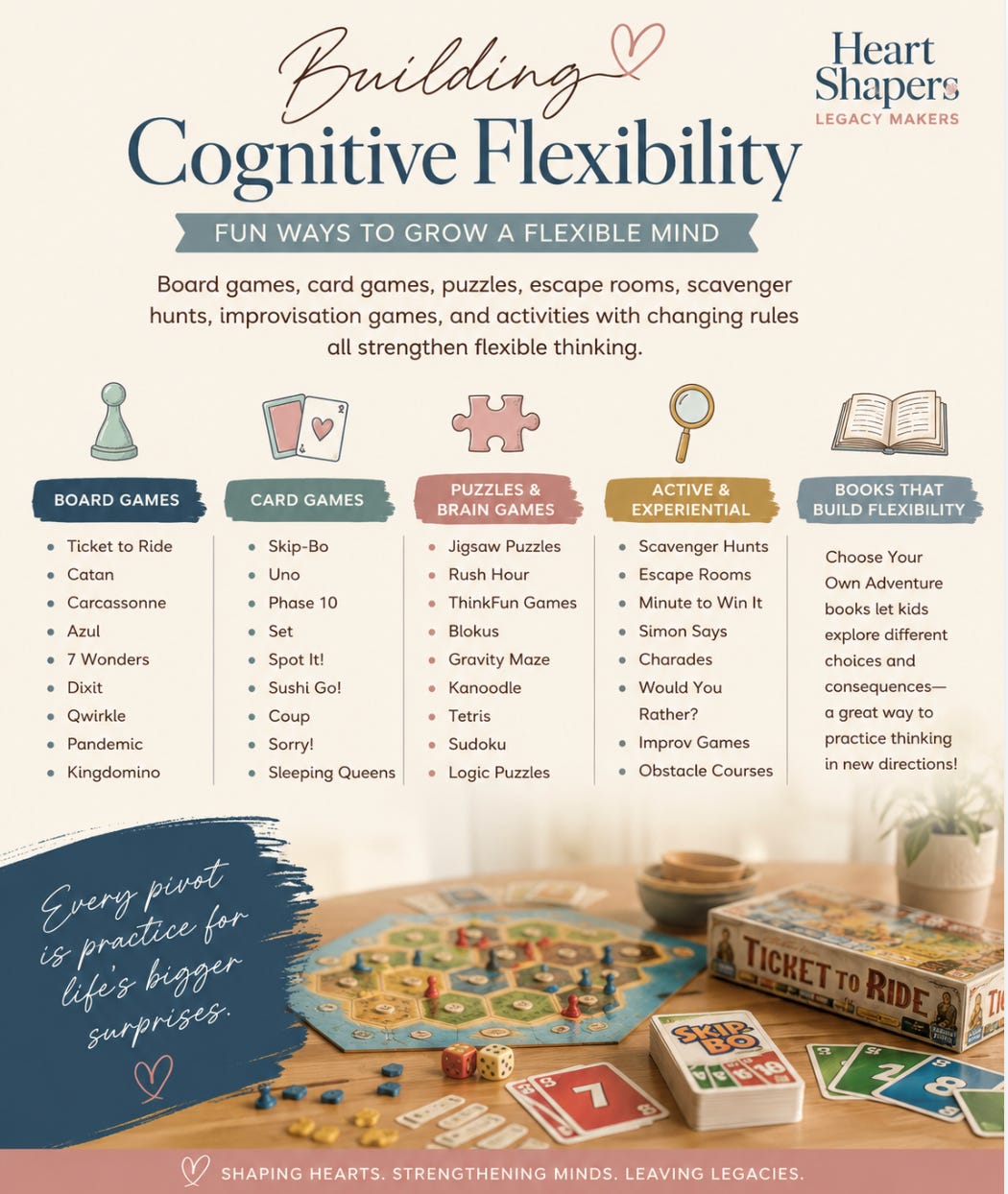
Build cognitive flexibility through play. Board games, card games, puzzles, escape rooms, scavenger hunts, improvisation games, and activities with changing rules all strengthen flexible thinking. Reading Choose Your Own Adventure books, creating alternate endings to familiar stories, or asking, “What else could happen?” while reading together also teaches children to consider multiple possibilities instead of becoming fixed on just one.
Every small pivot is rehearsal for the larger disappointments life will eventually bring. Today you’re helping them recover from a canceled playdate. Tomorrow you’re preparing them to trust God when life doesn’t unfold according to their plans.
If this article sparked something for you, please share it with a friend. And be sure to subscribe so you don’t miss tomorrow’s article on adult development and next week’s parenting article on Sustained Attention.
As we have learned with each of our kids, we have tried to teach the "why" behind the no's. I was told "Because I said so" a lot as a child by my father, and I felt like he thought I was dumb. I just wanted a reason. Nine times out of ten, I would have taken a good reason. I try my best to put myself in the place of the kids. It's just like my walk with God. If I keep up the communication with God before the storms hit, then it's more automatic and natural in the middle of them. What's that saying? If you fail to plan, you plan to fail. Again, good thoughts!