


Some of the behaviors we try hardest to correct are actually hiding our child’s greatest strengths.
“Why can’t she just sit still and stop joking around?” Our mind goes to attention-seeking, high-energy, and unfocused.
“But she’s always telling her siblings what to do, and she never listens to my correction.” We think strong-willed, bossy, and too independent.
“His incessant ‘why’s’ are driving me crazy. I just need him to obey the first time, move it along, and quit giving me attitude.” We think too in-the-weeds, perfectionist, and sensitive.
“I never know what’s wrong with him. I just asked him to put the dishes away, let the dog out, and re-do the lopsided clothes hanging in his closet. Now he’s just dragging his feet.” We think stubborn, lazy, and conflict-avoidant.

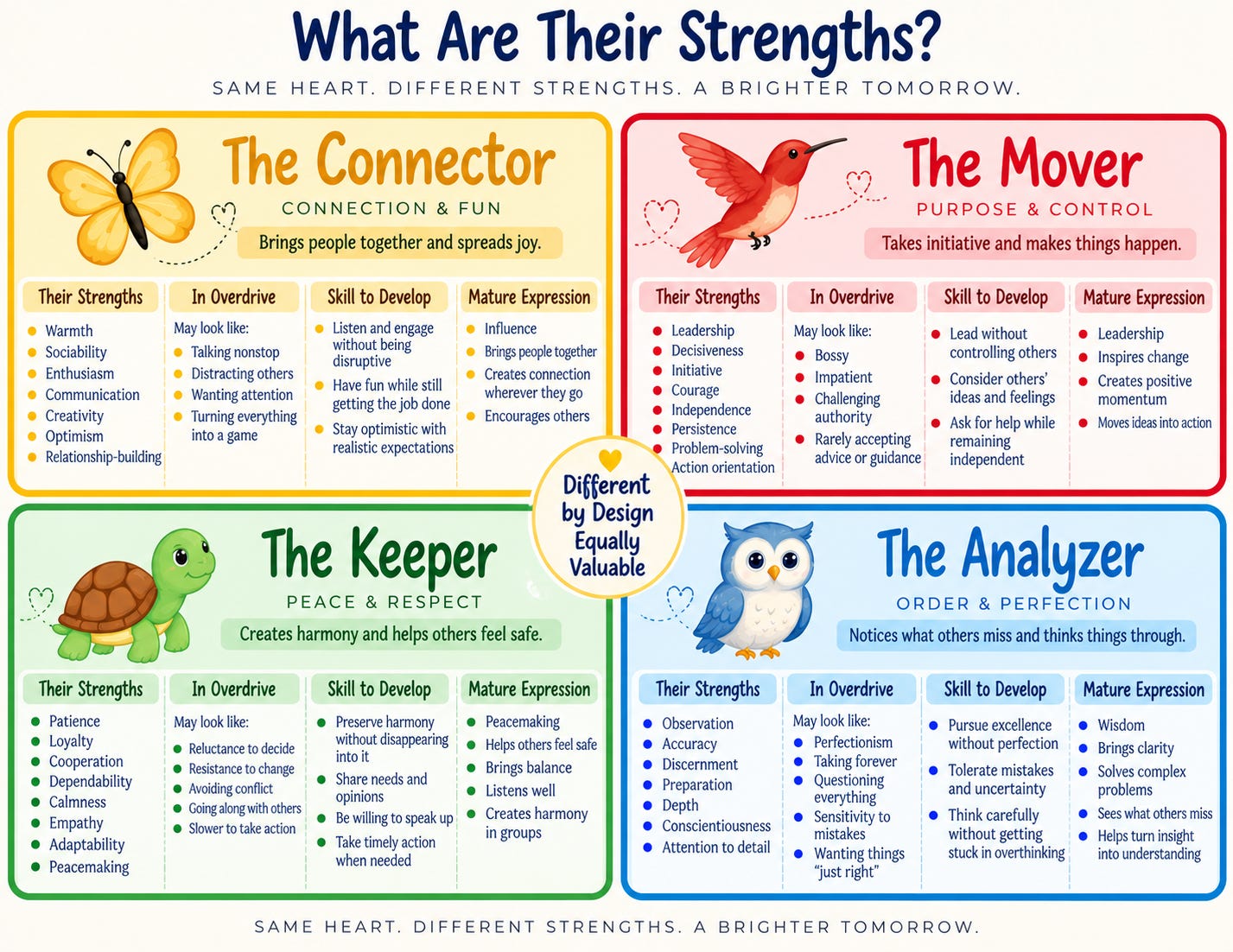
But some of the very behaviors that exhaust us in childhood actually have potential to become tremendous strengths in adulthood. The child who constantly seeks attention may grow into someone especially skilled at bringing people together in tough moments. The child determined to do things their own way takes the initiative to lead confidently without fear of failure. The child who questions every detail becomes the careful thinker who avoids catastrophe by catching the key detail everyone else missed. And the child who digs their heels in actually becomes the steady, grounded leader who isn’t easily pushed around by shifting sands.
That’s why our goal cannot be to squash the behavior. We must help them mold it into healthy strengths. But how?
Inborn Strengths Start Off Messy
An interesting finding in the psychology literature is that when parents intentionally recognize and encourage the strengths they see in their kids in early childhood, then as teens, they report greater life satisfaction and lower stress. But we can’t miss the important part. It wasn’t about having strengths. We all have strengths. It was about learning to use those strengths well.
Think about a new puppy. Whether you’ve had one yourself or watched a friend survive the puppy years, it gives a helpful frame of reference. Puppies are playful, energetic, and fun-loving. They want to jump on you, lick you, and constantly bark to get your attention. (It’s safe to say most puppies are Connectors). But there’s a time and place for those things, like the dog park or the backyard. Not at the dinner table or in the middle of the home improvement store. So you train them. You don’t extinguish their fun-loving nature; you just harness it.
You don’t want your Connector to stop being an energetic people person; you just don’t want them doing it at 11:37 pm.
You don’t want your Mover to stop leading the charge; you just want them to make sure they don’t steamroll everyone else in the process.
You don’t want your Analyzer to stop asking questions; you just want them to realize when they have enough information to move on to the next step.
You don’t want your Keeper to lose their desire for harmony; you just want them to learn that keeping the peace sometimes requires speaking up.
Every temperament has a core set of strengths. But until children develop the complementary skills to manage them, those strengths can easily go into overdrive.
Strengths in Overdrive
You’re driving through a mountain pass when you see the yellow sign indicating steep grades ahead. You have three options:
Let ‘er rip and fly down that mountainside at breakneck speed, hoping for the best
Ride the brakes, hoping you don’t smell them smoking by the time you reach the bottom, because then what good will they be at the next stoplight
Downshift into low gear, allowing the strength of the engine to control your speed without destroying your brakes.
Our goal isn’t to take away the power. It’s to teach our children how to use it without letting it run away with them.
With our kids, it looks like making excuses (Oh, that’s just the way he/she is), demanding better behavior (Quit being like that! You’re so bossy/talkative/annoying/stubborn. Can’t you just behave?) or slowing the moment down to help them consider another approach (Hey! I love that you’re so …How about you try to…?) Our goal isn’t to take away the power. It’s to teach our children how to use it without letting it run away with them.
For example:
For the Connector: “I love your energy. Look around the room. Is this a high-energy moment or a low-energy moment?”
For the Mover: “You’re a great leader. You’ve told me what you think should happen. Before you decide, tell me what your sister thinks should happen.”
For the Analyzer: “Being inquisitive is a good skill, especially for important decisions. What information do you still need to decide what to bring with you, and what information would just be nice to have?”
For the Keeper: “I know you want everyone to be okay. But I want to know what you think before we decide what everyone else wants.”
Every strength needs a complementary skill to keep it from becoming a liability.
What This Can Become
And this is why all that coaching is worth it.
The Connector who once interrupted every conversation can become the person who notices who’s standing alone and draws them in.
The Mover who once insisted everyone play the game their way can become the person willing to step forward when everyone else is afraid.
The Analyzer whose endless questions once slowed everyone down can become the person who notices what everyone else missed.
The Keeper who once seemed impossible to hurry can become the steady presence everyone looks for when life gets chaotic.
The very behavior exhausting you today may contain the raw material for something beautiful tomorrow. But raw material still needs shaping.
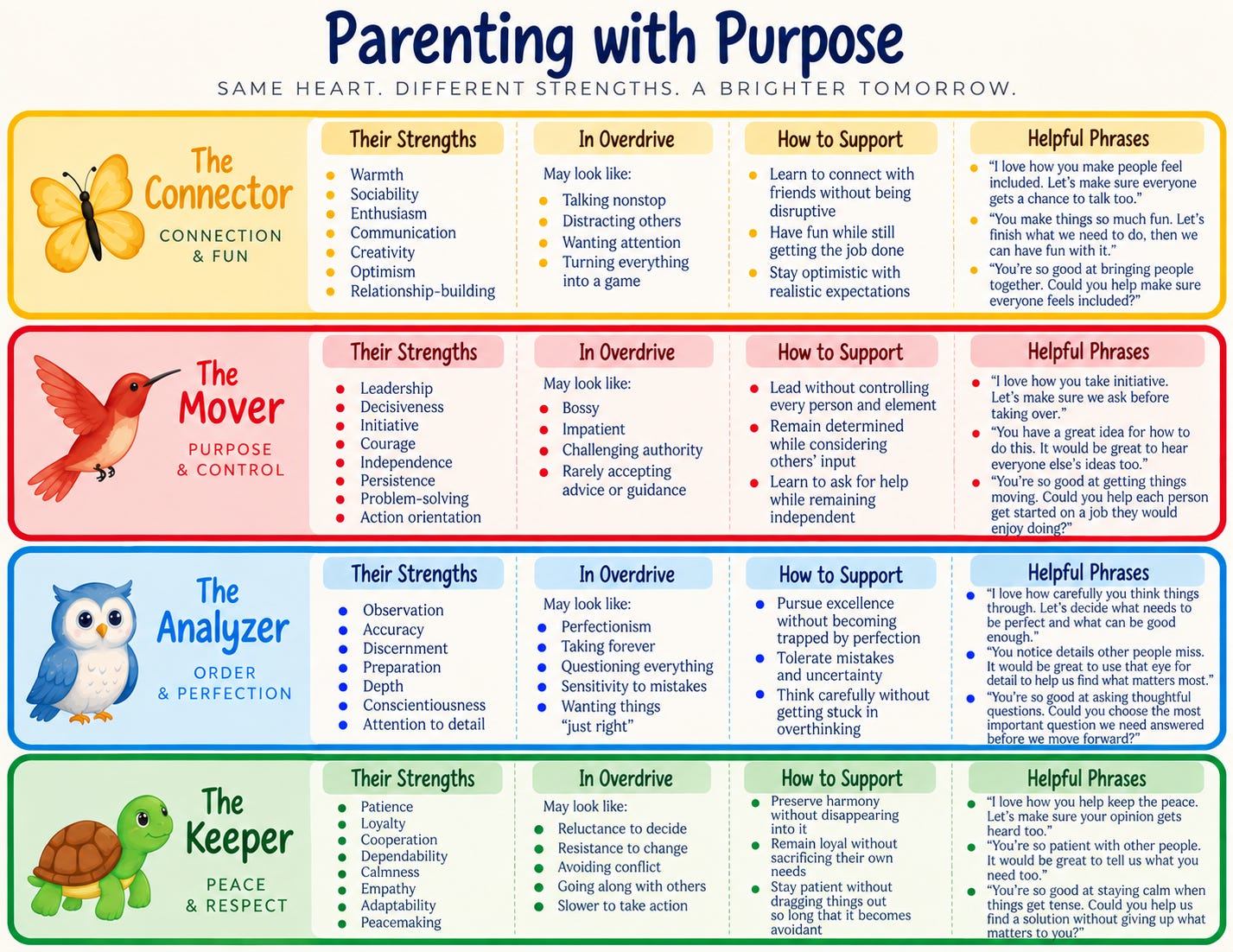
Parenting with Purpose
· Notice It ·
When a behavior gets under your skin this week, resist the urge to immediately label it. Instead, ask: What strength might be underneath this? Is the child interrupting because they naturally connect and communicate? Taking over because they’re decisive and quick to act? Asking twelve questions because they’re trying to solve the problem thoroughly? Digging in because they value steadiness and don’t shift easily?
Then look for the pattern. One behavior doesn’t reveal temperament, but repeated patterns across situations can help us recognize the strengths a child naturally reaches for.
· Name It ·
Start naming a child’s strengths in everyday conversation, especially when they are using the strength well. “You are so ___,” or “I appreciate how ___.” In moments when the strength starts to go into overdrive, name the strength along with the complementary skills that needs to be developed to manage that strength well.
The Connector: “I see how much you love bringing energy and fun to the people around you. That’s one of your strengths. Now let’s work on noticing when other people need a little less energy from you.”
The Mover: “I see how determined you are to make this happen. That’s one of your strengths. Now let’s work on bringing other people along with you.”
The Analyzer: “I see how carefully you think things through. That’s one of your strengths. Now let’s work on knowing when you have enough information to move forward.”
For the Keeper: “I see how much you care about keeping the peace. That’s one of your strengths. Now let’s work on sharing what you think, even when someone else might disagree.”
· Nurture It ·
Don’t wait for the strength to go into overdrive and then correct it. Give your child low-stakes opportunities to practice using it well. Identify one unique task or activity for each child this week, but make it something that naturally requires them to step up and use their strengths. If you need the table set for dinner, ask the Mover to get everyone on board and helping. If you need to carefully weigh a plan or schedule for the week, ask the Analyzer to weigh in. Leverage the Keeper to provide their opinion on a challenge in the week, because they bring good perspective. And if the family needs a good laugh or a moment of connection, invite the Connector to tell about the funniest moment at school that week or a fun story they recently heard.
Every child has strengths that naturally show up. At first, they can look pretty messy. Our job isn’t to squash the raw material because we don’t like its immature expression. It’s to recognize what’s underneath it, provide the guardrails it needs, and help that strength grow up.
What About Weaknesses?
Yes, there’s another side to all of this.
What happens when a child doesn’t know how to use these strengths well, or when something they deeply value feels out of reach?
Children are remarkably good at discovering what works in their relationships. They learn which behaviors get people to respond, back down, give in, pay attention, or leave them alone. It’s not that they’re sitting around plotting how to manipulate us. It’s simply that they have learned how to get their needs met in not-ideal ways.
The Connector may learn to influence through charm and flattery. The Mover through tone and volume. The Analyzer through mood and silence. The Keeper through procrastination and stubborn resistance.
Those can easily become the behaviors we call their “weaknesses.”
But next week, we’re going to look underneath them because understanding what a child is trying to accomplish through a behavior gives us a much better starting point for teaching them a healthier way to get there.