


Summary:
Temperament value systems can help explain child behavior in new ways
Each of the four temperaments holds a core value system: when met, strengths bloom; when violated, weaknesses take root
Recognizing temperament starts with 2 coordinates. From there, their value systems make more sense.
Meltdowns. Shutdowns. Showdowns. Tantrums. You simply told your kids to put their toys away, and now you’ve got the Revolutionary War in the playroom.
Last week, we described how temperament holds an essential key to understanding behavior. But if you read that article and walked away thinking, “So you’re telling me I have to say the same thing, a different way to each kid; who has time for that?!” then hear me out.
You don’t need four different scripts for everything you say.
What we’re going after is a simple reframe that shifts communication in ways that avoid inadvertent conflict and aim to inspire, empower, and encourage.

At first, understanding temperament often happens in hindsight: Ohhh, that’s why they reacted that way. But those hindsight moments add up until you recognize the temperament need before the conflict happens and shift your phrasing preemptively. What once were firestorms never even spark.
It’s simply a matter of speaking the language of their core values, which starts with identifying their temperament.
Dialing In the Coordinates
My brother took his family camping last month in the small Colorado town where we vacationed as children. He found this awesome little spot on top of a mountain.
I decided to follow suit and take my son there over Labor Day; only, I didn’t know where “there” was. “On top of Bachelor Loop” narrowed it down to about 17 miles, and somewhere between 8,900 and 13,000 feet. So I messaged my brother: “Can you send me a pin of the coordinates?”
(Sorry, I just can’t share those coordinates. They’re too precious. But here’s a picture of sunset!)

Recognizing temperament works much the same. Rather than memorizing a long list of left turns, right turns, stoplights, and speed limits, let me just give you two simple coordinates to start with:
Does your child tend to process internally or externally?
Are they naturally more oriented toward tasks or people?
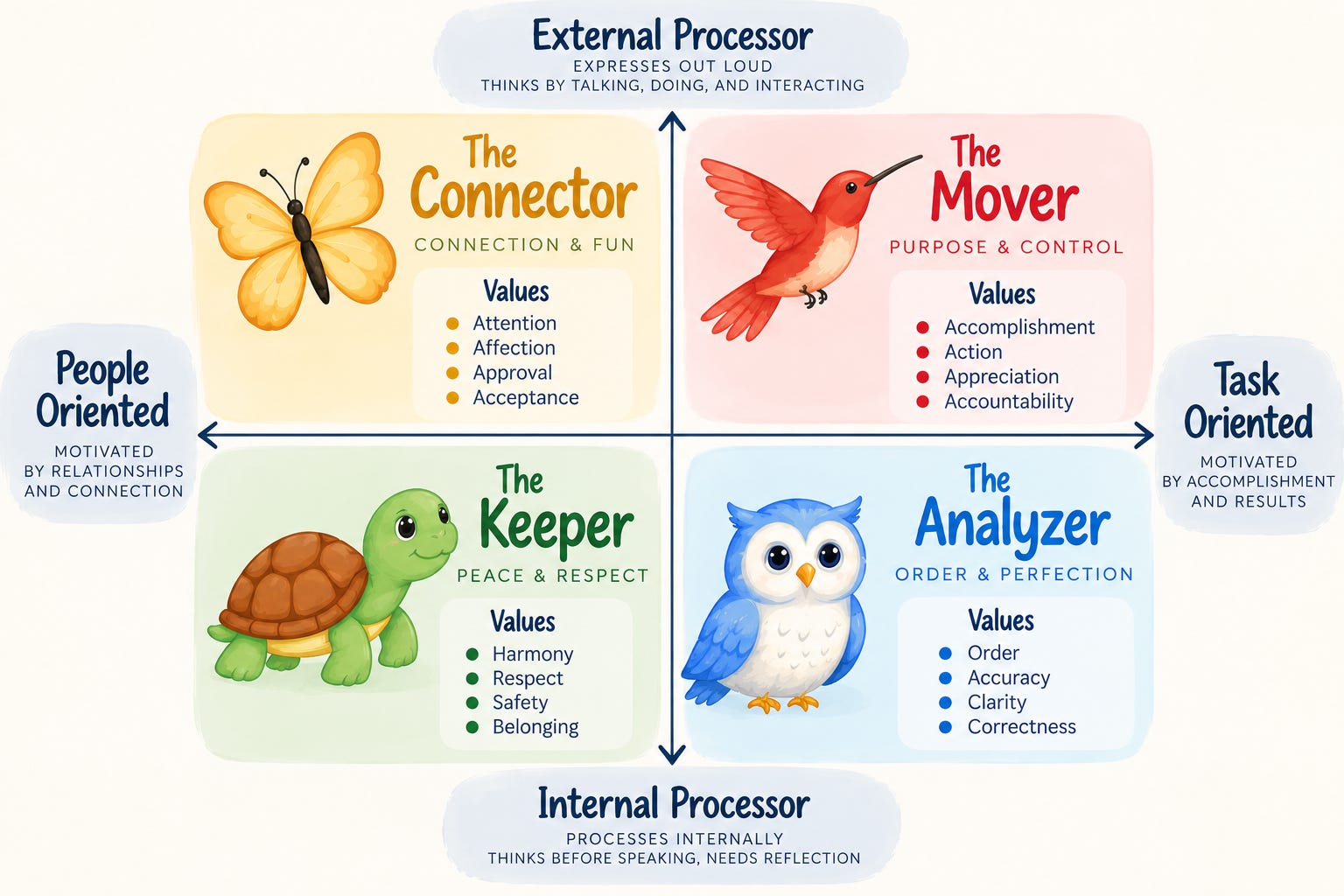
Those two coordinates give us four general orientations:
External + People = The Connector
External + Task = The Mover
Internal + Task = The Analyzer
Internal + People = The Keeper
Once you have your bearings, you can ask the important question:
What matters to this child?
That’s where temperament value systems come in.
The Values That Drive Us
Each temperament tends to value certain things. Often, our child’s disproportionate reaction makes more sense when we recognize what is being misunderstood beneath it.
The Connector: External + People
Values: Connection & Fun
The Connector processes life outwardly and through people. They talk things out, seek interaction, and often find an experience more enjoyable simply because someone else is part of it.
Tell them you’re going to the park: “Who’s coming?”
Give them an assignment: “Can I work with a partner?”
Ask how school went and you get an entire story about Ava, Liam, and what Sophie did at lunch.
For the Connector, people aren’t beside the experience. People are the experience. That’s why exclusion, disapproval, or a relational rupture can feel much bigger to them than we expect.
Luke’s Gospel helps us appreciate this people-oriented lens. Again and again, Luke draws our attention toward people and their stories—particularly those who might otherwise be overlooked.
The Mover: External + Task
Values: Purpose & Control
The Mover also engages outwardly, but their attention tends toward action: What are we doing? Where are we going? What can I make happen?
They want to participate, accomplish, decide, and move things forward.
Give them an appropriate way to have some say, and the entire interaction can change. This is why two acceptable choices can completely change an interaction: “Do you want to shower before dinner or after?”
It isn’t manipulation. You’ve simply honored something they deeply value: agency.
It also explains why micromanagement can produce such a strong reaction. Underneath “Stop telling me what to do!” may be something closer to: Please let me experience myself as capable. What looks like bossiness or defiance may actually be a child fighting for something they deeply value: agency and purpose.
Mark’s fast-moving, action-oriented Gospel gives us a helpful lens for appreciating this orientation toward action and movement.
The Analyzer: Internal + Task
Values: Order & Perfection
The Analyzer turns inward to process and tends to focus on information, details, accuracy, and getting things right.
This is the child who asks why, and then asks why about your why. They may need more time, more information, or seventeen attempts at tying their shoe because it still doesn’t feel right.
So “Don’t worry about it. Just do it!” may actually increase their distress.
They aren’t necessarily trying to make things difficult. Understanding and order help them know how to move forward.
Matthew’s structured, detail-rich Gospel helps us appreciate a lens that looks for order, patterns, and how the pieces fit together.
The Keeper: Internal + People
Values: Peace & Respect
The Keeper also processes internally, but their attention tends toward people and relational harmony.
These are often the children whose needs are easiest to miss because they don’t always speak up, often for fear of “rocking the boat”. They may simply go along, keep the peace, and prefer that everyone stop making things so complicated.
Often, they’re quietly watching the relational temperature of the room: Are we okay? Is everyone getting along? Can we please not make this a big thing?
They may accommodate, go with the flow, or keep their opinions to themselves to preserve peace.
Until something unexpectedly changes: “Actually, we’re not going home after school. We’re going somewhere else.”
Suddenly, the child who always seemed to “not care” shuts down, withdraws, and seems purposefully stubborn. Because predictability mattered more than we realized.
John’s slower, reflective Gospel—with its recurring themes of abiding, remaining, peace, and enduring relationship—helps us appreciate this orientation toward constancy and harmony.
When Values Collide
Conflict often happens when one person’s expectations, needs, or values collide with another’s. You’re thinking, We need to leave. Put your shoes on. Your Mover hears, I have no say. Your Connector thinks, But I wasn’t finished talking to you. Your Analyzer panics: Wait. Where are we going? How long will we be there? Your Keeper laments, But I thought we were staying home.
We’ll talk more about colliding temperaments in the coming weeks, but for now, what’s important is recognizing that the boundary doesn’t change. What does is our understanding of how they are responding and our efforts to communicate in ways that honor their intrinsically wired value system.
When we understand what matters underneath the reaction, we can communicate the same expectation in a way our child is better able to receive.
Practical Parenting for Today
This week, pay special attention to the moments when your child’s reaction seems bigger than the situation.
· NOTICE IT ·
Look for patterns: What happened immediately before the reaction? Did someone make the decision for them? Did they feel excluded? Did something stop making sense? Did the plan unexpectedly change?
· NAME IT ·
Before naming the behavior, try naming the possible value underneath it: Agency. Connection. Understanding. Stability. You don’t have to be certain. You’re forming a hypothesis, not reading your child’s mind.
· NURTURE IT ·
Then ask: How can I honor the value without surrendering the boundary? “I know you wanted to help decide. How about you decide <fill in the blank>?” (insert two choices) “I know you wanted to be included. What if you <fill in the blank>?” (insert idea) “I’ll explain what I know, and then we’re going to move forward even though we don’t know everything.” “I know you weren’t expecting this change. I’ll tell you what is staying the same.”
Temperament-informed parenting isn’t about giving children whatever they want. It’s about understanding what matters to them so we can communicate in ways that help them make healthy behavioral choices.
And the more you practice, the less this happens in hindsight, and the more you adapt what you’re asking or saying to match their underlying needs.
Next week, we’re going to look at the other side of these values—because the very things your child cares about most often become the soil where some of their greatest strengths begin to grow.
Want the full framework? The book is available on Amazon: Notice It · Name It · Nurture It
I absolutely love what you're creating around these temperament types Bethany! God has given you such a gift to see into the hearts, minds, personalities, and behaviors of children that is both rare and beautiful. And I'm so thankful you share what He gives you so abundantly and freely!! ♥️
And the sunset from the mountain top is gorgeous. What a wonderful adventure to take with your son!