


“Wait a minute. She made that decision way too easily.”
My husband hadn’t read a single page of THE LOST HEART SONG yet. I was standing in the kitchen, narrating the first fifty pages to him the way I narrate most things to him — half out loud, half still figuring it out as I talked.
I got to the part where Evie received a call about stolen texts checked out under her name, and within half a page, she was on a flight to Israel to clear her name, leaving her fiancé to battle his own demons alone.
That’s when my husband, who has never read a Save the Cat beat sheet in his life, stopped me cold.
“How could she just up and leave him like that, and so easily? It doesn’t make any sense.”
At first, I thought I’d simply blown past the part my husband’s inner romantic would have rather savored a bit.
But it stuck with me. He was onto something. Something I couldn’t name, and neither could my beta readers.
What Beta Readers Couldn’t Name
They liked the book. But something was missing, and nobody could tell me what. I went back through their notes looking for a pattern and found nothing specific enough to fix, just a vague sense that something in the early pages didn’t quite land.
Was it too fast? Too slow? Too boring? Needed more action? I’d basically rewritten it five times, one of which was a complete overhaul of Act I.
I’d written THE LOST HEART SONG the way I do most things in life: I pantsed it. No outline, no beat sheet, just instinct and momentum. It was part therapeutic and part intrigue.
I’d just come through my own jolting setback, and life was upside down. The more I journaled, the more my mind wove a story of mystery and puzzles as I learned to process what had blindsided me months prior.
But something was missing from my novel…
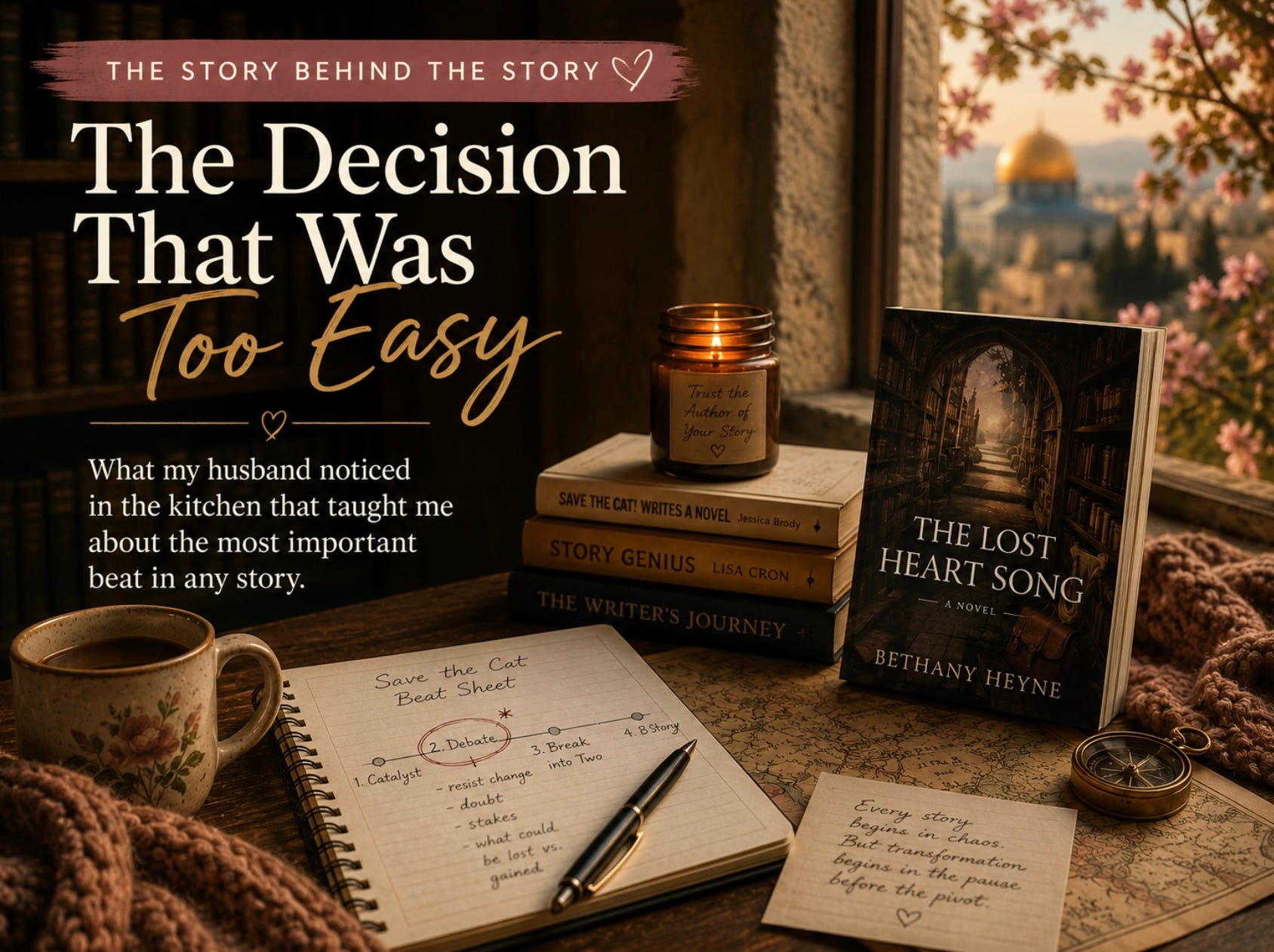
My business coach suggested Save the Cat Writes a Novel. So, out of some level of obedience, and mostly out of desperation, I started mapping my own manuscript against its structure. Catalyst. Debate. Break into two.
Wait…debate? The moment right after the catalyst, where the protagonist is supposed to wrestle with whether to accept the call to change… and I realized I didn’t have one.
I had a catalyst. I did not have a debate.
That’s what my husband had caught, standing in the kitchen, without a single page in front of him. It wasn’t about romance at all. It was more like I’d missed a “point/counter-point” moment that he knew needed to exist.
I had mischaracterized the human condition. How one responds in the space between disruption and decision, when life unexpectedly flips the script.
Queen of the Pivot
Here’s the part that stung a little…
My ministry coach has lovingly bestowed the title “queen of the pivot” upon me. She’s watched me bob & weave life’s curveballs and outright grenades, navigating them with effortless efficiency.
“Let her cook,” as the kids say these days.
I move from one plan to the next the way some people change lanes on the highway — quickly, cleanly, barely a flicker in the rearview mirror.
I wore it like a badge of honor until I realized it was self-sufficiency in its worst form.
I had assumed cognitive flexibility was a strength, but I’d left emotional honesty on the sidelines. I had given Evie my pivot-prowess without explanation or caution. I’d skipped the part where she must stand in the wreckage of her old plan long enough to actually grieve it before moving to a new one. I made her jump from one live wire to another, somehow never touching either, and my reader had no idea how she’d pulled it off, because it wasn’t true to the honest human response.
I’ve been talking about cognitive flexibility this week in our series on Executive Functions. The ability to release one plan and genuinely consider another.
But here’s what I had to learn from my own character: cognitive flexibility done wrong looks like…
Skipping grief
Moving forward so fast that we don’t count the cost
Worst of all, venturing onto Plan B without Godly Wisdom
That’s not cognitive flexibility. That’s avoidance and self-sufficiency masquerading as strength.
Going Back In
I went back into that scene and slowed everything down. I let Evie sit in the turmoil longer than I felt comfortable writing it. I let her circle the decision, resist it, bargain with it, before she got on the plane.
The debate beat isn’t there to delay the plot. It’s there because life requires flexibility, but it also requires a genuine human response to life’s toughest challenges.
That debate is the moment the protagonist reacts to the story’s inciting incident, highlighting the natural human tendency to resist and evade change; to doubt, deliberate, and bargain; and to establish the stakes of what will be lost versus what could be gained.
I am still the queen of the pivot. But I’m learning that the pivot means something different when you’ve let yourself grieve first and then walk it out with God.
A note for you, reading this: if you’ve ever moved on from something so fast that the people around you couldn’t quite track how you did it — that’s worth a second look. Not because the speed is wrong, but because somewhere in there, something may have gone ungrieved and you may have left Jesus at the last fork in the road.
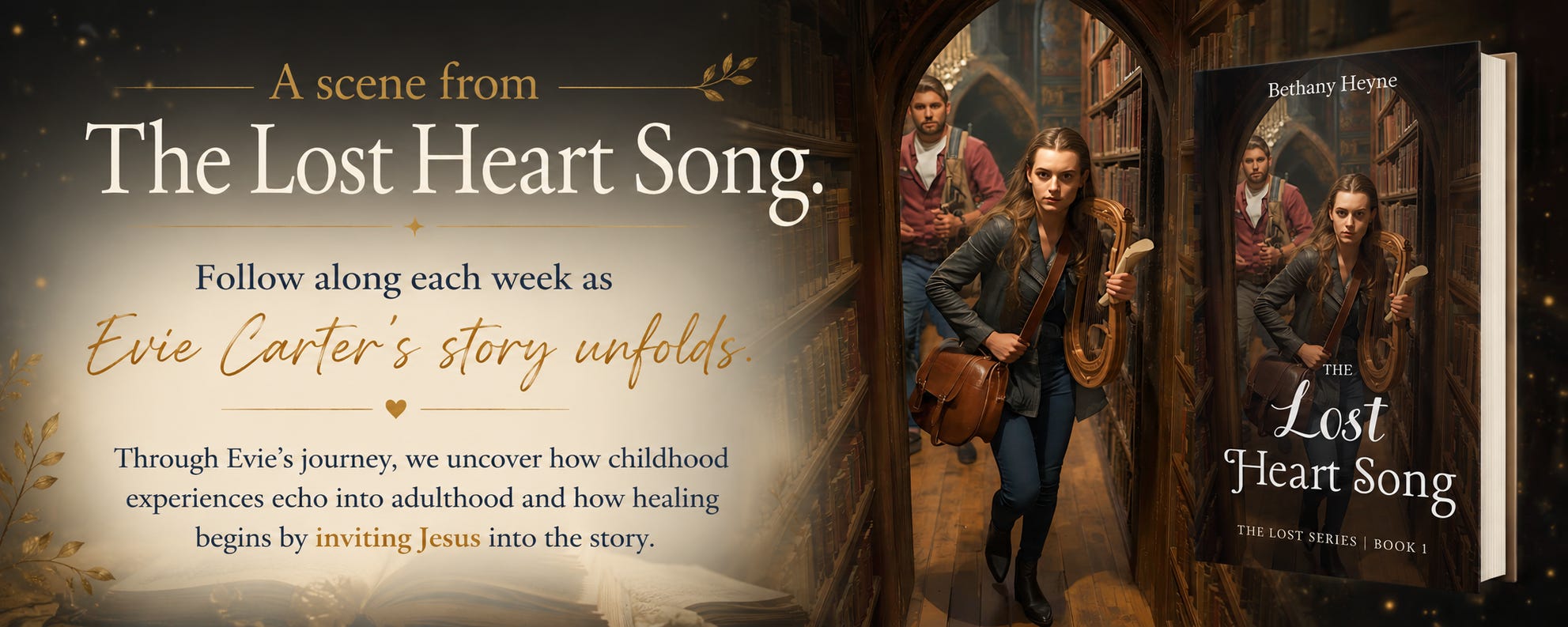
This is what every book in THE LOST HEART SONG series does. Each one follows someone reclaiming something their childhood taught them to suppress — and each one parallels a person in Scripture who wrestled with the exact same thing. The invitation underneath all of them is the same: the themes God is asking me to walk through in real life, handed to a character so you can feel them before you ever have to name them.
THE LOST HEART SONG is a completed manuscript, the first in the series. If you’ve been following Evie’s story, this is the scene that almost wasn’t there.
Susan here... thank you for sharing what you learned firsthand through this process, Bethany. And your conclusion is so good... "I'm learning that the pivot means something different when you've let yourself grieve first and then walk it out with God." I LOVE that.