


Five-year-old Micah came roaring into the kitchen with his arms tucked tight like a T. rex. “I’m a dinosaur! You have to be my baby dinosaur!”
“Oh, do I?” Amara asked while measuring ingredients.
“Yes! And baby dinosaurs have to do what their big dinosaurs say!”
“Well, this baby dinosaur has muffins to make.”
Micah’s eyes widened. “MUFFINS?! Can I help?”Before Amara could answer, he’d dragged a chair across the kitchen floor and climbed onto it. “I’ll crack the eggs!”
“Okay, but let’s—”
TOO LATE!
The egg hit the edge of the bowl, bounced off the counter, and splattered onto the floor. Amara closed her eyes. She’d only wanted to make a quick batch of muffins before they left for the park.
“That’s okay, buddy. Let’s clean it up.”
“I can do it!” As he reached for a towel, he knocked the measuring cup into the batter.
Amara took a breath. “Actually, why don’t you just watch Mommy for a minute?”
No more than three seconds passed before Micah asked to put sprinkles in the muffins. No matter how many times or how many ways Amara explained that sprinkles don’t go in blueberry muffins, Micah kept asking, “Why?”
Amara looked at the egg on the floor, the measuring cup submerged in batter, and the little boy beside her who had turned a quick batch of muffins into a 30-minute ordeal. She loved his imagination. She really did. But why was everything more complicated when he was involved, and why was he always so insistent?

Welcome to the Age of “I Have an Idea!”
If you’re parenting a preschooler, you’ve likely experienced some version of this kitchen takeover.
Perhaps your child interrupts constantly, insists on being the boss, or asks 417 questions a day. What about the endless pretend play, the enormous messes, and their insistence on helping when really, it’s a hindrance? They come up with elaborate plans, negotiate everything, test boundaries, and start projects only to abandon them within ten minutes.
It can be exhausting. Especially when you’re trying to get everyone dressed, fed, and out the door before lunchtime. But there’s something really important happening underneath all that noise, mess, and endless negotiation. Your child isn’t just learning to do things independently anymore. They’re learning that they can come up with an idea, act on it, and make something happen in the world. That’s an important developmental milestone that feeds directly into academic success, as long as we don’t extinguish it.
Initiative vs. Guilt: When Children Discover Their Own Purpose
Developmental psychologist Erik Erikson described eight stages of psychosocial development, each characterized by a central developmental challenge. Infancy was a time of developing trust. Toddlerhood was a time of developing autonomy. And now, between the ages of three and five, a new question emerges: “Can I come up with an idea and make it happen?” Erikson called this stage initiative versus guilt.
Here’s the difference: a toddler might insist, “I DO IT!” (independence) while a preschooler announces a fifteen-point plan, “I know what we should do! Let’s build a spaceship out of the couch cushions, and you can be the alien!” (initiative).
The preschooler is no longer interested in just completing a task. Their whole world is open to the possibilities, creative planning, assigning roles, experimenting with solutions, and discovering that their actions can influence what happens next. This stage is important because when children can explore ideas, take reasonable risks, contribute, and recover from mistakes, they can develop a growing sense of purpose.
But what about the guilt part? Children also begin learning that their ideas and actions have consequences.
Sometimes their plans inconvenience others.
Sometimes their choices cause harm.
Sometimes they discover that wanting to do something doesn’t mean they should.
Appropriate guilt can help children recognize wrongdoing and make things right. Unhealthy guilt arises when children repeatedly experience their curiosity, efforts, or attempts to take initiative as something bad, burdensome, or unwelcome. With repeated exposure, they hesitate to try, fear mistakes, and doubt whether their ideas are worth pursuing. The aftereffects show up big time in the next stage — the school years — where we scratch our heads wondering, “Why won’t they even try?”
That doesn’t mean parents must approve every plan or allow every mess. It means we’re learning to distinguish between correcting an action and discouraging the desire to act when an action is known to have destructive consequences. It’s about harnessing the value of initiative so it gets vectored into a healthy direction.
Notice It. Name It. Nurture It.
At The Kairos Bridge, we use three simple steps to understand children’s behavior through the lens of development.
Notice It: What am I actually seeing? What’s happening in the environment? What is my child trying to accomplish?
Name It: What emotions, thoughts, needs, or developing abilities might be contributing to this behavior?
Nurture It: How can I respond with both warmth and appropriate structure, supporting the skills my child is still learning?
Because when we recognize what’s developing underneath the behavior, we can respond with greater intention. Here are some familiar preschool-age moments linked to their developmental need.
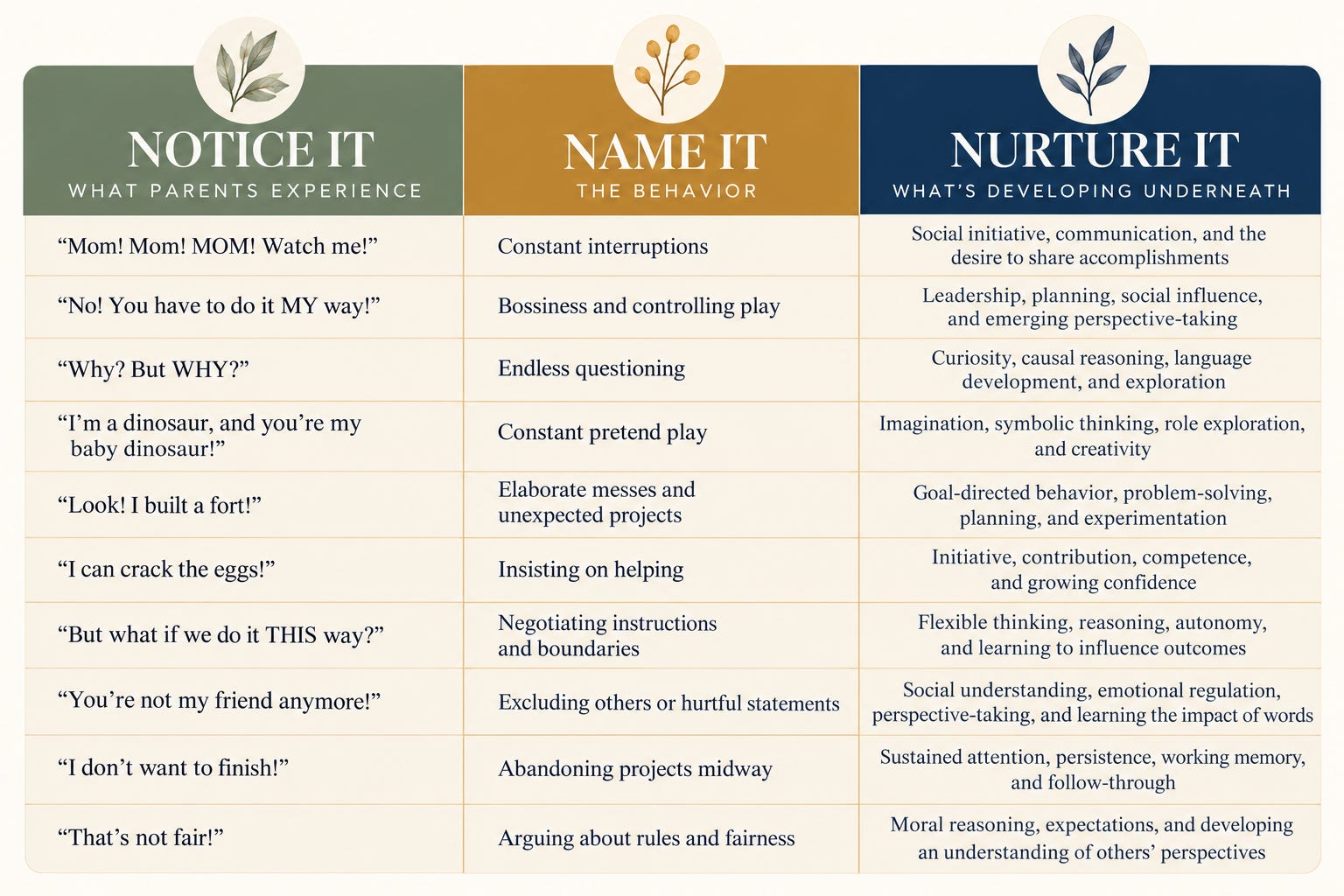
Behind the Behavior: What Your Preschooler May Be Practicing
The behaviors in this table aren’t automatically good or bad, and they aren’t always caused by the developmental processes listed here. Temperament, stress, fatigue, individual differences, and the demands of the environment all influence what we see. But these behaviors give us clues about the abilities children are practicing and the skills they still need help developing.
A child who insists on directing every game may have wonderful leadership instincts while still needing to learn cooperation.
A child who asks endless questions may be deeply curious while still needing to learn when to wait.
A child who wants to help with every household task may be developing a beautiful sense of contribution while still needing to learn patience, safety, and follow-through.
We don’t have to eliminate the initiative to correct and nurture better behavior. We can protect what’s developing while teaching the skills that help children use it well.
There’s More Developing Than Initiative
Erikson’s theory gives us one way to understand this stage, but initiative doesn’t develop in isolation. Between roughly three and six years old, several other developmental processes are unfolding alongside it.
Cognitive development: Children are rapidly expanding their language, imagination, memory, and ability to reason. They’re beginning to understand cause and effect, although their explanations may not always follow adult logic. Hence the endless questions and creative muffin negotiations.
Emotional awareness: Children are learning to identify increasingly complex emotions and understand what triggers them. But recognizing frustration and managing frustration are two different skills because their ability to regulate emotions is still developing.
Perspective-taking: Children are gradually becoming better at recognizing that other people have thoughts, feelings, desires, and knowledge different from their own. This helps explain why a preschooler can be wonderfully imaginative and still struggle to understand why everyone doesn’t want to play by their rules.
Moral development: Children are developing their understanding of rules, fairness, intentions, consequences, and right and wrong. They’re highly motivated by avoiding “no” rather than fully grasping the repercussions of their decisions. So while their reasoning is still emerging, they need our guidance as we help them learn through each attempt and mistake.
Executive functioning: Working memory, inhibitory control, and cognitive flexibility are developing, too. A child may have a brilliant plan for baking muffins but struggle to remember the steps, resist grabbing the sharp knife, or adjust when the plan changes because the sprinkles are actually all out!
All these developing abilities help explain the tension we feel as parents: Our children want to take initiative, but it is messy!
Micah knew exactly what he wanted to accomplish. He just hadn’t developed all the skills required to get there. And that brings us to an important shift in how we interpret behavior.
Coming Wednesday: Parenting with Purpose
So how do we encourage initiative without letting our preschoolers run the household?
How do we respond to bossiness, endless questions, messy projects, and constant interruptions without discouraging their confidence and curiosity?
And how do we teach cooperation, persistence, responsibility, and perspective-taking while protecting their growing sense of purpose?
In Wednesday’s Parenting with Purpose article, we’ll take these same everyday behaviors and explore practical ways to Notice It · Name It · Nurture It, turning frustrating moments into opportunities for skill development.
Because once we see what’s Behind the Behavior, everything changes.