


Noa looked antsy as Amara approached the park bench, pushing her stroller.
“Sit, sit! I have so much to ask you,” Noa begged.
Amara laughed, “I don’t think you need any more coffee!”
Little Liora ran off to play with Noa’s son as Amara sat with her mentee.
“I’ve read all these parenting books, plus a few podcasts,” Noa spilled, “but now I’m drowning in parenting tips with no idea of what technique to use when.”
She exhaled. “How can I lead executive marketing teams so effectively, yet I can’t even manage my 4-year-old? I don’t want to kill his creativity, but I find myself snapping… I even spanked him last week and I hated myself afterward.”
Amara placed a gentle hand on Noa’s to slow her breathing.
Amara spoke softly: “All of that advice isn’t wrong…it’s just incomplete. Parenting isn’t a checklist in the way that work is. It’s relational.
“You don’t need more parenting techniques. You need the right posture, guided moment by moment. That doesn’t come from the head. That comes from the heart.”

What the Parenting Science Shows
If you’ve ever felt overwhelmed by parenting advice… you’re not alone.
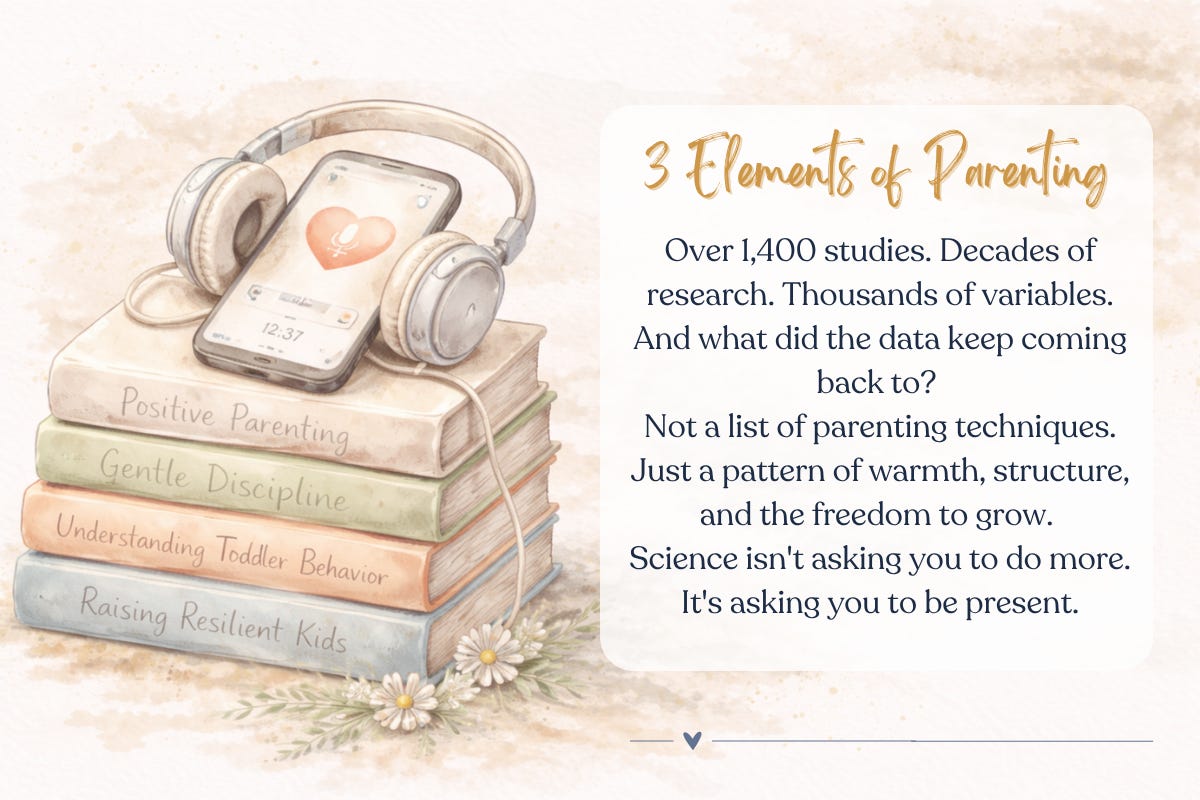
When researchers set out to identify parenting approaches that supported healthy child development, they analyzed decades of data from over 1,400 studies. What they found wasn’t a top 10 list of parenting tips, but rather a consistent pattern in how parents showed up in the parent-child relationship:
Warmth: connection over rejection
Structure: guidance over chaos
Autonomy support: growth over control
Parents didn’t need more techniques, the perfect script, or flawless execution.
Parents need a heart posture that builds a strong parent-child relationship. Warmth. Structure. Support.
So often, though, our children misbehave, and we default to the inverse of these.
The quick grocery run turns sour when our toddler throws a tantrum over the toy they can’t have. We react quickly, unempathetically scolding their emotional outburst, not realizing a 3-year-old doesn’t possess the capacity for emotional regulation yet. They don’t need emotional disapproval. That’s rejection. They need a regulated parent to provide emotion coaching. That’s warmth.
It’s 9 pm when our third grader tells us they need markers for school tomorrow. We lecture them for being forgetful, not realizing an 8-year-old’s brain literally cannot reliably foresee eight to twelve hours ahead. They don’t need an angry lecture from us. That’s chaos. They need a system of structure to support planning. That’s structure.
Our 14-year-old downloads a gaming app that turns out to be socially risky. We scold and punish, not realizing this is evidence of decision-making and critical thinking under development. They don’t need punishment. That’s coercion. They need someone to lean in, apply guardrails, and give guidance on how to handle this in the future. That’s autonomy support.
When we react too quickly, jump to correction without context, or expect swift behavioral compliance, all without understanding the underlying skill gap, we are operating from rejection, chaos, and coercion. These negative parenting postures predict poor long-term outcomes for children: anxiety, depression, loneliness, aggression, addiction, and academic or career struggles.
When child misbehavior rears its ugly head, we start reaching for new parenting strategies. But we don’t need new strategies. We need perspective that postures our hearts toward warmth, structure, and autonomy support.
And this is where many parents feel stuck: modern parenting advice gives lists of techniques. These bring knowledge, but fall short of the heart posture of understanding, insight, and wisdom with which to apply them.
Scripture
Noa was quieter now as something shifted. “How do I adopt this heart posture?”
Amara smiled. “Solomon asked God almost the same thing.
Humanity has wrestled with the difference between knowledge and wisdom since the beginning of time.
The tree in Eden gave knowledge of good and evil, but it did not give the wisdom to live it well.
We still feel that tension today.
We can know what’s right, and still not know what to do in the moment.
That’s why Solomon didn’t ask God for more knowledge. He asked for wisdom; the ability to discern. To see clearly what each moment actually requires.”
Noa frowned slightly. “Isn’t that just… knowledge?”
“No,” Amara said. “Knowledge is having the books in your bag. But to know your child, to understand their needs, to have insight into how to respond, and to have the wisdom to walk it? That’s a heart posture that starts with the fear of the Lord (Proverbs 9:10) and reverence to walk in His ways, because they are better.
Jesus is the wisdom of God (1 Corinthians 1:24). The Holy Spirit is our Counselor (John 14:26). And they walk with us, day by day.”
God approaches us with warmth, brings structure from chaos, and then supports our growth.
You already know more about parenting than you give yourself credit for. What you need is to take that knowledge into humble dependence on God, the One who designed our children, dwells within us, and guides us moment by moment.
Wisdom for Your Week
So what does this look like on a Tuesday night when everyone is melting down?
The Lord gave me a simple, slow, Spirit-led rhythm in 2023. I share it with all my coaching clients:
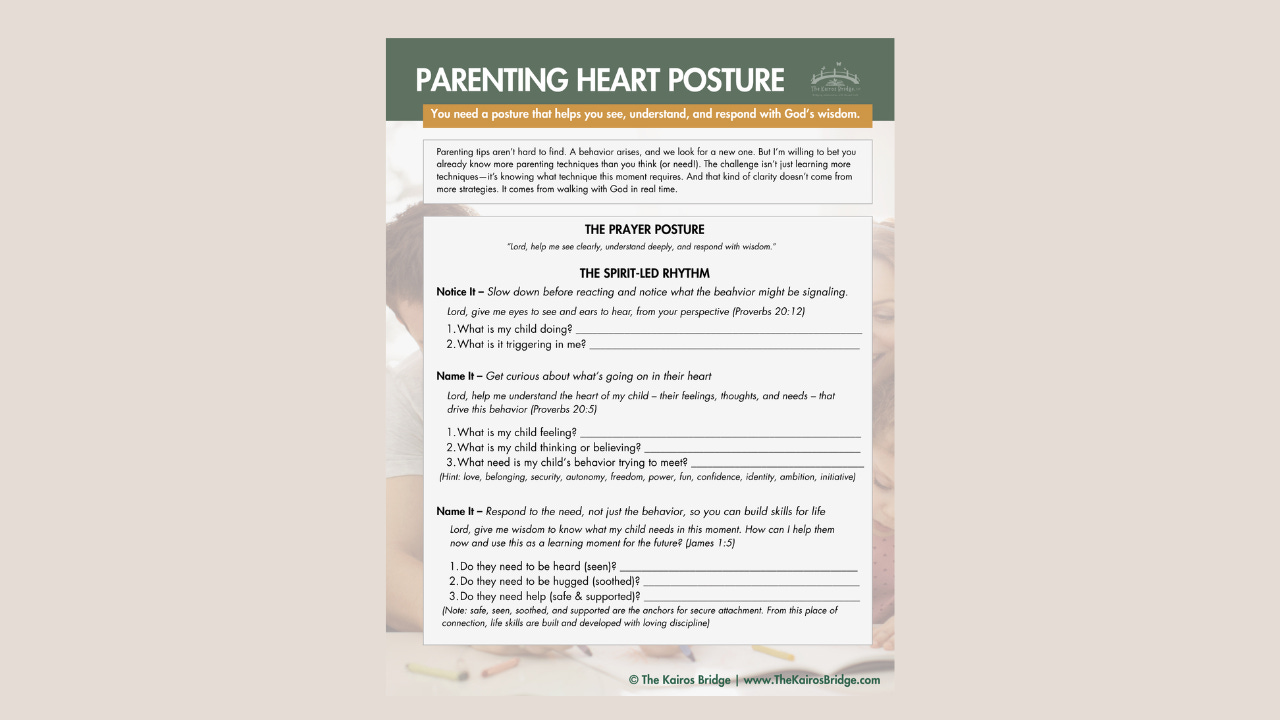
Notice It — Pause before reacting. Ask God to give you eyes to see and ears to hear (Proverbs 20:12). What is my child wrestling with? Remain approachable & empathetic. That’s warmth.
Name It — Look beneath the behavior. The heart goes far deeper than what’s visible, and our job is to draw it out (Proverbs 20:5). What might they be feeling? Thinking? Needing? Use visuals, checklists, routines, and organization to support the need. That’s structure.
Nurture It — Respond to the heart, not just the behavior, because everything flows from it (Proverbs 4:23; Luke 6:45). When you’re unsure, ask God, who gives wisdom generously (James 1:5). Most autonomy support flows from one question: Do they need to be heard, hugged, or helped? When we understand the emotional, social, or cognitive skill gap, we can provide guidance that supports growth. That’s autonomy support.
When we move this way, even imperfectly, something shifts. There are fewer escalations. Quicker repair. An atmosphere in you, in your child, and in your home, that grows, over time, to be more patient, more gentle, more connected.
Not because you found the perfect technique.
Because you’re finally seeing what the moment actually requires: a heart posture of warmth, structure, and autonomy support.
Subscribers: grab your copy of this week’s parenting resource, The Parenting Heart Posture: Notice It · Name It · Nurture It
Fun fact for readers: In each issue, I follow a character from my in-progress fiction series, The Lost Heart Song, as she navigates real parenting and real healing. Today, you got a glimpse into the life of Amara from The Lost Way and Noa from The Lost Compass. Be sure to subscribe so you don’t miss any of the behind-the-scenes stories as these novels come to life!