


Child Psychology and Development: Why Kids Forget What You Just Told Them
We’re in the middle of our executive function series, exploring the brain skills behind everyday parenting struggles. If you missed the first two articles, be sure to catch up on executive function and impulse control.
Today we’re tackling a challenge nearly every parent knows well: working memory.
Scenario: You’ve asked your child to put on their shoes, grab their backpack, and meet you at the door. Five minutes later, they’re standing in the kitchen with one shoe on, staring into the refrigerator, having forgotten the rest of the instructions.
It’s tempting to call it laziness or defiance. Sometimes it may be. But often it’s something else entirely. A skill gap.
As child psychologist Dr. Ross Greene reminds us, kids do well when they can, meaning that many behavior problems are actually skill gaps.
Working memory is the brain’s temporary “mental whiteboard.” It holds information in mind long enough to use it. Multi-step directions, mental math, reading comprehension, conversations, and daily routines all depend on this skill.
When that whiteboard becomes overloaded, the information disappears.
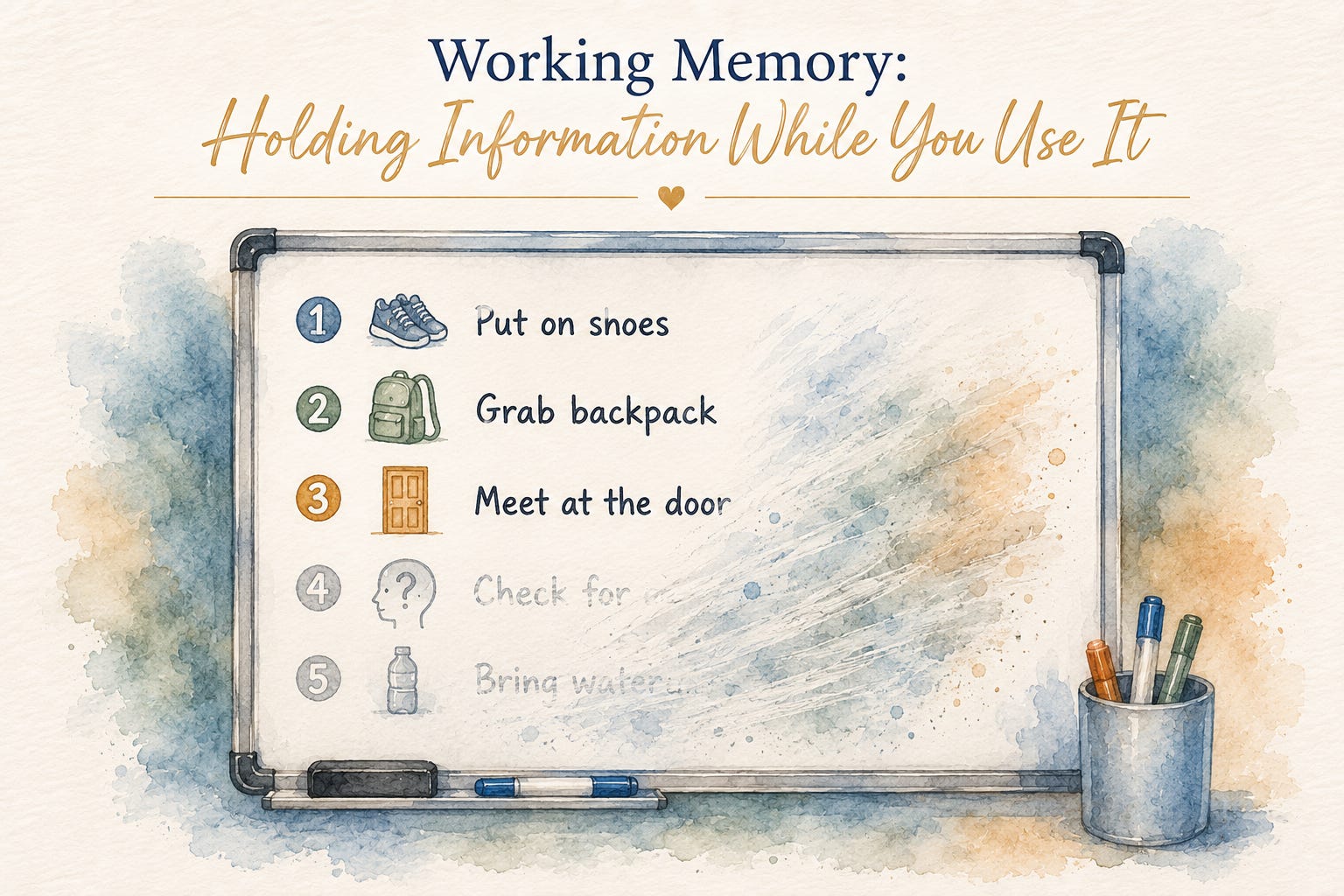
Suddenly, the child who intended to follow directions can’t remember what came next.
Working memory challenges show up in surprising ways. A child may:
forget the second or third step of an instruction,
lose their place while reading,
abandon a dinner-time story halfway through because they forgot where they were going with it, or
become overwhelmed when too much information is given to them at once.
Here’s the good news: working memory isn’t fixed or static. Like other executive function skills, it develops with practice and support.
The key is a supportive adult.
Developmental psychologist Lev Vygotsky described how humans learn, and it’s not by staying in our comfort zone, but it’s also not by jumping so far outside it that we freeze.
He called it the “Zone of Proximal Development,” where a supportive adult or peer holds out a proverbial hand to help us learn something harder than we are currently capable of.
That requires some outside support. It’s what researchers Wood, Bruner, and Ross called scaffolding.
Scaffolding essentially means we provide just enough support for the skill they are trying to build. Once it’s built, the scaffold comes down, and the skill stands on its own.
That’s exactly what purposeful parenting looks like.
God Showed Us How to Support Working Memory
God knew we needed this kind of support for our working memory, and He encouraged it throughout Scripture:
Moses didn’t just tell people the 10 Commandments; he wrote them down on tablets
But the tablets didn’t live in each person’s home, so Deuteronomy 6:6-7 encouraged families to repeat them often, to write them down on the doorframes of their house and their gates (v9), and to tie them as symbols on our hands, our necks, and our foreheads (v8)
When it came to commandments and prayer, God encouraged the people to tie tassels on their garments as reminders (Numbers 15:37-41)


The point is simple: people remember better when important information is supported by their environment.
As parents, we can do the same.
In modern times, this looks like sticky notes, chore charts, and checklists.
Practical Parenting

Notice It
Ask yourself where the breakdown happens.
Do they miss the instruction entirely?
Do emotions overwhelm them before they begin?
Do they start but forget the next step?
Do they become overwhelmed halfway through?
Do they only respond after repeated reminders?
Name It
Once you’ve identified the gap, consider the skill that may still be under construction.
Not hearing → attention or auditory processing working memory
Melting down → emotional regulation, metacognition, and working memory
Forgetting steps → working memory and sustained attention
Becoming overwhelmed → planning, organization, and working memory
Waiting for repeated reminders → task initiation, time management, and working memory
Nurture It
Rather than assuming defiance, scaffold; provide support that matches the struggle.
Get on their level before giving instructions.
Let them verbalize frustration, which makes room for offloading emotion so logic can work
Use visual reminders or checklists.
Break large tasks into smaller steps or let them complete one step before introducing the next. Stay available for guidance without taking over.
And when possible, resist repeating yourself over and over. Clear expectations followed by calm, consistent consequences teach far more than endless, nagging reminders.
I’ve included a companion handout with practical scaffolding strategies and a weekly tracker to help you put these ideas into practice.
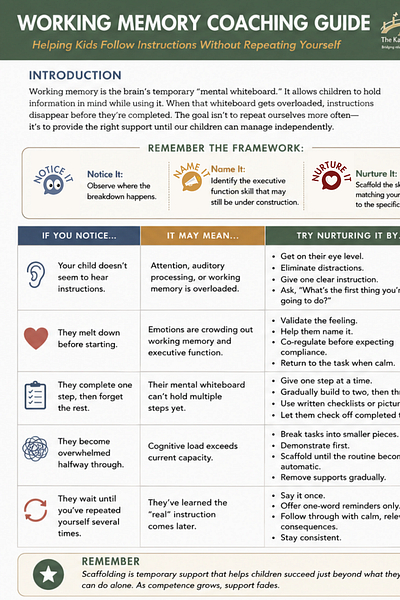
The goal isn’t to rescue children from difficulty. It’s to build the skills they’ll eventually use on their own.
Because discipline isn’t about punishment, it’s about development.
Next week, we’ll explore emotional regulation, one of the executive function skills most likely to derail every other part of the brain when big feelings take over.
Want the full framework?
The book is available on Amazon: Notice It · Name It · Nurture It
References:
Greene, Ross. (2008). Kids do well if they can. Phi Delta Kappan. 90. 160-167.
Baddeley, A. D., & Hitch, G. J. (1974). Working memory. In G. H. Bower (Ed.), The psychology of learning and motivation: Advances in research and theory (Vol. 8, pp. 47–89). Academic Press.
Vygotsky, L. S. (1978). Mind in society: The development of higher psychological processes. Harvard University Press.
Wood, D., Bruner, J. S., & Ross, G. (1976). The role of tutoring in problem solving. Journal of Child Psychology and Psychiatry, 17(2), 89–100.
What a great read! Thinking on how well my daughter does this with her 5 kiddos…I’m sure she doesn’t call it scaffolding…but that’ll stick in my brain now!
Bethany... this is such a supportive, purposeful, and downright wonderful series for parents of young children!! My initial degree was in elementary education, and children are some of my favorite people. So I love what you're doing and how well you're doing it! And the way you place it within a biblical framework is strong and awesome. God bless you, your family, and your work!!