


Welcome to this series on cognitive development
We’re unpacking executive function, which could change the way you view child behavior.
We’ll answer questions like, Why won’t my kid listen, How many times do I have to tell them, Why can’t they find the shoes sitting right in front of them, Why do they melt down when plans change, and How can they focus for hours on things they love but not 15 minutes on chores or homework?
Rather than assuming laziness, defiance, or irresponsibility, it may come down to a simple set of teachable skills. Before you know it, responsibility, initiative, resilience, and even impulse control blossom.
Note: Don’t miss our twice-a-week posts moving forward: Tuesdays focus on parenting and child development, while Thursdays explore stories of formation (Because sometimes the lessons we’re trying to teach our children are the very lessons God is still teaching us in adulthood.)

The Air Traffic Control Tower of the Brain
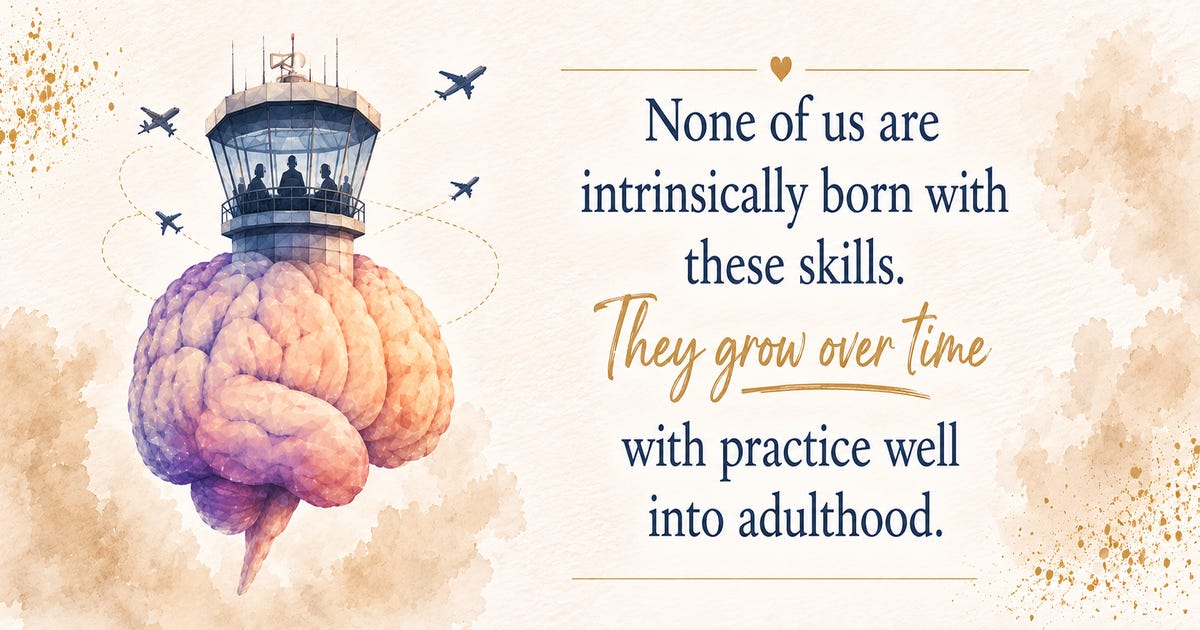
My husband and I each have brothers who are pilots, which means our kids are big fans of air traffic control apps like FlightRadar24. It’s wild to see so many planes in the air at once. My son commented the other day, “Imagine controlling that chaos.”
Actually, our brains do that all day long, on a slightly lesser life-or-death scale.
A child’s brain manages dozens of incoming demands at once: Remember your homework. Finish your breakfast. Don’t forget your shoes. Listen to Mom. Stop arguing with your sibling. Stay on task. Regulate your emotions. Ignore distractions. Shift gears when plans change.
It may sound simple to us, but we have fully formed brains and decades of experience. The prefrontal cortex of our brain has learned to manage it all, like an air traffic control tower.
Depending on whose research you follow, there are between eight and eleven cataloged executive functions that the prefrontal cortex is responsible for carrying out during the day. We’ll cover these eleven functions over the next several weeks, and how they show up in parenting, so don’t miss it!
Impulse Control: When Kids Struggle to Think Before They Act
Working Memory: The Real Reason Kids Don’t Follow Instructions
Emotional Control: So Your Kid Keeps Melting Down Over Small Things
Cognitive Flexibility: How to Avoid Tantrums When Plans Change
Sustained Attention: Squirrel! How To Help Kids Maintain Focus and Stay on Task
Task Initiation: Kids Not Listening? The Secret Is to Stop Repeating Yourself
Planning/Prioritization: How a Simple To-Do List Sparks Responsibility in Kids
Organization: A Scattered Brain Means Scattered Behavior
Time Management: Time Flies and They’re Not Having Fun
Goal-Directed Persistence: Growth Mindset, Goal Setting & Resilience
Metacognition: The Secret SuperPower Kids and How Not to Extinguish It
These skills matter far beyond homework, chores, and getting out the door on time. Executive functions influence academic success, emotional regulation, resilience, relationships, decision-making, and the ability to navigate adulthood well.
None of us are intrinsically born with these skills. They grow over time with practice well into adulthood.
God’s Design for Executive Function

Long before neuroscientists identified executive functions and mapped the prefrontal cortex, God was already cultivating these skills in His people.
God didn’t simply hand Bezalel a completed tabernacle. He gave him the capacity to plan, organize, create, solve problems, and persist through a complex project. (Exodus 31:1-6) #Planning #Organization #GoalDirectedPersistence
When Moses became overwhelmed by the demands of leading Israel, God used Jethro to help him establish systems, structure, and delegation. (Exodus 18:13-26) #Organization #Planning #Prioritization #TimeManagement
Jesus taught His followers that wise people don’t begin building a tower without first sitting down to count the cost by planning ahead, evaluating resources, and thinking through the steps needed to accomplish a goal. (Luke 14:28-30) #Planning #Prioritization #Metacognition
While rebuilding Jerusalem’s wall, Nehemiah faced criticism, distractions, threats, and repeated invitations to abandon his work. Yet his response remained steady. He knew his purpose, stayed focused on the task before him, and finished what God had called him to do. (Nehemiah 6:1-4) #SustainedAttention #GoalDirectedPersistence #TaskInitiation
Jesus spoke about integrity and the ability to act consistently with our commitments, rather than being driven by impulses or emotions in the moment (Matthew 5:37) #ImpulseControl #EmotionalControl #GoalDirectedPersistence
David gives us one of the clearest pictures of metacognition in all of Scripture: “Why, my soul, are you downcast? Why so disturbed within me?” Rather than allowing his feelings to drive him, he reflected on them, evaluated them, and redirected his heart toward hope in God. (Psalm 42:5) #Metacognition #EmotionalControl #WorkingMemory
God develops people over time. He teaches us to plan, persevere, focus, organize, remember, regulate our emotions, and steward responsibility well.
Today, researchers call these skills executive functions. Thousands of years ago, Scripture simply called it wisdom.
(And if you’re already seeing pieces of yourself in some of these descriptions, you’re not alone. Executive function isn’t just something relevant to childhood. It’s a lifelong growth area. Many of the struggles we experience as adults, such as procrastination, overwhelm, impulsive decisions, difficulty staying organized, and emotional reactivity, trace back to these same skills. That’s our story for Thursday.)
Parenting with Purpose This Week

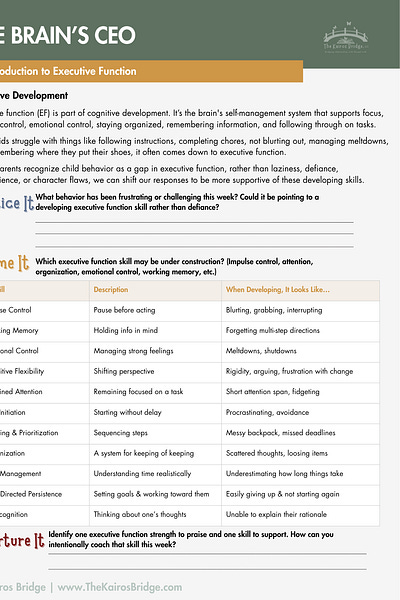
Many of the behaviors that frustrate us most are actually signs of a developing brain learning skills that God designed to grow over time. Our job is not simply to correct behavior, but to coach growth. (Download this week’s guide to get started)
Notice It: What recent child behavior has been a point of contention in your home that you realize now may be a skill gap in executive functioning?
Name It: Which functional areas do your kiddos seem to struggle with the most?
Nurture It: Choose one skill they are already good at. This becomes your praise point for the week. Then choose one skill that needs development, which is where you can parent with purpose this week.
Next Week:
We’ll tackle one of the most frustrating parenting challenges of all: Impulse Control.
Why do kids blurt things out? Hit before they think? Grab things they know they shouldn’t? Melt down over something small?
And what can we do to help them grow?
Want the full framework? The book is available on Amazon: Notice It · Name It · Nurture It

Bethany... I'm so thrilled with the level of valuable instruction you're sharing in these posts!! When we as parents better understand what's really behind these day-to-day experiences of our children we can deal with them in such a way (as you describe) that will result in spiritual, psychosocial, and relational healthier children and, eventually, adults. May God bless you and your work!!