


Summary:
Two weeks ago, we talked about strengths.
Last week, we talked about not mistaking weakness signals as identity markers.
This week, we are learning how to speak to the strength under the signal, not with empty phrases of positivity, but with purposeful praise that nurtures God’s natural design.
They say passion and purpose are two of life’s greatest motivators. While purpose inspired me to memorize my first bible verse, it morphed into a passion of mine.
I was eleven, and my new best friend at school, who happened to ride the same bus as me, had this habit of speaking so negatively about herself: “I’m going to get sick. I just know it. I can feel it. Then I’ll get behind. Then my grades will slip. Then I’ll be stressed.”
Like clockwork, she’d be ill within 48 hours, sometimes less.
I decided to memorize Proverbs 18:21, hoping it would help her overcome her negative talk.
Death and life are in the power of the tongue, And those who love it will eat its fruit. — Proverbs 18:21 NASB
“Words have power: life and death,” I’d say. It took a few weeks, but I noticed she started to catch her words before speaking illness over herself.
One afternoon, she said, “I just know I’m going to get si—” she caught herself. And then finished, “…sooo much sleep tonight.”
The next morning was one I’ll never forget. The bus stopped at her house, and she hopped on. But that wasn’t even the amazing part. As she climbed the bus steps, the driver said, “Good morning; there’s that sunshine smile!” and my friend simply beamed, ear to ear, glowing like the sun itself.
In that moment, I saw more than avoiding words of negativity, illness, and death; I saw the other side of Proverbs 18:21. The beauty of speaking life into someone’s spirit.
I hope you can recall one from your own childhood. A well-timed comment from a coach, teacher, mentor, or parent. One that does more than simply tell us “Good job.” It’s the words that sink down into our soul and call out the best in us.
It’s why I call them Golden Words.
Golden Words
There are words we spend our entire childhood waiting to hear. We may not even realize it until someone utters them and basically changes our outlook. Not just on life, but on ourselves. Suddenly, we feel a thousand feet tall, as if we could conquer a mountain, withstand the impossible storm, and outlast any challenge.
There are the basics like: I love you. I’m proud of you. You matter. You belong here. Tell me about yourself. But golden words are more specific. More personal.
Have you ever noticed the words that seem to hit you deeper than any others? As if the person had peered into our soul and knew the very words we needed to hear. Those words matter because they touch something we value deeply about ourselves. To be seen, understood, and known by someone else in that way is life-giving.
What words from childhood had the greatest impact on you?
The same words don’t necessarily carry the same weight for every child. Just as temperament affects how we interpret situations and interact with others, it also affects which words sound like Golden Words to us.
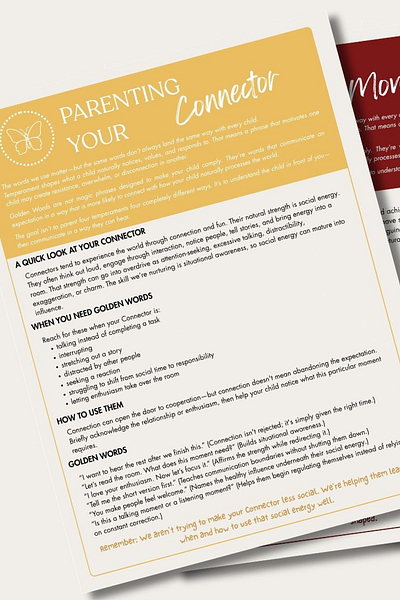
For The Connector, it may sound like: You’re so fun to be with. You light up the room. You’re a great friend.
For The Mover, it often sounds like: You did a great job. Thanks for taking the lead. What a great plan.
For The Analyzer, they are uplifted by words like: You notice things the rest of us often miss. You really thought that through. Thanks for thinking through all the details.
For The Keeper, it sounds like: Thank you for caring about everyone’s perspective. The group really benefits from your steady presence. You have a way of bringing people hope.
Temperament researchers call this goodness of fit. It’s the degree to which a child’s natural temperament fits with the expectations and responses of the people around them. Children thrive when parental figures help them learn to adapt within the world around them so they can thrive within it.
Speaking to a child’s Golden Words is like giving them permission to be who they are and find the key to where that fits within the world around them.

The Science Behind Words
The words we say to a child help them make meaning of themselves and the world around them. But there’s more to it than just positive words. Truly life-giving words are personal, purposeful, and speak to our passions.
· Notice It ·
To truly speak to a child’s strengths, we must first learn to see them. It begins with noticing what a child naturally does well, even when the strengths may be hidden beneath immature behavior. It’s like finding a diamond in the rough, or winnowing the wheat from the chaff (Matthew 3:12). Research shows that children whose parents speak to their strengths actually use those strengths more and tend to have greater emotional health, social skills, and general well-being.
· Name It ·
Once we see it, we want to put words to it. In an fMRI study, positive parental feedback to adolescents activated brain regions linked to improved mood and social cognition. Other research has shown that praise linked to a child’s specific effort on a task, effort, strategy, or perseverance (called process praise) is not only associated with greater desire for challenge but, in later years, shows gains in math and reading comprehension. Our words inspire passion and purpose!
· Nurture It ·
Knowing the strength and speaking to it are one thing, but just as Scripture reminds us that hearing the Word is one thing, doing it is another, so too with our children. They need opportunity to use those strengths. When parents encourage opportunities for children to exercise their strengths, it improves a child’s well-being. So give the budding leader something meaningful to lead; invite the problem-solver into a real problem; let the Connector bring people together; and give the Keeper opportunities to create harmony while practicing a strong voice.
We don’t just tell children who they can become. We give them opportunities to practice becoming it.
Following Christ’s Example in Parenting
Jesus gives us a beautiful example of calling out seeds of greatness in people, long before others might see evidence. The first time Jesus met Simon (see John 1:42), He started calling him Cephas (Aramaic)/Peter (Greek), both of which translate to rock.
While Peter demonstrated some bold qualities of a becoming leader, he wasn’t particularly rock-like at the beginning. Throughout the Gospel, we see evidence of his impulsivity, speaking before thinking, overestimating himself, panicking in the face of fear, sinking in the waves, rebuking Jesus, drawing his sword, and eventually denying Jesus. Yet Jesus called him rock because he could see his strength and who he would become.
Even on the morning of breakfast on the beach in John 21, after Peter had denied Jesus three times, Jesus didn’t take it all back. Jesus said, “Simon, son of John.” (Think of this like a parent calling a child by his full first, middle, and last name! Simon Peter knew he’d messed up, and a lesson was coming.) But it was more beautiful than that. Each time that Simon Peter confessed his love for Jesus, Jesus gave him a task:
Tend My lambs.
Shepherd My sheep.
Tend My sheep.
Even though Simon Peter messed up, Jesus still encouraged his passion, higher purpose, his calling, and his apostolic ministry.
When our children mess up, we may need to use their full given name at birth, but it doesn’t change who they are, what their strengths are, and what they’re called to be.
Our words can help set them back on track toward their God-given purpose and passion.
Childhood’s Most Valued Moments
Looking back, I vividly remember moments when a teacher, mentor, or friend spoke life to me that ended up being Golden words: *You're a great leader. You're so organized. You can handle this.* Those weren't random compliments to me. They spoke directly to things I valued most: action, accomplishment, responsibility, capability.
Someone else could have said, “Everyone loves having you around!” and I would have appreciated it, but tell me, “I trust you to handle this”? That landed, and I’ve carried those with me to this day.
I’ve created a free set of guides for you to use with the kiddos in your life.
Looking for a handy list of Golden Words you can use with each temperament?
Want help identifying a particular child’s temperament? Use the Temperament Assessment Tool
Need to know what makes a certain temperament tick? Check out the videos
The Mover Video:
The Analyzer Video:
The Connector Video:
The Keeper Video:
References:
Waters, L., Loton, D. J., Grace, D., Jacques-Hamilton, R., & Zyphur, M. J. (2019). Observing Change Over Time in Strength-Based Parenting and Subjective Wellbeing for Pre-teens and Teens. Frontiers in psychology, 10, 2273.
van Houtum, L. A. E. M., Will, G. J., Wever, M. C. M., Janssen, L. H. C., van Schie, C. C., Tollenaar, M. S., & Elzinga, B. M. (2022). Adolescents' affective and neural responses to parental praise and criticism. Developmental cognitive neuroscience, 54, 101099.
Gunderson, E. A., Sorhagen, N. S., Gripshover, S. J., Dweck, C. S., Goldin-Meadow, S., & Levine, S. C. (2018). Parent praise to toddlers predicts fourth grade academic achievement via children's incremental mindsets. Developmental psychology, 54(3), 397–409.
Jach, H. K., Sun, J., Loton, D., Chin, T.-C., & Waters, L. E. (2018). Strengths and subjective wellbeing in adolescence: Strength-based parenting and the moderating effect of mindset. Journal of Happiness Studies, 19, 567–586.