


Summary:
The behavior frustrating you the most may actually be a weakness signal.
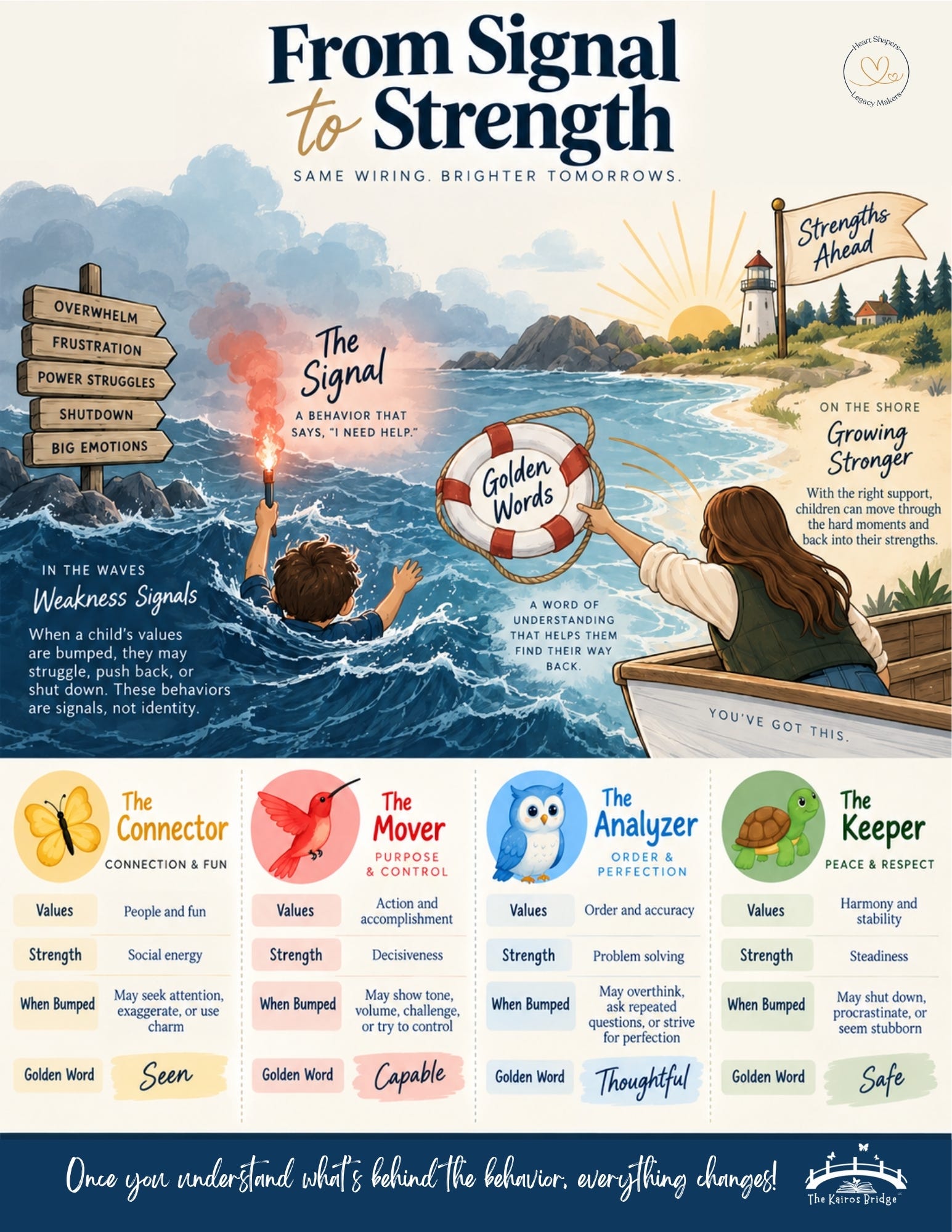
Every temperament has predictable weaknesses when its core values get bumped.
Parents can learn to notice the signal, name the need, and nurture back toward strengths.
I sat on a park bench, enjoying the breeze while my son played nearby, as a weary mother next to me did her best to answer her young child’s questions.
If I had to guess, it was round seventeen “whys.” Why did they have to leave? Why now? Why couldn’t they stay a little longer? Why couldn’t they do whatever came next another day?
You could tell Mom was trying. She didn’t want to snap. She was answering calmly. But she was also running out of answers (and patience).
What she needed was a lifeline. A boundary that could honor her child’s natural desire to understand without allowing seventeen rounds of why to derail the entire afternoon.
And then, almost on cue, her older daughter bounded over. “I figured out how to get my own library card! Now you don’t have to worry about how many books I check out or whether they’re late because they’ll all be under my name.”
Mom sighed. Her daughter’s ingenious solution meant she’d missed the point of the discipline.
I smiled to myself, wanting desperately to give this mother a helpful lifeline:
One child desperately wanted to understand the boundary. The Analyzer.
The other had simply found a way around it. The Mover.
Welcome to temperament! Once you see it, it changes the way you parent.

When Their Wiring Bumps Into Your Boundary
Last week, we talked about the strengths hidden inside our children’s temperaments. But temperament has another side. Every temperament has predictable ways of responding when something important to them feels threatened, blocked, rushed, controlled, or overwhelmed.
And those responses aren’t always pretty.
The Connector may turn on the charm, exaggerate how much energy they must burn off unless you want them to be bouncing at bedtime, or try to make the whole thing funny enough that perhaps you’ll forget you said it was time to leave.
The Mover, who values action and accomplishment, may challenge the boundary, find the loophole, or let you know (with a certain tone) exactly what they think about your decision and why they have a better idea.
The Analyzer, who values order, accuracy, and understanding, may ask question after question after question, growing more and more distressed with each vague answer we offer, and
The Keeper may not argue at all. Give them three instructions at once: 1) gather your things, 2) put the trucks away, 3) dump the sand out of your shoes, and suddenly they seem to move at approximately the speed of refrigerated honey. Or they stop moving altogether.
This is where we often become incredibly frustrated as parents (or at least I do). We default to common questions: Why can’t you just listen? Why does everything have to become an argument? Why do I have to ask you five times? Why can’t you just go with the flow?
While those questions are valid, it rarely gets us where we need to go. In fact, the child often digs in, and the signal becomes a full-on battle of wits and manipulation.
So there’s another question worth asking: What if the behavior that’s driving me crazy is also giving me actionable information?
Weakness Can Be a Signal
We’ve all experienced this. There are circumstances, and sometimes people, that seem to bring out the worst in us.
We stare in the mirror, loathing our response, wondering, Who was that version of me? Where did he/she come from, and how do I stop him/her from showing up inside of me again?
That “worst version” of you often shows up when something you deeply value has been bumped up against (or steamrolled!)
If you value connection, feeling ignored can make you work awfully hard to regain someone’s attention, affection, or approval.
If you value efficiency, being slowed down can make you impatient, bossy, and demanding.
If you value accuracy, being rushed into a decision without enough information can make you anxious or rigid.
If you value peace, being pushed into conflict can make you want to disappear into the couch cushions until the whole thing blows over.
Children experience these collisions too. The difference is that they don’t yet have decades of experience recognizing what is happening inside themselves. So it comes out super sideways.
Tone. Volume. Twenty questions. Requiring perfection. Charm. Exaggeration. Avoidance. Procrastination. Stubbornness.
These are the behaviors we tend to experience as weaknesses. But with kids, I prefer to think of them as signals. Seeing behavior as a signal helps us recognize it as a cry for help.
Signals tell us: Something about this moment is bumping against this child’s wiring, and they don’t yet know what to do with it.
That changes what I do next.
Because This Is How Our Father Sees Us
One night, after the altercation had passed, my tearful son was feeling pretty low about how he’d responded in the moment. I had only been trying to help move the situation along, but it bumped up against his need for order and perfection.
As I rubbed his back, I offered my own stories of really mucking up a situation with my tendency to get things done efficiently. And in that moment, the Holy Spirit dropped in my heart:
“You know what the most remarkable thing is? God, our Heavenly Father, sees us at our worst: our impatience and control tendencies; our anxiety and avoidance; our self-ambition and vain conceit; even our stubborn laziness. And He still calls us His own. Not just that, but throughout Scripture, God repeatedly calls people by name, reminds them who they are, anchors their worth in Him, equips them for what He has asked them to do, and calls forward strengths they sometimes cannot yet see in themselves. He doesn’t confuse our worst moment with our identity.”
That’s a beautiful model for how God parents us, and it’s comforting to remember that His model guides how we can parent our children.
Whether you turn to the right or to the left, your ears will hear a voice behind you, saying, “This is the way; walk in it.” Isaiah 30:12 NIV
We get to offer them a small reflection of that same grace.
I see what’s happening. This isn’t who you are. Let me help you find your way back to who you’re becoming.
That’s very different from simply making a behavior stop.
Don’t Remove the Boundary. Change how you help them through it.
This is important because understanding temperament does not mean rearranging the entire family around a child’s preferences.
The Analyzer doesn’t get unlimited questions. The Mover doesn’t get to take over. The Connector doesn’t charm you into another thirty minutes at the park. And the Keeper doesn’t get to avoid every uncomfortable demand. Instead, we can make small pivots that help children practice moving through the very situations that are difficult for them.
Give your Analyzer three really good whys: “You can ask me your three most important questions. Think carefully about which ones you want answered.” The boundary remains. But now their need for understanding has somewhere productive to go.
Give your Mover something appropriate to own: “We’re still leaving the library with ten books. You can decide which ten make the cut.” They don’t control the boundary. But their decisiveness has somewhere productive to go.
Give your Connector a little fun that moves everyone forward: “I bet you can’t get everything into the car before I finish this song.” We’re not letting charm hold the afternoon hostage. We’re redirecting that social energy toward the next thing.
And give your Keeper one manageable step: “Don’t worry about all three things yet. First, let’s put the trucks away.” The expectation hasn’t disappeared. We’ve simply made the path toward it feel possible.
Suddenly, the strength that was getting lost underneath the behavior becomes the tool that helps them move forward.
Notice It. Name It. Nurture It.
This is where Notice It · Name It · Nurture It becomes incredibly useful in the day-to-day. It’s the pattern we just established in the examples above, and it’s the framework you can use in everyday moments of parenting.
· Notice It ·
Notice the signal. Not just what is my child doing? Ask: What happened right before this? Where did the collision happen?
Maybe your Analyzer was asked to move forward without enough information. Maybe your Mover encountered a boundary they couldn’t control. Maybe your Connector had to leave something fun. Maybe your Keeper suddenly faced several demands at once.
We’re looking for the pattern, not assigning a character flaw.
· Name It ·
Now help them put language around what’s happening. “I know you want more information before we decide.” (The Analyzer) “I can tell you really wanted some say in making this decision.” (The Mover) “I know you’re disappointed that the fun is over.” (The Connector) “That felt like a lot of instructions all at once.” (The Keeper)
Those are statements of truth that allow a child to feel seen and known. The boundary doesn’t move. They simply know now that you see them in life’s challenging moments, and you’re there to keep them safe, soothe them, and support them. Save, seen, soothed, supported. Those are the core elements of secure attachment, which make nurturing healthy behavior possible.
· Nurture It ·
This is where we call the strength forward. Give them something productive to do with the wiring that is currently working against them. Let the Analyzer use their problem-solving. Let the Mover use their decisiveness. Let the Connector use their social energy. Let the Keeper use their steadiness. It’s almost like throwing out a life preserver.
Their behavior sent up the flare: I’m struggling here.
And instead of meeting weakness with more weakness, we reach for the strength we know is already there. We help them get their feet underneath them. Then we give them a do-over so they can try again. That’s how new behavior is developed.
Eventually, They Learn to See the Signal Too
When our children are little, we do a lot of this work for them. Our role is to scaffold support, and it looks much more robust when they’re younger. We notice the pattern. We give it language. We help them find another response.
But we’re not supposed to do that forever. We slowly step back, removing scaffolding in places where they are showing capability, and we watch them grow.
Eventually, we want the Analyzer to recognize: I’m asking the same question six different ways because uncertainty is making me uncomfortable.
We want the Mover to recognize: I’m getting louder because I don’t like that I’m not in control.
The Connector: I’m trying really hard to win everyone back because I don’t like where this interaction is going.
The Keeper: I’m avoiding this because conflict feels uncomfortable.
That’s the long game. Self-awareness. Self-regulation. And social skills.
We aren’t raising children who behave appropriately simply because Dad or Mom is standing nearby. That’s coercion. We are raising children who begin to understand themselves well enough to recognize when their wiring is getting pulled into weakness, and know how to find their way back to strength.
The Words We Use Matter
Sitting on that playground bench, I wanted so badly to hand that mother a lifeline.
Not because she was doing anything wrong, but because I could see how tired she was, and I knew it didn’t have to be that way.
I kept thinking how much easier these moments become when we recognize the signal. You don’t need seventeen more answers. You don’t need to overpower the Mover. You don’t need to out-negotiate the Connector. You don’t need to drag the Keeper along. Sometimes you simply need the right words to speak to the child standing in front of you.
And that’s where we’re going next.
Next week, we’ll talk about the Golden Words for each temperament: the words that speak directly to what each child values and help call them from weakness back toward strength.
Because when you’re standing in the library, the grocery store, the playground, or your own kitchen, wondering why you and this child keep butting heads, there may be more happening underneath the behavior than you realize.
Notice the signal. Name what is happening. Nurture the strength that can help them through it.
Because our children’s hardest moments don’t have to define them.
Sometimes they’re simply showing us where they still need help becoming who God created them to be.
Such wisdom and grace always fill your posts Bethany! I move through them amazed at everything that's here. And what's also so wonderful is that these truths can also be directly applied to the child that still resides inside the adult. Whether or not we have little ones to guide, we can use this same wisdom and grace to reparent ourselves when we see our own weaknesses surface. As always, thank you for what you do!