


Summary: What looks like defiance may actually be a child practicing autonomy, and our response can either support or interfere with that development.
It was one of those days. The ones where her three-year-old Liora insisted on doing everything herself, even when she clearly needed help.
This morning had been about tying her shoes. “No, I DO IT!”
This afternoon was a fit about getting out of the shopping cart to push it, which was fine until she steered it into a giant display of precariously balanced pumpkins.
Now it was bedtime, and Liora wanted to get her doll out of the car: “Mommy, I just go get her. Real fast.”
Liora was nearly out the door when Amara yanked her back. “It’s dark, sweetie, and you don’t have shoes on. The driveway acorns will hurt your feet. Let me go.”
Two minutes later, now back inside, Amara found Liora battling a waterfall of tears as she blubbered, “But Dolly is mine, and I am brave. I can get her myself.”
For the first time that day, Amara wondered which was more costly: doing it for her daughter and reaping the frustration that followed, or taking the time to support her child through actually trying to do it herself?
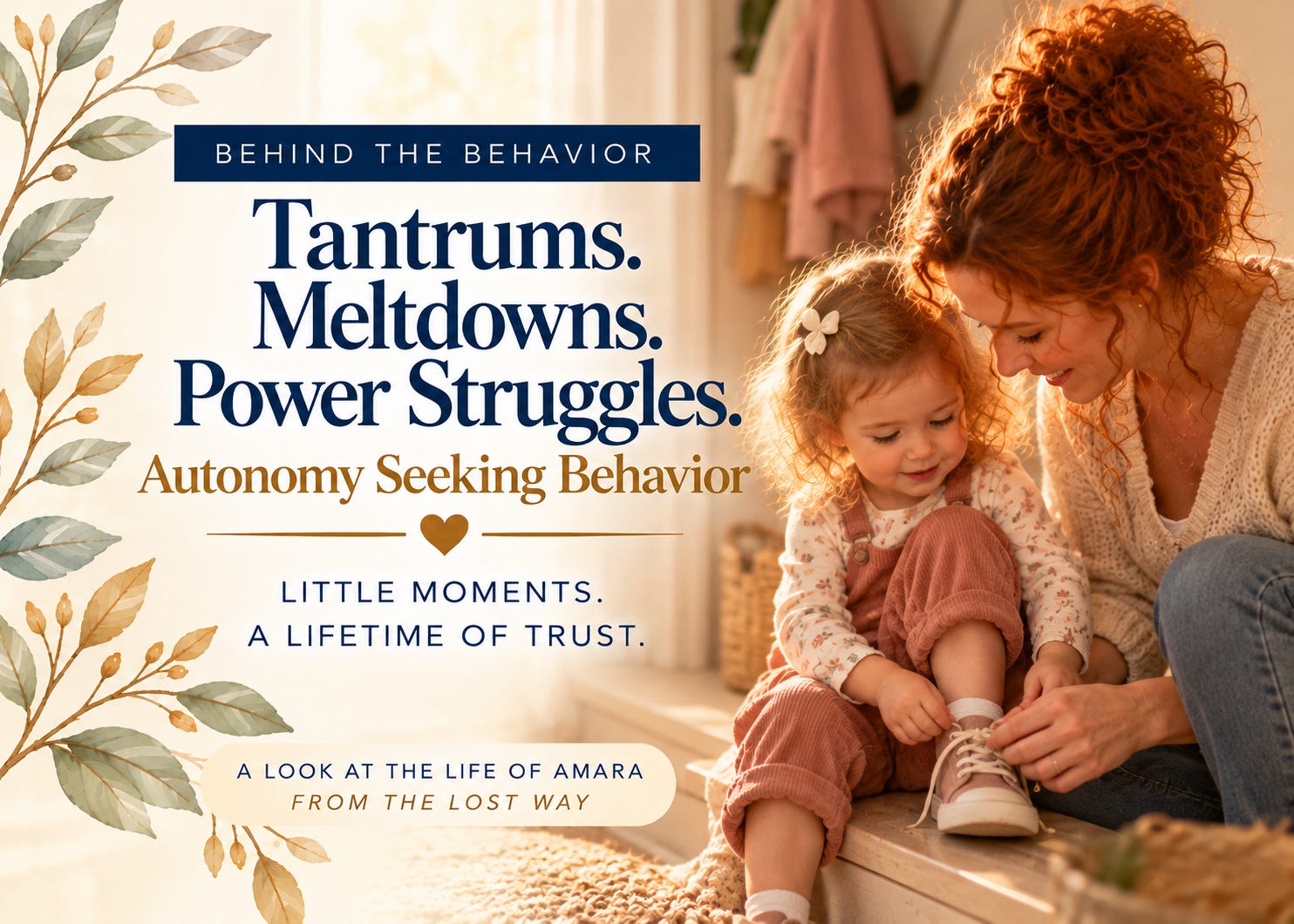
The Balance Between Autonomy and Control
Amara’s dilemma is one most parents of toddlers know well. We want them to become independent, but we also know things will be easier if we just do it for them: the shoes, the teeth brushing, the picking up of toys. And while some moments call for efficiency, what happens when that becomes the default?
As children turn two, they are entering the next stage of Erik Erikson’s psychosocial development termed Autonomy vs Shame/Doubt. The trust we helped them build in infancy as they asked “Can I trust someone to help me?” is now the foundation for “Can I do things for myself?”
They can walk where they want, reach things that were once out of sight, express preferences, make simple decisions, imitate adults, and begin imagining what they want to accomplish. They’re discovering that they can influence what happens around them.
We want our kids to become independent, but their language is still developing; their fine motor skills are inconsistent; their capacity to wait, tolerate frustration, shift attention, and manage powerful emotions is immature. And so we have a toddler who desperately wants to zip her own jacket but doesn’t have the coordination or emotional regulation to handle repeated failure.
They use parental support as a launchpad into the world of learning, exploration, and play. They try new things, knowing that if they fail or life gets hard, they can turn back to us for support and the encouragement to try again. But there’s an important difference between knowing help is available and having that help imposed before they’re ready for it.
Unwanted or excessive parental support that seems like control is interpreted as another obstacle between them and what they want to accomplish on their own.
The Cost of Control
Erikson proposed that children who receive appropriate opportunities to exercise this new independence can develop a growing sense of autonomy and confidence in their abilities.
However, children who are excessively controlled, punished for their mistakes, or given little opportunity for choice are likely to develop chronic self-doubt, difficulty making decisions, and fear of disapproval.
But one rushed morning or one frustrated parental response doesn’t determine a child’s developmental outcomes. It’s about the pattern we create over countless interactions.
It’s why our very tendency to jump in and do something for our toddler warrants a pause-and-ponder before responding.
The cost of control isn’t always found in the big parenting decisions. Sometimes it hides in the smallest moments of our daily routines.
We dress them because it’s faster.
We answer for them because they’re taking too long to decide.
We tell them what to wear, when to play, and how to complete a task.
Sometimes these decisions are completely necessary. Two-year-olds still need guidance, supervision, and protection. But also consider how well each of us takes to being told what to do, when to do it, and how to do it. We don’t usually like it so much.
Neither do toddlers.
That’s because we all have a fundamental psychological need for autonomy—the freedom to exercise choice and have some influence over our lives. For toddlers, that often looks like wanting to make their own decisions, experience a sense of control, and have fun exploring the world around them. They want freedom, power, and fun! When those opportunities are unnecessarily restricted, frustration can follow.
Those battles have familiar names: The Temper Tantrum. The Meltdown Mode. The Power Struggle.
Do a H.A.L.T.S.S. Check to Figure Out What’s Behind the ‘No!’
Just because our toddler is at an age when they’re learning to exercise autonomy doesn’t mean every ‘NO!’ is a demand for independence. Sometimes what looks like defiance is a child who is hungry, tired, overwhelmed, or afraid, or several at once! And sometimes those needs make an ordinary frustration feel completely unmanageable.
Before we decide how to respond to the behavior, we need to figure out what’s fueling the behavior. That’s where a simple H.A.L.T.S.S. check can help.
Are they hungry? Face it, we all get kinda crabby when we are hungry, especially if we don’t have the freedom or power to eat what or when we want. Perhaps give them an option: “You can have an apple now, or you can eat dinner in 20 minutes.” We’ve addressed the need: hunger. We’ve reinstated power: they have a choice.
Are they angry? Sometimes anger emerges when children feel frustrated, misunderstood, or unable to influence what happens next. Start by empathizing with the issue and then offering choice where possible. “I know you want to run and play, but we must wait until we are safely inside the park. Do you want to ride in the stroller or hold my hand while we walk?”
Are they lonely? Sometimes clinginess signals a need for reassurance or connection, particularly during transitions or separation. Sometimes the answer is as simple as, “Tell me something that made you happy today. What was one thing that made you sad today? What is something you are looking forward to tomorrow?”
Are they tired? An overly tired and taxed nervous system doesn’t regulate well. Fatigue can make it harder to regulate emotions, tolerate frustration, and cooperate. When we see these behaviors show up and fatigue is the issue, it’s ideal to provide rest and then plan for how to avoid that in the future (such as not going grocery shopping right before nap time)
Are they sick? This can look similar to fatigue. None of us are particularly pleasant when sick. A child who is teething, running a fever, or experiencing other physical discomfort may have less capacity to manage frustration. That doesn’t mean we excuse behavior; it means we extend a bit of grace and set environmental boundaries that support them when they are sick.
Are they scared? Fear drives us to seek comfort, security, and protection. The catch is that what scares a toddler may be outside of what we would find terrifying. So that clingy infant who wants to hide behind your skirt or wrap around your leg may need reassurance before we can expect them to move forward with normal behavior.
Sometimes we focus so much on correcting the behavior that we overlook the needs making it difficult to manage in the first place. A fascinating example of this is in 1 Kings 19. Elijah is afraid, exhausted, isolated, and deeply distressed. And God’s first response isn’t to tell him how to behave differently. It’s to let him rest and eat. That’s the image we can hold as parents.
Parenting with Purpose
What I love about the psychology of child behavior is that once we understand what’s really behind the behavior, it changes how we choose to respond.
When we recognize that a two- to three-year-old is building the autonomy needed to be successful in later stages of life, we can reframe our approach to support that autonomy.
When we recognize meltdowns as gaps in H.A.L.T.S.S., we can address those underlying needs so we can support them rather than use coercive control.
When we recognize tantrums as fighting for freedom, power, and fun, we can find easy ways to honor those desires.
Tomorrow we’ll jump into those parenting approaches and take a special look at Genesis 2:18 to see exactly how God models the importance of autonomy.