


You’ve seen it a hundred times. They hit, they grab, they interrupt, and then comes the look on your child’s face that tells you they knew better.
So why do they keep doing it?
The answer is simple, but life-changing. They may know better; they just couldn’t get there fast enough.
This week, we’re unpacking impulse control:
What’s actually happening in your child’s brain in that split second,
What Scripture says about the pause between impulse and action, and
Three practical ways to start building the brake today, in calm moments, before the next flooded one arrives.
(Spoiler: you might recognize not just your child but yourself in some of these moments, too!)
Science
The gap between knowing what to do and being able to do it in the moment is called impulse control. But we must be careful not to label it a character flaw with phrases like, “You’re so…” or “Quit being so…”, when it’s merely a skill still in development.
This is a specific, teachable, and coachable brain skill that is still being built, from birth through to adulthood.
Once we understand how impulse control develops and our role as parents (and teachers!) in coaching it, everything changes. Our responses. Our guidance. And yes, subtly, their behavior!
Impulse control is the ability to:
Think before acting
Pause between the impulse and the response
Consciously choose whether to act on an impulse, or not
It may sound simple because for an adult brain, it’s relatively automatic. We’ve had decades of practice to build these neural (brain) pathways.
But our children’s brains are still under development. Not only are they collecting data points by observing us and how we behave to integrate them into learning, but they are also building the neural pathways to implement the “pause-think-act” skill for themselves.
Plus, add in stress, excitement, frustration, or social pressure, and the pause is genuinely unavailable yet.
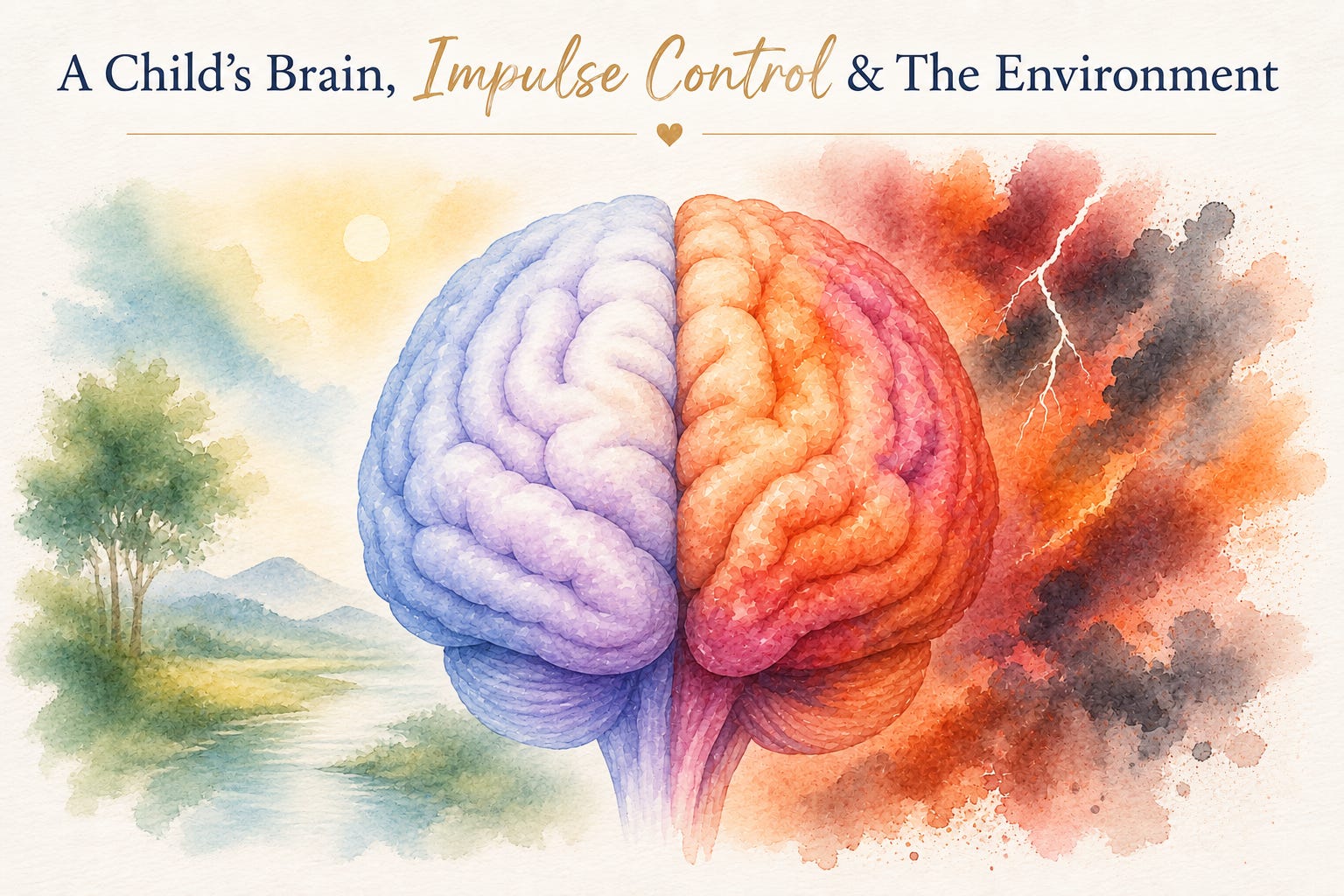
Here is why. The impulsive urge to blurt, grab, hit, or react is driven by the limbic system, the brain’s emotional, reactive, fast-moving part. Think of it like a car’s gas pedal.
So where’s the brake pedal? It’s in the prefrontal cortex, which is responsible for evaluating the impulse and deciding whether to act on it. The challenge is that the prefrontal cortex is still under construction until the mid-twenties.
So the race between impulse and control isn’t fair because the brake pedal isn’t fully functional yet and struggles to balance the gas pedal's effort.
This is where we can step in to help kids learn how to let off the gas pedal, slow down, and give the brakes some time to engage a car that’s coasting rather than a car that has the pedal to the metal. It’s called coregulation. We step in and provide external impulse control through teaching and coaching so they can learn to build internal impulse control.
Hopefully, you’re beginning to see this is less about outright defiance and more about neurobiology.
You may even recognize this in yourself: the sharp word that escaped before you could stop it, the reaction you had before processing all the details, or the impulse to rush a child when what they needed was breathing room. It’s truly a lifelong development skill.
Once we understand that, it makes it easier to extend grace to our children as we Notice · Name · Nurture their growth (and ours!)
Impulse control gaps vary by gender and developmental stage in childhood. I talk about the various differences in my YouTube series (Part 2: minute marker 3:23), which is designed to help parents and teachers calibrate expectations so we can provide teachable moments that match a child’s age-appropriate capabilities.
Scripture
Scripture understood the impulse control challenge long before we had the neuroscience to explain it.
Jesus himself modeled the pause when he was under pressure, accused, and genuinely threatened. When the Pharisees tried to trap him. When he was falsely accused before Pilate. When Peter cut off the guard’s ear, Jesus stopped, turned, and healed the man before saying a word about what had just happened.
The pause between stimulus and response was modeled in the most high-stakes moments in the Gospels.
But there’s another important section of Scripture, where Jesus was tempted by Satan in the wilderness. Satan taunted him with sustenance, identity, and power.
Our kids are tempted by very similar things, on a smaller scale, nearly every minute of the day: snacks, social insults, and power struggles.
Jesus responded by standing firm on who He was as the Son of God, and quoting Scripture as His proof.
We can teach our kids to do the same. Bible studies, devotionals, prayer time, and memorizing Scripture are essential tools for this.
The ability to pause and choose righteousness is described in Scripture as wisdom, integrity, and the fruit of life ordered toward God rather than the impulses of the moment.

Practical Parenting
(Note: I typically try to keep posts short by placing the practical parenting details in a free download. This week, I’m testing how it performs embedded 😊 Please bear with me as I learn your preferences)

1. Notice It.
Before you respond to the impulsive behavior, pause and ask:
What just happened in my child’s brain?
Where did the brake fail?
Was this a calm moment where they chose not to pause, or was this a flooded moment where the pause was genuinely not available? The distinction changes how we nurture growth.
(Notice your own impulse in the moment, too, because a dysregulated parent responding impulsively to an impulsive child escalates rather than teaches.)
2. Name It.
Replace the character label with a skill description.
Not “you are so out of control” but “your brain moved faster than your pause right now. That is something we can work on.”
Not “why would you do that” but ‘I think the impulse got ahead of the brake. Let’s talk about what happened.”
Name the growth, rather than a perfect outcome, as the goal. “I noticed you took a breath before responding. That’s growth. We can practice choosing responses.”
You are naming the gap without shaming the person. And you are giving your child a framework for understanding their own brain, which is the beginning of metacognition and self-correction (topics of future posts)
3. Nurture It.
The brake is a skill that can be built. Here is how:
Build the pause in calm moments, not flooded ones. Role play is a great tool!
Practice stopping before acting when the stakes are low (perhaps at home) so the pathway exists when the stakes are high (like at the store).
Use games (Simon Says, Red-Light/Green-Light), routines, and simple pause-practices in everyday moments
Create a pause ritual. For young children this might be a physical cue like hands on knees, three breaths, a specific word. For older children, it might be an internal phrase. The goal is to give the brain a practiced pathway between impulse and action.
And for the moments when the brake fails completely, which it will, respond to the behavior calmly and return to the skill conversation after the nervous system has settled. Regulation before instruction. Every time.
Want the full framework? The book is available on Amazon: Notice It · Name It · Nurture It
I always love the practicality, the doable nature, of your truths, Bethany. The "how to do this in real life" stuff is awesome.