



You’ve just finished giving the class instructions on the assignment. You conclude with, “You can work with a partner or independently. Just make sure you finish before lunch.”
One student immediately turns to a friend and starts talking about what they’re going to do together.
Another has already decided how the project should be done and is explaining the plan to everyone at the table.
A third is still reading the directions because there is one part that seems unclear, and they want to make sure they understand exactly what the teacher expects before they begin.
The fourth quietly gets started, perfectly content with whatever option creates the least disruption.
Same teacher. Same classroom. Same assignment. Four very different responses.
We tend to notice these differences quickly as teachers. The child who seems to need an explanation for everything. The one who talks through every transition. The one who wants to be in charge. The one who rarely causes trouble but may disappear into the background.
Eventually, we start developing descriptions for them.
“She’s very social.”
“He’s strong-willed.”
“She’s a perfectionist.”
“He’s so easygoing.”
Those observations aren’t necessarily wrong. But they become much more useful when we understand what may be underneath them. That is where temperament comes in.
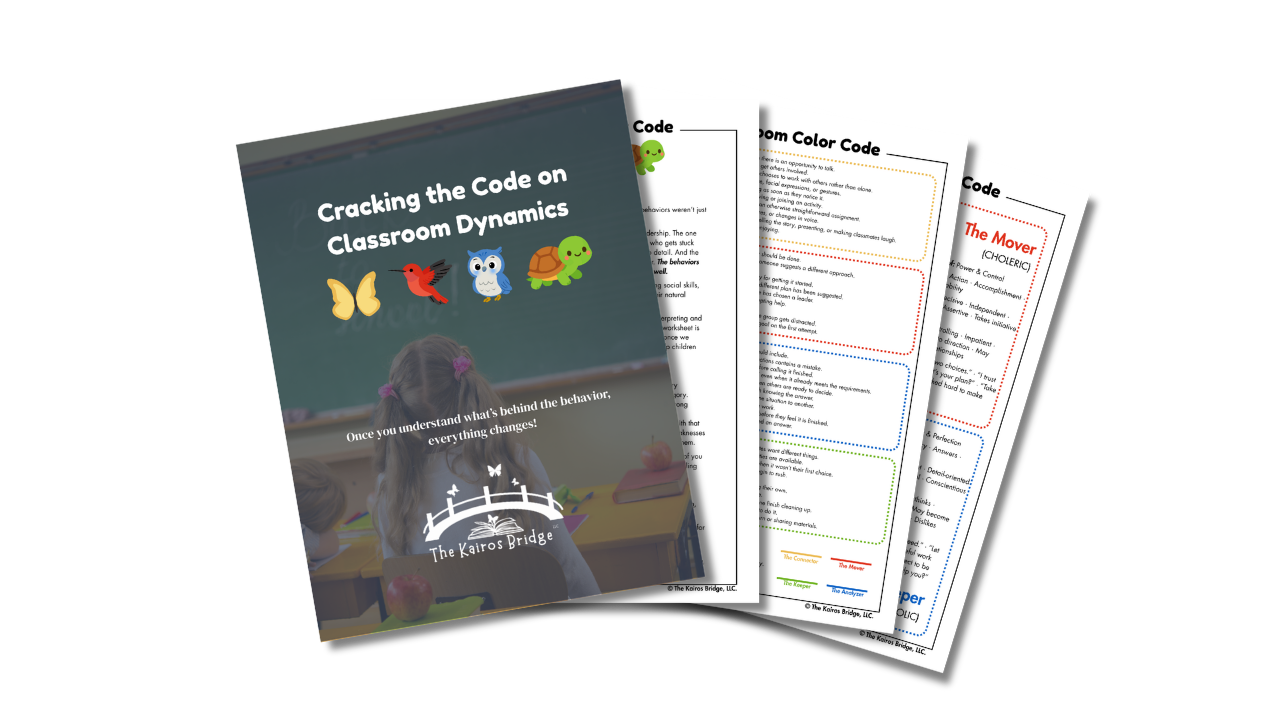
Don’t miss the free Classroom Color Code download at the end!
Temperament is the “how” of behavior
Temperament refers to biologically influenced differences in the ways people tend to respond to their environment. Researchers have studied temperament through several different models, but across those models we see recurring differences in things like emotional intensity, activity level, sociability, adaptability, persistence, sensitivity, inhibition, and self-regulation.
In other words, children don’t simply differ in what they experience. They differ in how they tend to experience and respond to it.
Temperament is all about how we interpret and interact with the world around us.
Some children approach something unfamiliar almost immediately. Others stand back and observe. Some respond intensely when they’re frustrated. Others seem relatively unruffled. Some are highly sensitive to mistakes, details, or changes in expectations. Others barely notice. Some naturally seek interaction. Others need considerably less of it.
These patterns begin remarkably early in development, although the way they are expressed changes as children mature and their brains become increasingly capable of regulating those natural tendencies.
But temperament is not an excuse for behavior. A child who naturally has a strong drive for control still has to learn how to respect other people’s boundaries. A highly social child still has to learn when talking is appropriate. A child who dislikes conflict still needs to develop assertiveness. A child with high standards still has to learn how to tolerate mistakes.
Temperament gives us information about where the child may be starting from before people, events, and life experiences form their personality.
And when we know the starting point, we become much better at teaching the skills that need to develop next.

The classroom makes temperament visible
One of the reasons temperament becomes so interesting in schools is that classrooms constantly place children in situations that expose individual differences.
Think about what we’re asking children to do all day.
Wait. Transition. Work with people they didn’t choose. Follow someone else’s plan. Perform in front of others. Tolerate mistakes. Share materials. Accept feedback. Start something difficult. Stop something enjoyable. Navigate noise. Handle competition. Manage disappointment. Ask for help. Solve conflict.
Every one of those experiences interacts with temperament. That is why two children can encounter the exact same classroom expectation and experience it very differently.
When we understand temperament, we gain another question to ask when we’re trying to Notice It · Name It · Nurture It.
We can NOTICE what we’re seeing. We can NAME what might be driving it. Then we can NURTURE the skills the child needs without treating their basic temperament as something that needs correcting.
When it comes to temperament, you may already be familiar with the classical literature from Hippocrates and Galen, who named them Sanguine, Choleric, Melancholic and Phlegmatic.
For the Classroom Color Code, I use those familiar temperament patterns but give them teacher- and kid-friendly names: The Connector, The Mover, The Analyzer, and The Keeper.
These aren’t boxes we’re trying to squeeze children into. Most children will recognize parts of themselves in more than one, and personality is far more complex than four categories. Think of these instead as lenses that help us notice recurring patterns in what children value, what tends to motivate them, where their natural strengths emerge, and where those same strengths may become challenging when they are immature or stretched too far.
And perhaps most importantly, they help us understand why the words that motivate one student can completely miss another.
The Connector: “Experience this with me.”
You usually don’t have to look very hard to find the Connector.
They are often the children who experience school relationally. They notice who is sitting beside them, who laughed at the joke, who wants to be their partner and whether everyone else seems excited about what is happening.
Connection and fun matter enormously to them.
Needs and Desires
Underneath that orientation, you will often find a strong desire for approval, acceptance, affection and attention. That doesn’t mean every Connector is constantly demanding attention. It means relationships carry significant motivational weight for them.
Strengths
This can produce some wonderful classroom strengths.
Connectors often bring enthusiasm into a room. They can be expressive, encouraging, imaginative and socially courageous. They may be the child who welcomes the new student, volunteers enthusiastically, turns an ordinary assignment into something entertaining or gets an entire group excited about a project.
Weaknesses
But developing brains don’t always know how to manage strengths wisely yet.
The desire for connection can become talking when they should be listening. Spontaneity can become impulsivity. Enthusiasm can become distraction. Their ability to entertain others can become attention-seeking, and their attraction to whatever is interesting right now can make follow-through considerably harder.
If we only see the behavior, we may spend all day saying, “Stop talking. Pay attention. Quit distracting everyone.”
Understanding temperament allows us to recognize what the child is reaching toward while still teaching appropriate boundaries around how they reach for it.
Golden Words
Golden words are language that speaks toward something the child deeply values in such a way that inspires them and empowers them toward their strengths. Relational language often lands particularly well with a Connector:
“Come do this with me.”
“I love your enthusiasm.”
“Tell me about it.”
“You bring great energy to this group.”
We aren’t bribing them with attention. We’re learning how to communicate through a channel that already matters to them.
The Mover: “Let me handle this.”
The Mover often walks into a classroom looking for agency.
These are the students who want to know what we’re doing, where we’re going and, quite frequently, whether they can have some say in how we get there.
Power and control matter to them, although I want us to be careful with those words because adults tend to hear them negatively. A healthy sense of power means, I can affect what happens. A healthy sense of control means, My choices matter.
Needs & Desires
Movers are often driven by action, accomplishment, appreciation and accountability. They like movement toward a goal. They enjoy seeing something happen because they made it happen.
Strengths
This is why they can become extraordinary classroom leaders.
They may take initiative before anyone asks. They make decisions quickly. They organize the group, volunteer for responsibility, defend an idea and keep pushing toward the finish line when everyone else has lost interest.
Weaknesses
That same leadership strength can become bossiness.
Confidence can become argumentativeness. Independence can become resistance. Decisiveness can become impatience. Their desire to accomplish something can become such a strong focus on winning or being right that relationships get bulldozed along the way.
This is where temperament changes the way we interpret the interaction.
A Mover who responds to an instruction with, “But why can’t I do it this way?” isn’t necessarily communicating, I don’t respect you. They may be communicating, I want some ownership here. We still need the boundary. Sometimes the answer really is, “Because this is what we’re doing.”
Golden Words
Whenever appropriate, we can build legitimate agency into the boundary.
“You can start with the first three problems or the last three.”
“What’s your plan?”
“I trust you to handle this.”
“You’ve got a strong idea. Show me how you’re going to make it work.”
The goal isn’t to win a power struggle with a Mover. It’s to teach a child with a strong drive toward power how to use personal power responsibly.
The Analyzer: “Help me understand it.”
While the Mover may be ready to begin before you’ve finished explaining, the Analyzer may still have a question. And then another one. Because something doesn’t quite add up.
Needs & Desires
Analyzers tend to speak the language of order and perfection. Accuracy, answers, assurance and appreciation often matter deeply to them. They want to understand the expectations, and many care a great deal about doing things correctly.
Strengths
These are often wonderfully thoughtful students.
They notice details other children overlook. They plan. They analyze. They organize information. They may produce exceptionally careful work because “good enough” doesn’t feel particularly satisfying when they know they could make it better.
Weaknesses
But high standards in a developing child can become perfectionism.
Carefulness can turn into hesitation. Analysis becomes overthinking. A desire for accuracy becomes frustration when directions are ambiguous. A child may spend so much time worrying about whether something will be right that they struggle to begin at all.
Then we see an especially interesting classroom paradox. The child who appears unmotivated may actually care too much about the outcome. “Just do it!” is unlikely to solve that problem.
Golden Words
Sometimes the Analyzer needs clarity. “Let me give you the details.”
Sometimes they need permission to tolerate imperfection. “This is a first draft. It isn’t supposed to be perfect yet.”
And sometimes they need their carefulness recognized as a strength while simultaneously learning that a strength does not have to control them.
“I can see how much thought you put into this. Now we’re going to practice deciding when it’s finished.”
We aren’t trying to make the Analyzer care less.
We’re helping them develop enough flexibility that their high standards can serve them rather than trap them.
The Keeper: “Can we keep things steady?”
Then there is the student teachers sometimes worry about least. The Keeper.
They aren’t usually campaigning to lead the group. They may not be telling elaborate stories during instruction or agonizing visibly over every detail.
They tend to value harmony and respect.
Needs & Desires
Agreement, appreciation, acceptance and accommodation can carry significant weight for them.
Strengths
Many Keepers are wonderfully steady people. They can be patient, loyal, dependable and cooperative. They often make excellent partners because they aren’t constantly fighting to get their own way.
Weaknesses
And that can make them very easy to overlook. Because compliance isn’t the same thing as confidence. A child who goes along with everyone else’s idea may genuinely be flexible. They may also be learning that keeping the peace is safer than expressing what they actually think.
A preference for harmony can become conflict avoidance. Patience can slide into passivity. Steadiness can become resistance to change. Their willingness to accommodate others can mean their own voice rarely enters the conversation.
The Keeper therefore may need something very different from the Mover.
Golden Words
Instead of containing their voice, we may need to invite it.
“I’d like to hear what you think.”
“You can disagree with someone and still be kind.”
“You don’t have to rush.”
“Thank you for being someone people can depend on.”
We want to preserve that beautiful steadiness while helping the child discover that harmony doesn’t require disappearing.
Strengths and weaknesses may be closer than we think
This may be my favorite part of understanding temperament.
We often talk about children’s strengths and weaknesses as though they are entirely separate lists. But watch what happens when we place them beside each other.
The Connector’s sociability can become distraction.
The Mover’s leadership can become control.
The Analyzer’s conscientiousness can become perfectionism.
The Keeper’s peacefulness can become avoidance.
Sometimes the behavior frustrating us is a strength that hasn’t learned its boundaries yet. So, instead of trying to remove the characteristic, we can begin teaching the child how to steward it.
The Connector doesn’t need to become less relational. They need to learn when and how to connect.
The Mover doesn’t need to become passive. They need to learn how to lead without controlling.
The Analyzer doesn’t need to abandon high standards. They need to learn flexibility and tolerance for mistakes.
The Keeper doesn’t need to become confrontational. They need to learn that healthy relationships can survive disagreement.
That’s developmental work. And classrooms give children thousands of opportunities to practice it.
Golden Words aren’t magic words
I use the term Golden Words because there are certain kinds of phrases that tend to resonate particularly strongly with each temperament.
But I don’t want teachers walking away thinking, Great. Bethany gave me the cheat codes. I’ll say these five phrases and everyone will behave.
If only.
Golden Words work because of what they communicate.
To the Connector: I see you and enjoy your presence.
To the Mover: I recognize your capability and agency.
To the Analyzer: I respect your thoughtfulness and will give you enough information to feel equipped.
To the Keeper: I value your steadiness, and your voice matters here too.
This is why the exact sentence matters less than learning the language. Once you understand what a child tends to value, you begin noticing opportunities to speak that language naturally. And that can change a relationship.
The goal isn’t to teach four different classrooms
Whenever I teach temperament, I want to make one thing especially clear: understanding individual differences does not mean creating 25 different sets of expectations.
Children still need boundaries. They still need accountability. They still need to learn how to function in environments that won’t always cater to their preferences. In fact, temperament gives us a better framework for doing exactly that.
We can hold the same classroom boundary while recognizing that different children may need different pathways toward meeting it.
“It’s time to work independently” may disappoint the Connector.
“You need to follow these directions” may frustrate the Mover.
“Turn it in even though you aren’t completely satisfied with it” may stretch the Analyzer.
“You need to tell your partner that you disagree” may be deeply uncomfortable for the Keeper.
Good teaching doesn’t eliminate those moments. It recognizes the developmental opportunity inside them.
Notice It. Name It. Nurture It.
This is ultimately why temperament belongs in our understanding of classroom behavior.
When a student’s behavior catches your attention, NOTICE IT before you immediately interpret it. What actually happened? What was being asked of this child? What changed? Who was involved?
Then NAME IT. What skill might still be developing? What does this child seem to be protecting, pursuing or needing? Could temperament be influencing how they are experiencing this situation?
And then NURTURE IT. Hold the boundary. Teach the skill. Offer the support. Use language that the child can hear.
Because the purpose of understanding temperament isn’t to say, Well, he’s a Mover. That’s just how he is.
It’s to say, Ah. Now I understand why this particular situation may be harder for him and what I can help him learn through it.
That is an entirely different way of seeing classroom behavior.
Over the course of a school year, you will watch these patterns appear hundreds of times: during group projects, transitions, correction, competition, difficult assignments, friendship problems and ordinary Tuesday mornings when everyone is supposed to be quietly finishing their math.
The more we understand the child standing in front of us, the less likely we are to mistake difference for defiance, hesitation for laziness, enthusiasm for disrespect or agreeableness for having no needs at all.
We begin to see the person underneath the behavior.
And once we see them more clearly, we become much better equipped to teach them what comes next.
If you want to see how this comes to life in the classroom, head over to www.YouTube.com/@TheKairosBridge for classroom case examples
If your campus or classroom wants to go deeper on this topic, head over to www.TheKairosBridge.com/teachers to schedule a call and map a custom workshop for your school!

Download your copy of The Classroom Color Code for free!
Bethany, this was such an insightful and practical post. As a former teacher, I wish I had understood temperament this clearly when I was in the classroom. I especially appreciated your reminder that behavior we find challenging may actually be a strength that has not yet learned its boundaries. “Notice It. Name It. Nurture It.” offers such a compassionate way to look beneath a child’s behavior, while still maintaining expectations and teaching the skills they need. Every student wants to feel understood, and your Golden Words give teachers such helpful ways to communicate that they are truly seen and valued.