


If you’re raising a toddler, it’s likely you’ve had a day like the one Amara had yesterday. The pretend play. The muffins. The egg mess. Some moments of toddlerhood are precious, while others seem to zap the last of our energy. We may love their adventurous spirit, but grow weary from the boundless energy bursting forth with countless ideas that are nearly impossible to execute.
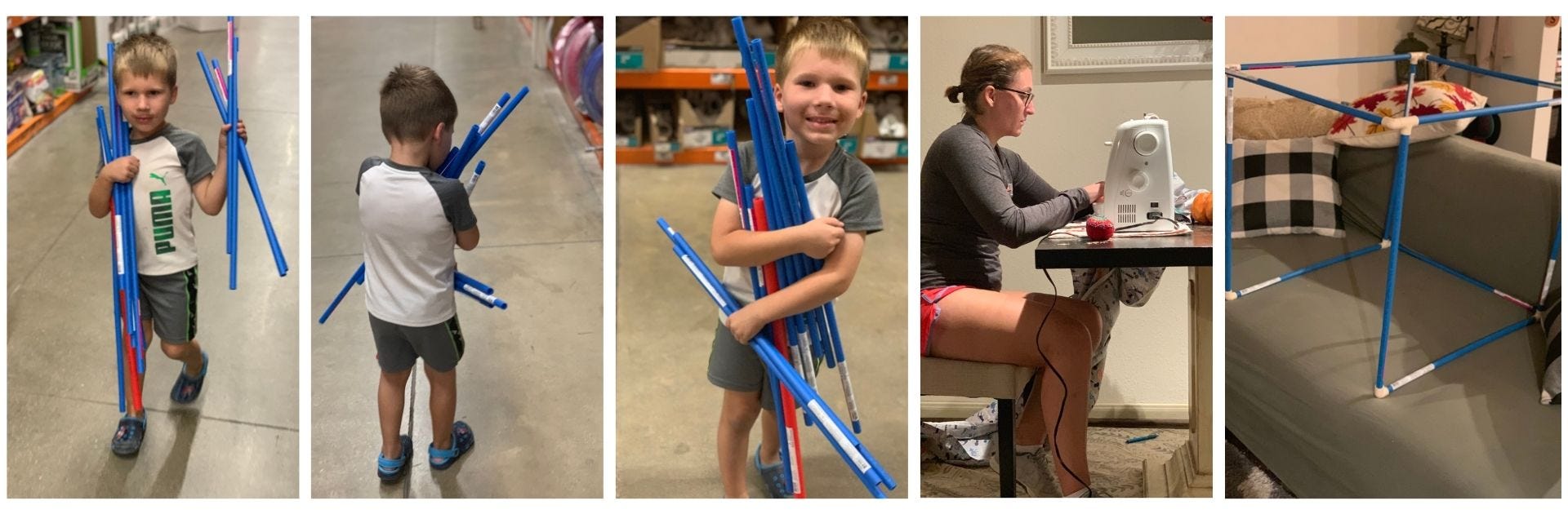
Other times, we let them run with it, and it turns out quite well, like the time I let my 5-year-old son run with a crazy idea at Home Depot.
The older worker approached us, thoroughly confused. “You’re trying to do what with these PVC pipes?” he paused, as if I were crazy. “Ma’am, that’s not what these pipes are for.”
“Shhhhhhh,” I urged. “He’ll hear you!”
My son had an idea for a tent, and far be it from me to squash it. It wasn’t your typical teepee-shaped tent. No, he wanted a square tent that would fit right over the top of a couch cushion for stability, and he wanted me to sew him a cover with a flap that opened so he could sit on the couch and watch his shows in a cozy little tent. So off we went to Home Depot for materials to build a frame.
Are We Discouraging the Very Qualities We Hope to Develop?
Think about the qualities we hope our children will possess as adults — confidence, creativity, leadership, problem-solving. Have we noticed where these qualities come from? Toddlerhood’s moments in the kitchen and at Home Depot!
Yet, it’s often the middle-school years before we grow concerned that our children aren’t taking initiative without someone telling them what to do.
But think about how often we respond in those early years between 3 and 5:
“Just let me do it.”
“That’s not how we’re going to do it.”
“We don’t have time for this right now.”
“Stop asking so many questions.”
“Why can’t you just do what I asked?”
Sometimes these responses are completely reasonable. We have schedules to keep, responsibilities to fulfill, and safety concerns that aren’t open for negotiation. But when children repeatedly encounter frustration, dismissal, or criticism whenever they propose an idea, attempt something new, or try to contribute, they may begin to draw conclusions that extend beyond the immediate situation.
My ideas aren’t very good.
It’s better to let someone else take charge.
I shouldn’t try things unless I know I’ll get them right.
In yesterday’s article, I unpacked the importance of developing initiative at this stage (versus guilt) as outlined by child developmental psychologist Erik Erikson. That doesn’t mean telling your child “not right now” will damage their confidence. Children need to learn that not every idea can be acted upon, and not every desire can be accommodated. It’s the pattern of our parenting responses that builds character, so we have to ask ourselves: Are we helping our children learn how to pursue their ideas appropriately, or are we inadvertently teaching them that having ideas is more trouble than it’s worth?
The Reward is Worth the Effort
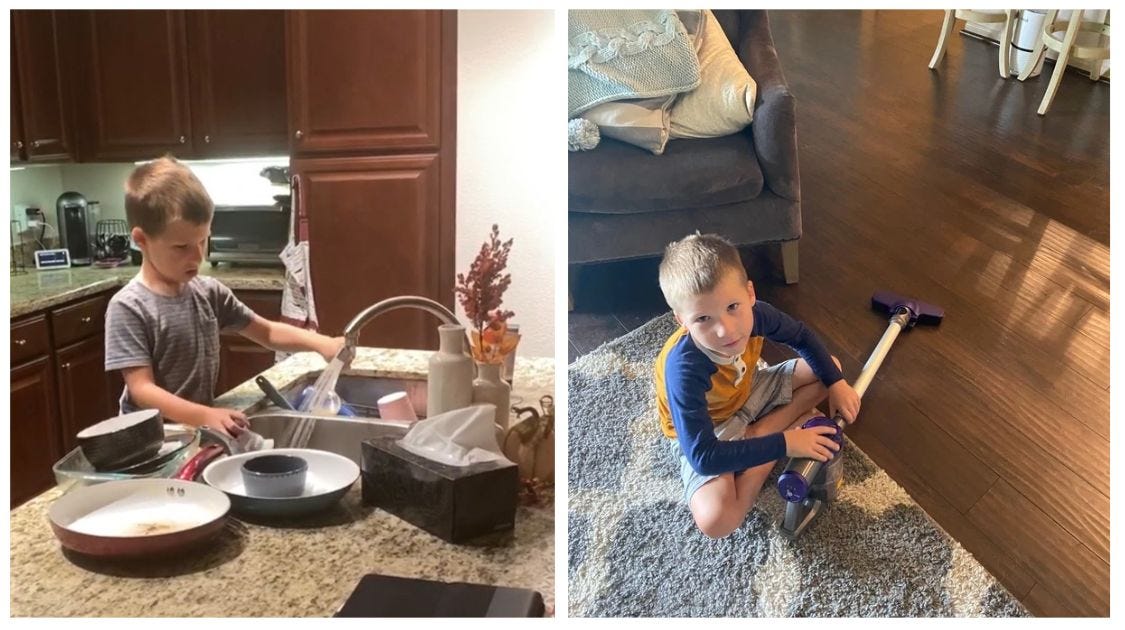
I vividly remember a day when my son was three. He wanted to wash the dishes and vacuum the floor. Not only was he sorely underqualified, but we were headed out the door for church. “Not right now, sweetie. Later.” And I meant it. As soon as we got home that afternoon, I set him up, and he set to work. Now, eight years later, his initiative brings me to tears. Literally. It was just last month that I came downstairs to find the dishes were washed. “Did you do this?” I asked my now eleven-year-old. He popped his head up over the couch. “Yeah, I knew you had a headache, so I did them for you.” Y’all, he’s an 11-year-old boy! Who does that?! I’ll tell you who: the toddler who was given a dish rag and a vacuum when he expressed interest in helping. Not at the very moment, but I circled back when the timing allowed.
Parenting with Purpose
Encouraging initiative doesn’t mean allowing children to run the show. A child who wants to lead still needs to learn cooperation. A child who wants to experiment still needs to respect safety rules. A child who wants to help still needs to learn responsibility. A child who has a wonderful idea still needs to understand that other people have ideas, needs, and priorities, too.
Without guidance, initiative can become impulsivity, bossiness, or a tendency to disregard others. But just as important is to recognize that without opportunities to take initiative, children may miss valuable practice in confidence, decision-making, and purposeful action.
Neither extreme prepares them particularly well for adulthood. Our goal is to preserve their willingness to take initiative while teaching the wisdom, self-control, and consideration needed to use it well.
And sometimes, that requires us to think differently about how we choose to respond to behavior.
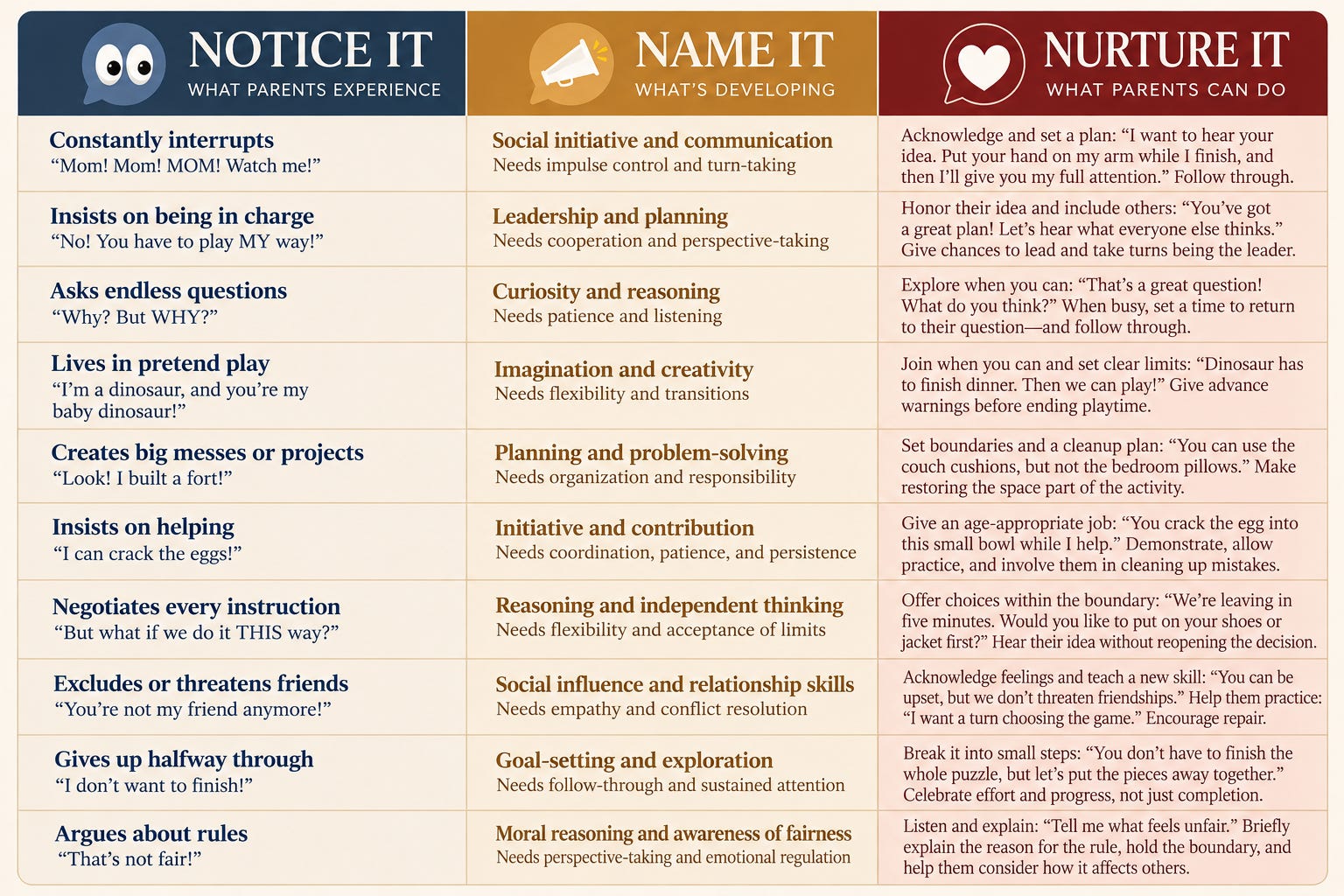
Notice It · Name It · Nurture It
When your preschooler insists on helping, interrupts with another elaborate idea, or tries to take charge of everyone’s afternoon, it’s tempting to focus entirely on stopping the disruption. But what if we could address the behavior while also developing the skill underneath it?
That’s where our three-step approach comes in.
Notice It: Recognize what your child is trying to accomplish rather than focusing on how to stop the behavior in its tracks.
Name It: Identify the developing ability and the skill they still need to learn. Is this curiosity that needs direction, leadership that needs perspective-taking, or initiative that needs patience and follow-through?
Nurture It: Provide an appropriate opportunity to practice the skill. It’s best to establish clear boundaries at the outset and then guide your child toward using that skill.
The question isn’t simply, How do I get my child to stop doing this? It’s, How can I use this moment to help my child become the person I’m hoping to raise?
Here’s what I hope we will remember the next time our child interrupts us with another outrageous idea: that little boy who wants to build a tent out of PVC pipes will one day be the teenager who sees a problem and starts looking for a solution without waiting for someone to tell him what to do. That little girl who insists on cracking the eggs may one day become the young woman who isn’t afraid to try something difficult, make a mistake, and try again.
That’s the legacy we’re building.
And if your children are already older and you recognize some hesitation to take initiative, don’t despair. There’s still time to give them opportunities to make decisions, solve problems, take appropriate risks, and experience the satisfaction of following through.

But What About the Initiative We Never Learned to Take?
What about when we are the ones who hesitate to take initiative, or don’t share our plans because we fear criticism, rejection, or losing control of what happens next?
Something happened this weekend that made me realize I sometimes approach God with that very same hesitation. I have plans. I have ideas. I have things I’m excited to pursue. But sometimes I hesitate to ask for His direction because, deep down, I’m afraid He might tell me something I don’t want to hear.
And suddenly I had to ask myself: Have I been so afraid of having my plans redirected that I’ve stopped inviting God into the planning?
Tomorrow, I want to share what happened and what the Lord revealed to me about trust, initiative, and the difference between pursuing our own plans and seeking His guidance.
Because perhaps learning to take initiative isn’t just something we’re teaching our children. Perhaps it’s something God is still teaching us, too.