


Exhaustion weighed on Amara like a 50-pound blanket. 2:17 AM. Amara trod downstairs for a cup of chamomile tea in hopes of catching a few uninterrupted hours of sleep before dawn.
She curled up with her cable-knit blanket on the sofa and sipped her tea as she considered 11-month-old Liora’s emerging sleep pattern. A 6:30 PM bedtime meant she’d sleep till 6:30 AM with rarely a nighttime awakening. But Micah and Asher’s Tuesday and Thursday soccer evenings were a different story. 6:30 PM turned into 8:30 PM, and an overtired infant meant the nights became brutal for mom and baby.
Amara had done the cry-it-out method with her older three, but a recent article on insecure attachment made her fear that approach may have contributed to their tendencies toward emotional distance now that they were five, eight, and fifteen.
Amara wanted to be responsive, but half the time she couldn’t figure out what Liora was crying about at every odd hour of the night. During the day, she was such a happy baby. What was her deal at night?
Amara was torn: Should she go into her room or not? How long should she wait before going in? Was it better to pick Liora up and rock her or simply use soothing words and pat her back? The endless questions were dizzying.
She prayed silently, Lord, why is this so hard? Am I breaking my kids? Can You just tell me what to do?
Cloud by day and pillar of fire by night, my child.
Amara placed the empty tea mug on the table as she grabbed her Bible, turning to Exodus 13.
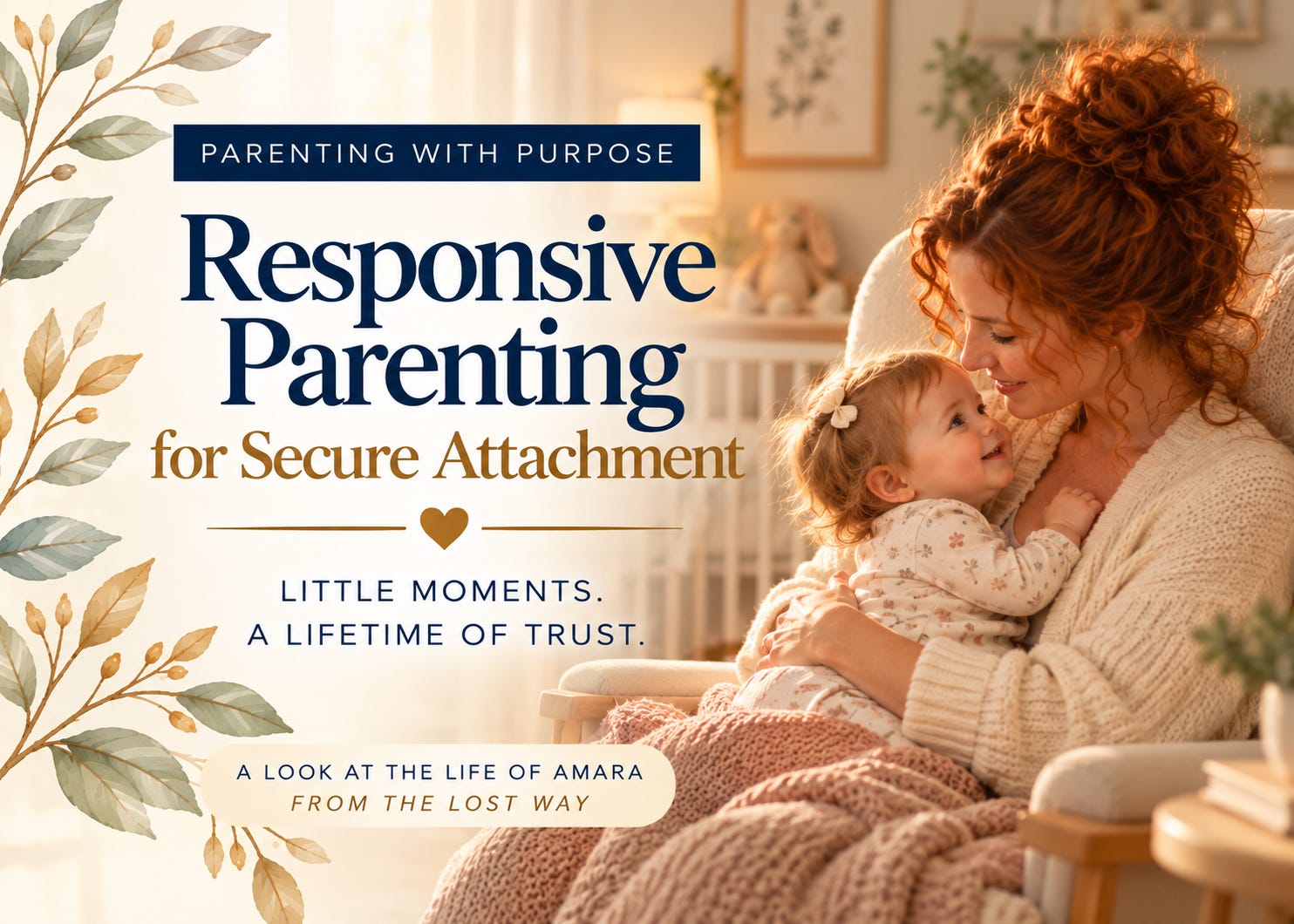
The Pressure to Get It Right
The infant months are a wild time of midnight nursings, diaper changing, swaddling, daytime caretaking, feeding, playtime, and bonding. One moment, they’re happy as can be, and the next they could be screaming at the top of their lungs. Whether it’s midnight or mid-afternoon, a million questions come to mind:
Why does my mother-in-law keep saying I’m not comforting her, I’m spoiling her?
At what point are they supposed to learn to self-soothe without co-regulation?
What’s the difference between cry-it-out, sleep training, and responsive parenting?
If I don’t breastfeed, bed-share, or baby-wear, will my child suffer from insecure attachment?
So often, the pressure to “get it right” slips in. But research shows it’s not about individual moments. It’s the pattern of attunement. The presence, the responsiveness, and the repair, even when we might miss the mark.
Yesterday’s article unpacked the importance of developing trust and secure attachment. So what does that actually look like in our parenting approach?

Responsive Parenting
Responsive parenting doesn’t mean eliminating every frustration. It also isn’t about perfectly executing a decided-upon parenting strategy. Children don’t need perfect parents. They need present ones.
That’s why responsiveness is simply about recognizing a need exists and making an attempt to respond sensitively to that need. It’s not about getting it right every time. It’s about a pattern of responses that allow a child to know they can count on us.
In the Parenting with Purpose series, I teach this pattern through four essential experiences: Safe. Seen. Soothed. Supported.
Seen: Notice the cry and consider what may be happening. Is your baby hungry, uncomfortable, overtired, overstimulated, or seeking reassurance?
Safe: Respond with calm, predictable care. Your familiar voice, gentle touch, and consistent routines help create a sense of security.
Soothed: Offer comfort that meets the the need. Sometimes that means feeding or rocking; other times, a quiet voice or hand on their back may be enough.
Supported: Allow opportunities to practice emerging skills without withholding help when it’s needed. As babies mature, they can gradually learn to settle with less assistance.
Notice what’s not there? A requirement to respond perfectly. Sometimes we’ll get it right and sometimes we won’t. But simply trying was worth way more than we recognize. And when we mess up, the repair cycle is very forgiving.
What About Self-Soothing?
Self-soothing isn’t something babies learn by being left alone with every difficult feeling. Emotional regulation develops with neurological maturation and repeated co-regulation with a trusted caregiver. Each time we respond with age-appropriate support, we help them build self-regulation capacity. It’s why comforting them isn’t spoiling them; it’s giving them the launchpad for future independence.
Which brings us to sleep training. Sleep training is an umbrella term for approaches intended to help children develop more independent sleep habits. Cry-it-out is one approach, but it’s certainly not the only one. For an older infant who is developmentally ready, parents might establish a predictable bedtime routine, put their baby down drowsy or awake, and gradually reduce the assistance they provide at bedtime. Some families choose methods that involve brief waiting periods before checking in. Others prefer gradual parental withdrawal or more hands-on soothing.
No single sleep-training method is required for secure attachment. Studies of some behavioral sleep interventions have not found evidence of long-term attachment harm, although that doesn’t establish that every method is appropriate for every infant. And none of this means ignoring hunger, illness, discomfort, or distress that calls for care.
Likewise, breastfeeding, baby-wearing, and bed-sharing aren’t prerequisites for secure attachment. Loving, responsive caregiving can take many forms. Safe sleep recommendations still apply regardless of the approach a family chooses.
The goal isn’t to produce a baby who never needs you. It’s to help your child gradually develop the confidence and capacity to manage what they can, knowing you’re available when they cannot.
What truly matters is the pattern of responsiveness over time.
Cloud by Day and Fire by Night
As Amara’s eyelids grew heavy, she went upstairs to check on Liora before heading back to bed. That’s when she noticed the warm, fiery glow of the cloud-shaped sleep machine next to Liora’s crib.
When the Israelites left Egypt, the Lord didn’t simply tell them where to go and expect them to figure out how to get there. His presence remained constant, even as His people's needs and the challenges they faced along the way kept changing.
“And the LORD went before them by day in a pillar of cloud to lead them along the way, and by night in a pillar of fire to give them light.” — Exodus 13:21 (ESV)
And isn’t that what we’re trying to do as parents? Our infants may need us to rock them to sleep today, but eventually they’ll learn to fall asleep without us. They may need us to comfort them through every unfamiliar experience now, but eventually they’ll learn to face new challenges with confidence.
We don’t have to get every response right. We just need to be present, attentive, and responsive. When we don’t know what to do, we can turn to the Holy Spirit for wisdom and direction, just as Amara did. The Holy Spirit is our cloud by day and fire by night, just as we get to be a guiding presence for our kids, too.
Parenting isn’t about being perfect. It’s about being present. And once we adopt that posture, parenting not only becomes easier to navigate; it’s actually a whole lot more fun!
Join Us for Parenting With Purpose
Substack weekly wisdom posts will highlight core concepts in child development, but when you’re ready to go deeper, you can join the Parenting with Purpose series.
We’re offering a virtual option starting Tuesday, November 3, from 6–7 PM Central, with recordings available if you can’t attend live.
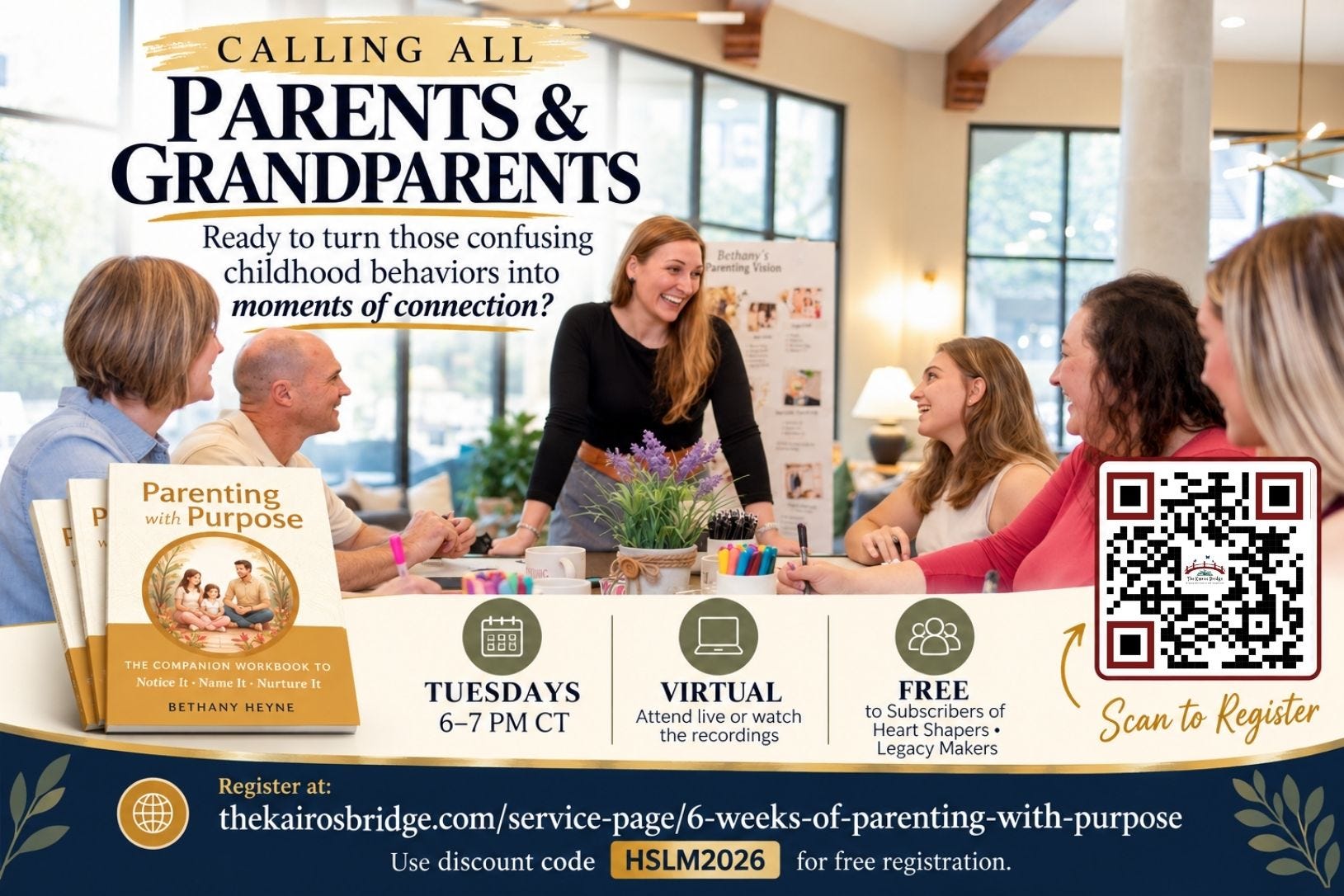
Register for Parenting with Purpose
Coming tomorrow in Legacy Formation: What happens when we grow up believing we can’t depend on anyone but ourselves? And how might the independence we’ve learned to pride ourselves on be teaching our children that asking for help is a weakness? We’ll uncover the patterns we may be passing down without even realizing it—and why it’s never too late to change them.
References:
Responsive parenting, attachment, and spoiling
Bell, S. M., & Ainsworth, M. D. S. (1972). Infant crying and maternal responsiveness. Child Development, 43(4), 1171–1190. https://pubmed.ncbi.nlm.nih.gov/4643768/
De Wolff, M. S., & van IJzendoorn, M. H. (1997). Sensitivity and attachment: A meta-analysis on parental antecedents of infant attachment. Child Development, 68(4), 571–591. https://doi.org/10.1111/j.1467-8624.1997.tb04218.x
Sleep training, self-soothing, and attachment
Bilgin, A., & Wolke, D. (2020). Parental use of ‘cry it out’ in infants: No adverse effects on attachment and behavioural development at 18 months. Journal of Child Psychology and Psychiatry, 61(11), 1184–1193. https://doi.org/10.1111/jcpp.13223
Gradisar, M., Jackson, K., Spurrier, N. J., Gibson, J., Whitham, J., Williams, A. S., Dolby, R., & Kennaway, D. J. (2016). Behavioral interventions for infant sleep problems: A randomized controlled trial. Pediatrics, 137(6), e20151486. https://doi.org/10.1542/peds.2015-1486
Price, A. M. H., Wake, M., Ukoumunne, O. C., & Hiscock, H. (2012). Five-year follow-up of harms and benefits of behavioral infant sleep intervention: Randomized trial. Pediatrics, 130(4), 643–651. https://doi.org/10.1542/peds.2011-3467
Bedtime routines and safe sleep
Mindell, J. A., Telofski, L. S., Wiegand, B., & Kurtz, E. S. (2009). A nightly bedtime routine: Impact on sleep in young children and maternal mood. Sleep, 32(5), 599–606. https://doi.org/10.1093/sleep/32.5.599
Moon, R. Y., Carlin, R. F., Hand, I., Task Force on Sudden Infant Death Syndrome, & Committee on Fetus and Newborn. (2022). Sleep-related infant deaths: Updated 2022 recommendations for reducing infant deaths in the sleep environment. Pediatrics, 150(1), e2022057990. https://doi.org/10.1542/peds.2022-057990