


I remember sitting in the hospital room shortly after my son was born, with my parents on the nearby sofa, eager to hold their new grandson.
He began to cry when my dad said, “Isn’t that just the most precious sound?”
Precious? Not to me. Every wail seemed to make my insides contract in pain.
Eleven years later, I still feel that way.
Just this week, we were hiking through Zion National Park when a family ahead of us carried their crying toddler along the trail. Perhaps she was hungry. Maybe she needed a diaper change. Or perhaps she was simply as miserable as the rest of us, soaking wet in 40-degree windchill. Whatever the reason, I desperately wanted to put some distance between us.
My son cocked an eyebrow. “Why does it bother you so much when babies cry?”
I explained how difficult it had been to hear him cry as an infant. Back then, I saw his tearful cries as a discomfort to solve, and every time he kept crying, I felt like a failure. I only wish someone had explained the more important connection between my child’s cries and my response and how it would affect later stages of life.
Our Response to a Baby’s Cry
Crying is how an infant expresses their needs at this stage of life. They may be hungry, lonely, or uncomfortable in their poopy diaper.
Clinging isn’t necessarily unhealthy dependence. Crying isn’t necessarily manipulation. Sometimes these behaviors reflect an attachment system doing precisely what it was designed to do: seeking safety and connection.
We may not always know what’s wrong or get it right on the first try. That’s okay. What matters more is simply that we were attentive, responsive, and supportive.
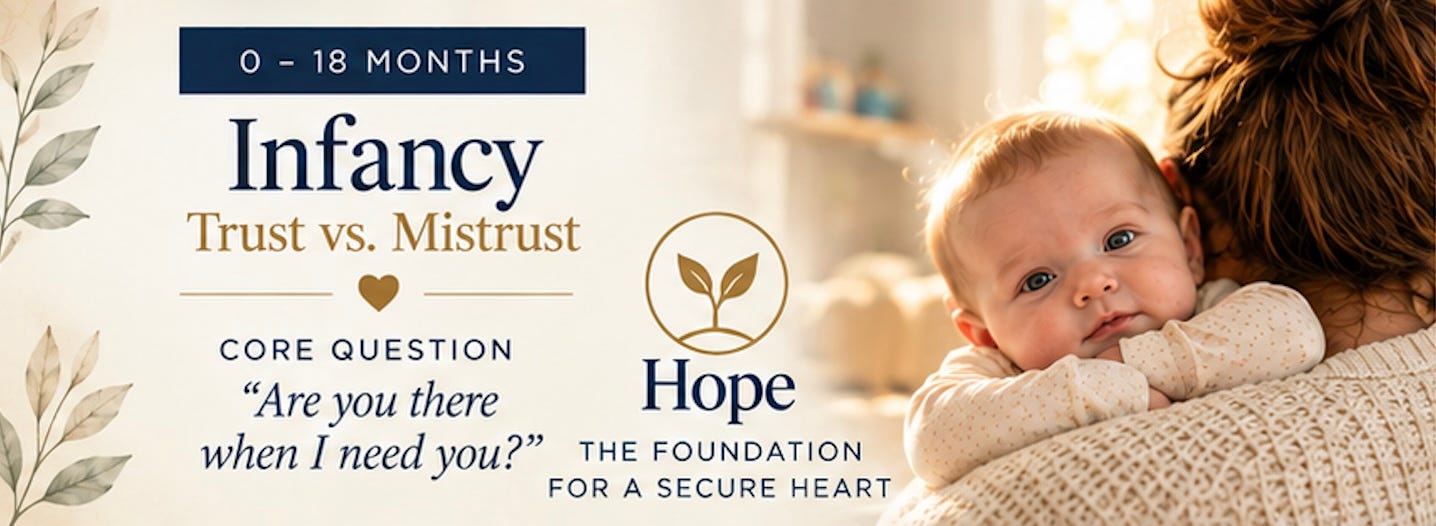
Why? Because the name of the game at this stage of life is simply about developing trust. It’s the first of eight core stages of psychosocial development, as outlined by psychologist Erik Erikson, and it’s the foundation for all future stages, five of which happen in childhood.
Trust vs Mistrust
Sure, an infant is crying for milk, a diaper change, or meaningful interaction, but behind every cry is a deeper question:
Can I trust someone in this world to help me when I need them?
When caregivers respond with reasonable consistency and sensitivity, infants begin developing a foundation of trust which supports secure attachment.
From this, the virtue of hope emerges. And hope becomes one of the earliest building blocks of resilience. It’s the developing confidence that when life gets difficult, someone will be there to help us through it.
Researchers John Bowlby and Mary Ainsworth found that children who experience attentive, sensitive, and responsive caregiving are more likely to develop secure attachment. These children learn that their caregiver is a reliable source of comfort and a secure base. This gradually helps them build the confidence necessary to learn, explore, and play.
But when caregiving is consistently unresponsive, unpredictable, or frightening, children may develop patterns of insecure attachment:
Anxious (ambivalent/resistant): Children may become intensely distressed by separation and struggle to be comforted even when their caregiver returns.
Avoidant: Children may appear unusually independent, minimizing their expressions of distress or avoiding closeness when their caregiver returns.
Disorganized: Children may display contradictory, confused, or apprehensive behaviors toward the very caregiver they turn to for safety.
A Pattern of Hope
But a single interaction doesn’t establish an attachment style. It’s built by patterns of parental responsiveness over time.
When we drop our infant off with the babysitter and they cry, it doesn’t necessarily mean they have insecure attachment. Perhaps they simply haven’t developed object permanence (the awareness that mom or dad still exists, even when they cannot see them), or they are in the 9- to 13-month stranger-danger phase. The answer isn’t to eliminate every separation. It’s to help them experience that separation doesn’t mean abandonment. Predictable routines, reassuring goodbyes, sensitive caregivers, and warm reunions help build the expectation over time that “Mom or Dad will return; I am safe to play and explore until then.”
When an infant cries during a nighttime awakening, we may go into the room to offer assurance, check their diaper, or feed them if they’re hungry. Our response depends on the need. Sometimes we’ll get it right; other times we’ll miss it. The importance is that we are present and responsive.
We build this trust in those little moments when we respond to their cries. That trust becomes the foundation for exploration, learning, and play, which eventually leads to independence in the next stage of life.
But first, they must develop trust.
Am I Responding the Right Way?
But perhaps you’re wondering whether you’re responding the right way. Whether you’re comforting too much or too little. Whether you’re somehow getting it wrong. This is where we can become so wrapped up in trying to be perfect parents that we get in our own way.
The apostle Paul reminds us of the Lord’s words: “My grace is sufficient for you, for my power is made perfect in weakness.” — 2 Corinthians 12:9 (ESV)
God doesn’t require perfection from us. When we don’t know whether our baby needs a bottle, a diaper change, a nap, or simply to be held, we can turn to the Holy Spirit for wisdom and strength.
Secure attachment isn’t built through flawless parenting. It’s built through a consistent pattern of sensitive, responsive care, including the willingness to recognize when we’ve missed the mark and reconnect.
It’s not about being a perfect parent. It’s about being present.
And every time we respond with warmth, reassurance, and care, we’re helping our children build something that will carry them far beyond infancy: trust that nurtures hope, and hope that lays the foundation for resilience.
Deep Dive Into the Parenting with Purpose Series
Want to understand what’s really behind your child’s behavior and how to respond with confidence?
That’s exactly what we explore in the 6-week Parenting with Purpose series. We’re offering a virtual option starting Tuesday, November 3, from 6–7 PM CDT/CST, with recordings available if you can’t attend live.

Register for Parenting with Purpose here.
Coming tomorrow: Can comforting a crying baby actually spoil them? And how do we help children learn to soothe themselves without compromising the security they’re still developing? We’ll explore what it means to be a responsive parent when we don’t always know the right response.
The line I'd underline is the one about reconnecting when we've missed the mark. Ed Tronick's research found that even attuned parents and infants are out of sync much of the time. Security grows from the repair that follows. That's freeing news for any parent who once read every cry as a verdict on themselves.
Thanks for sharing! 👍🏻🙌🏻