


A scene from The Lost Heart Song. New here? Start here to read from the beginning.

Recap: Last week, Evie was still in Boston, wrestling with the fallout of the academic committee’s decision to side with her academic rival, Samantha. This week takes us 8 weeks forward, to Israel, where Evie is begrudgingly deep in research on King David’s lost melody.
Evie stared too long into the steam curling from her espresso.
Samantha’s voice still echoed in her mind from the phone call she overheard in the library. The same woman whose lies had uprooted Evie’s research. Why was Samantha here in Kiryat Oriah instead of Rome? And what was she hiding? Whatever it was left Evie with the dreaded sense that she was coming after her work. Again.
Holly studied her quietly across the table. “What are you feeling?” she asked gently.
Evie opened her mouth, only to realize every answer she had was an analysis: “I think she’s hiding something.” “I think this is dangerous.” “I think none of this makes sense.”
Holly smiled softly, the way a mentor does. “Those are thoughts. What are you feeling?”
Evie looked down at the table. “…Angry, maybe.” She paused. “And probably more afraid than I care to admit.”
Holly reached across the table and rested her hand over Evie’s.
“Anger often tells us something feels unjust. Fear tells us we need protection.” She paused. “God never shamed people for fear in Scripture. He met fear with His presence, inviting them into faith, and then gave wisdom for what to do next.”
Something in Evie’s chest loosened. Not because the problem disappeared, but because someone finally helped her understand what was happening underneath it.
Evie was never a big fan of emotions, but she began to wonder whether emotional honesty was a path toward healing, redemption, and even freedom.
Many of Us Were Never Taught What to Do With Emotion
Some of us grew up learning that emotions were too dramatic. Some learned emotions should be ignored. Others learned we should follow our emotions
And many of us became adults carrying an internal voice we didn’t realize was formed long ago.
Sometimes that voice says, “Stop overreacting.” Or, “Just move on.” Or even, “If I feel it strongly enough, it must be true.”
The problem is not that we have emotions. The problem is that many of us were never discipled in what to do with them.
And before shame starts whispering that you’ve somehow ruined your children because you’re learning this late, hear this clearly: There is no condemnation in Christ.
Not for the parent who didn’t know. Not for the grandparent trying to repair what they passed down. Not for the exhausted mother realizing her own childhood still echoes in the way she responds today. Not for the father trying to figure out how to connect best with his children.
Every generation learns something new that can become a blessing to the next generation.
And the fact that you are here reading this? Reflecting? Wanting to grow? That is the exact opposite of failure. That is love.
Love for your children. Love for your family. And ultimately, love for Jesus.
Growth often begins the moment we become aware enough to say: “Lord, teach me a better way.”
Psychologist John Gottman’s research found that children thrive when adults help them process emotions rather than suppress or surrender to them.
As I studied emotional development, attachment research, and Scripture over the years, I kept seeing the same pattern emerge.
It became the framework I now call "Notice It · Name It · Nurture It."
It captures the essence of positive parenting postures found in the child psychology and development literature and models the pattern by which Scripture shows God’s relationship toward us.
Emotion Coaching in Scripture

When our children feel overwhelmed by big emotions, there’s a surprising parenting lesson hidden in Scripture for us.
By now, you have realized King David was a highly emotional individual. To his credit, he often took those emotions to God, except this one time when his anger nearly got blood on his hands.
In 1 Samuel 25, David became so angry after being insulted by a man named Nabal that he was ready to take revenge and kill him.
That’s when a woman named Abigail stepped in. She’d noticed his anger. She didn’t confront David’s anger with harsh words, nor dismiss them, or shame him.
Instead, Abigail did something remarkable. She named his feelings, showed empathy for his situation, and gently helped him see the future consequences of his actions.
She brought calm, spoke wisdom, and helped David pause long enough to process his anger and make a better decision. She nurtured a healthier response.
David recognized her wisdom and actually thanked her for stopping him from making a terrible mistake.
That’s what emotion coaching can look like.
A Different Way Forward This Week

1. Notice It:
Remain emotionally attuned so children feel seen before they are corrected. Children regulate best when they first feel emotionally safe. This is the heart of healthy attachment, and God demonstrates it in countless ways (see Genesis 2:18, 3:9, 16:13, Exodus 3:7, Luke 19:1-10, John 4:4-26)
Instead of: “Stop crying.” “You’re fine.” “Calm down.”
Try: “Something feels really big right now.” “I can see this is hard.” “Let’s slow down together.”
2. Name It:
Verbal grounding helps children identify emotions, thoughts, and underlying needs with clarity and empathy. God modeled this approach in naming what His people needed (Genesis 2:18, 1 Kings 19:1-8, Matthew 11:28-30, Mark 4:40, John 4:13-14)
Instead of: “Why are you acting like this?”
Try: “You seem frustrated.” “I wonder if part of this feels scary.” “That looked disappointing.”
Often, the first emotion we see is not the deepest one beneath the surface. Anger may be masking fear. Withdrawal may be masking shame. Defiance may be masking insecurity. As children gain emotional language, they develop emotional awareness, communication skills, and clearer thinking.
3. Nurture It:
Help children move forward with wisdom, boundaries, regulation, and problem-solving. God meets us in our every need. (Isaiah 66:13, Exodus 16, 1 Kings 19
Instead of: “Quit acting like that.”
Try: “That makes sense.” “Let’s figure out what would help.” “What’s the next right step?”
Nurturing doesn’t mean letting emotions lead everything. It means helping children learn what to do with what they feel. Over time, children internalize something powerful: “My feelings matter, but they are not meant to lead my life alone.” Emotions become information, not dictators.
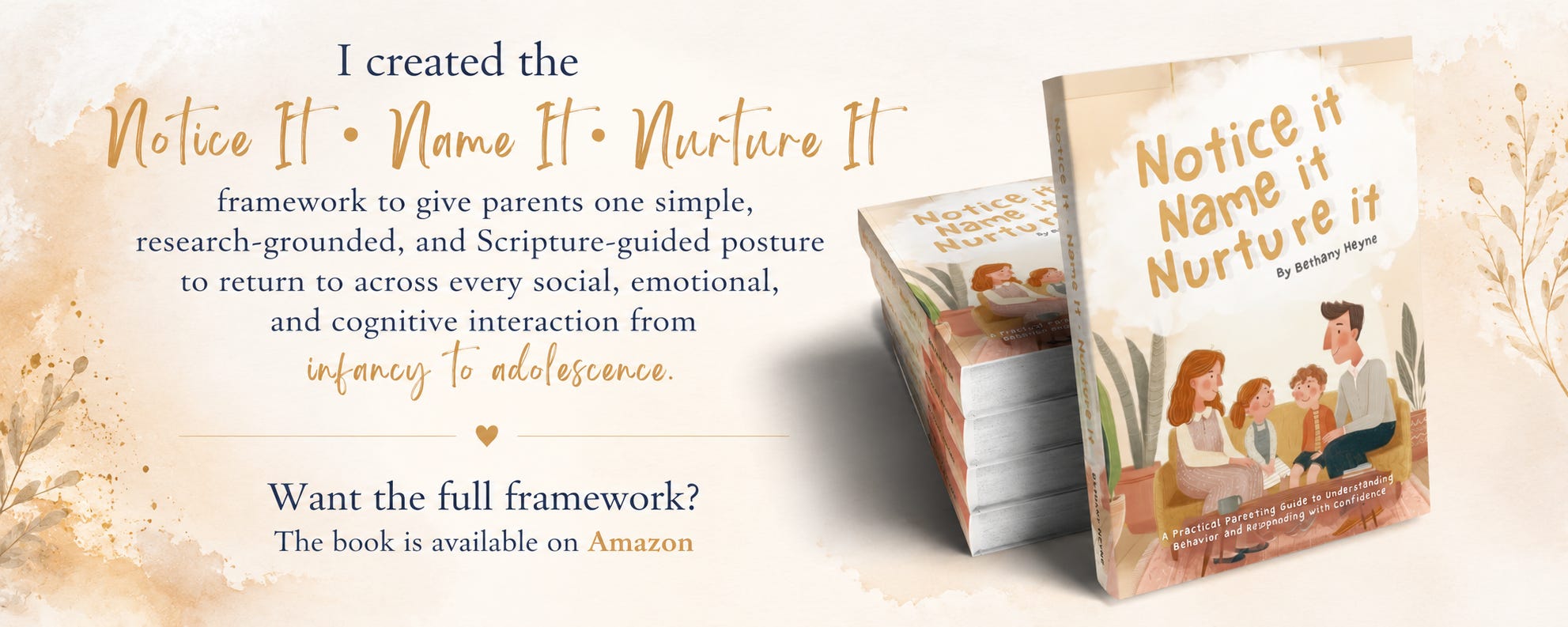
Want the full framework? The book is available on Amazon: Notice It · Name It · Nurture It
Maybe your parents never helped you process emotions. Maybe you’re not sure how to help your children process their own. Maybe you’re realizing for the first time that your own childhood still echoes in your parenting today.
But Jesus is still meeting people in emotions now, just like He did then. And healing begins by allowing yourself to become a supported child of God, too.
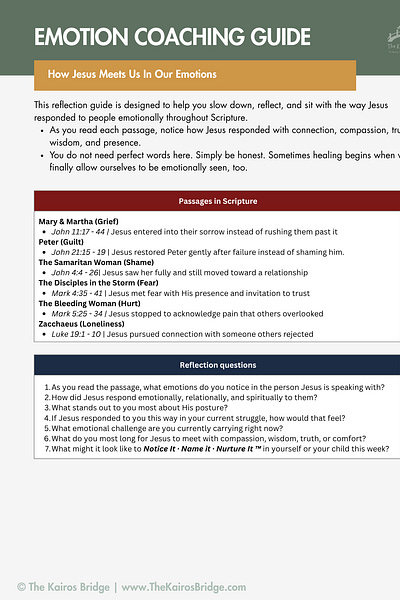
This week’s companion reflection guide walks through each Gospel story above and includes space to:
Read the Scripture passages slowly
Reflect on how Jesus responded emotionally to people
Consider how you would have felt in their place
Identify a current emotional struggle in your own life
Pray honestly about how you long for Jesus to meet you in it
Because sometimes spiritual growth begins with a simple realization: Jesus is not asking us to become less human. He is teaching us how to bring our humanity to Him.
This 3-step framework -- notice it, name it, nurture it -- is such wise counsel for parents dealing with their young children's emotions. And those of us adults who missed out on this kind of attentive parenting can use these same steps to better understand and process our own emotions by becoming more aware of what they are, when they show up, and how to process through them in a healthy way. It's also really useful for supporting others going through emotional pain to feel heard, understood, and helped. I love this Bethany!