


We’ve all said it.
Use your words.
Your four-year-old melts down when you serve triangle-cut sandwiches instead of square ones. Your eight-year-old lashes out at her brother over a genuine mistake. Your teenager storms off in a huff after you’ve asked one too many questions.
“Use your words” is good advice. And it’s the right instinct for social, emotional, and cognitive growth. But it’s like asking a child to read a chapter book when they haven’t even learned their ABC’s or how to read.
Do they have the emotional vocabulary?
Do they know how to name their need?
If the answer to either of these is no, then queue the waterworks, grunts, groans, huffs, puffs, and all other outward wordless displays of frustration.
What “Use Your Words” Actually Requires
When we say “use your words,” we mean we want them to express their feelings clearly: I feel left out. I want a turn. I don’t like this. This seems unfair.
As they grow and mature, we want them to communicate what they need or want and then take steps toward healthy problem-solving.
But it’s a process, and it starts with something as basic as learning their ABCs.
Step one: They need a word for the feeling itself.
Not a solution word. An emotion word. Words like happy, sad, and mad around the age of four are just the beginning.
Nuanced words like anxious, embarrassed, overwhelmed, and disappointed don’t arrive on their own. They have to be taught.
The child who acts out or simply shrugs when life gets hard doesn’t yet have the emotional vocabulary they need. And many times, it’s because they haven’t been taught it yet.
Step two: They need a word for the need behind the feeling.
Adults do this so automatically that we don’t even realize it. When we call a friend after a hard day, we don’t lead with a solution. We say, “I am so angry. I helped her, and then she took all the credit”.
You name the feeling and the need that was violated.
Only then can the logical brain have space to problem-solve.
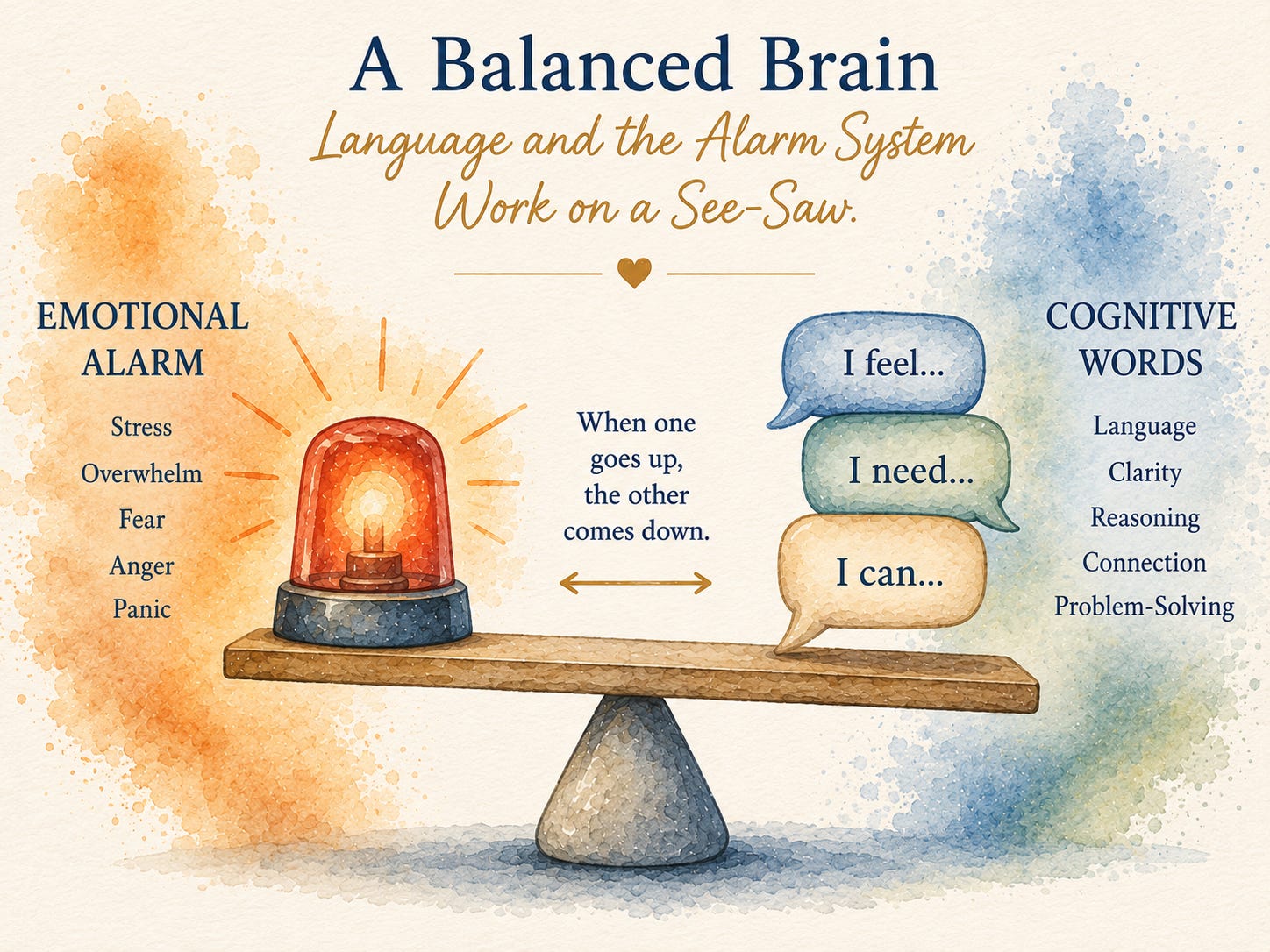
Your child needs help building the same sequence. Because without words, the brain’s alarm system takes over faster than words or thoughts can process, and suddenly, logic and words are forced offline.
But researchers at UCLA found that simply naming an emotion out loud reduces that alarm response by up to 30%, because language and the alarm system run on a biological seesaw. When one activates, the other quiets.
This means when you kneel down and say, “You seem so disappointed. I know you were really counting on that,” you are handing your child’s brain words that it can use the next time they feel this way.
David. Saul. The Cave. And the parts we miss about what led up to it…
We often read 1 Samuel 24 and think of David’s response as pass/fail.
Saul enters the cave, alone and unaware of David’s presence. David’s men encourage him to end the life of the man who had hunted and tormented him for years. Fear, sadness, anger, and loneliness all come to a head and could potentially be solved by ending one man’s life…
But David showed self-control.
We applaud David. “Test passed. Well done. Moving on.”
But no test is truly passed in a single moment. It is all the moments that lead up to it that result in successful submission to God’s commands.
Before the cave, David practiced processing his emotions:
He constantly named his feelings out loud to God
And beneath each feeling, he made his needs and desires known to God
By the time David stands in that cave, he doesn’t arrive as a man who doesn’t feel rage. He arrives as a man who has already processed it, across years, in the wilderness, in songs.
The true solution, to cut Saul’s robe, becomes clear only because steps 1 and 2 were already ingrained in his brain.
Start Training Your Kids for Emotional Regulation This Week
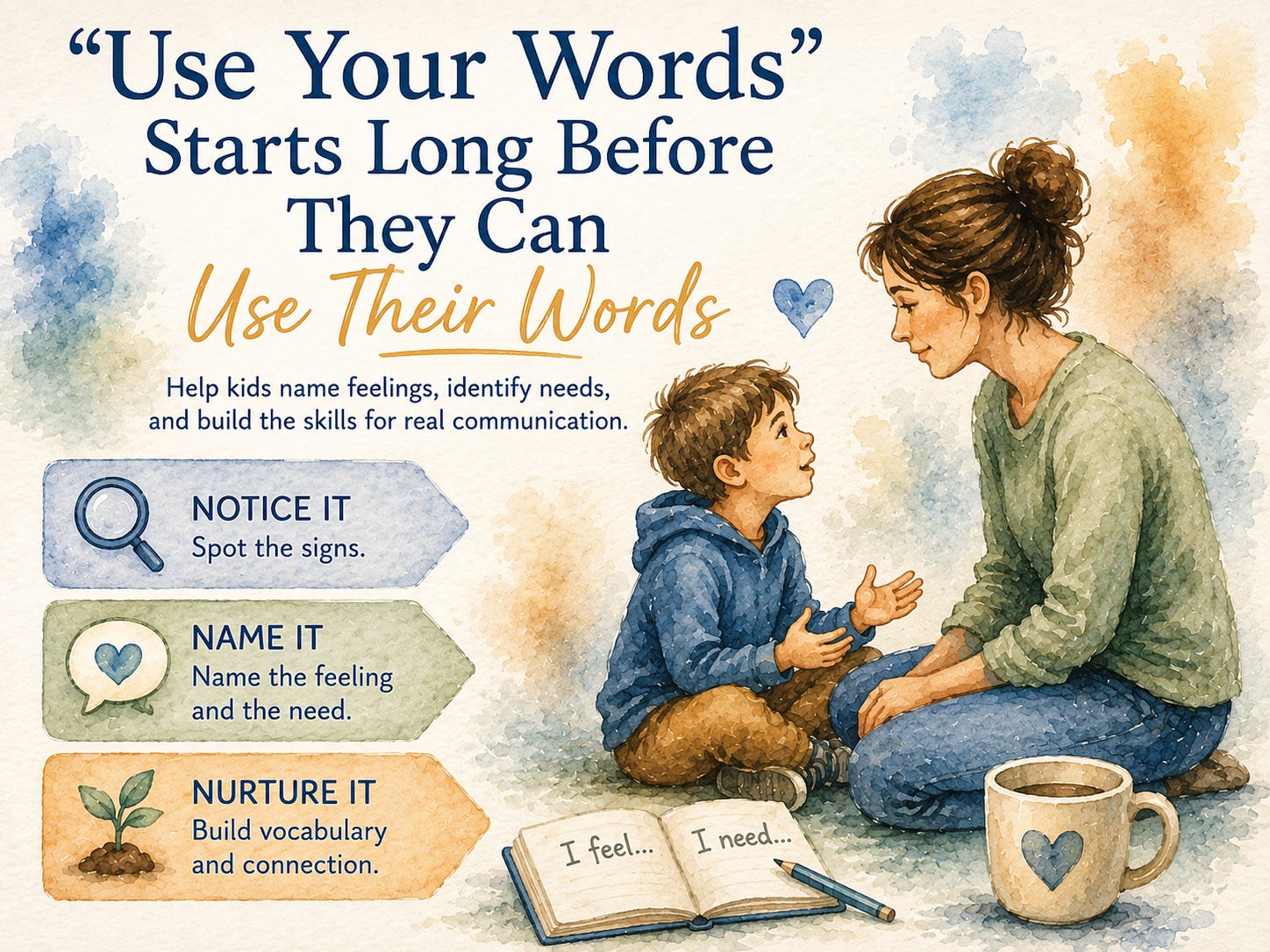
Notice It. Watch for the climbing voice, the tight jaw, the pooling tears. This is the brain’s alarm system getting ready to take over. Get on eye level, be present with them, and start naming what you see.
Name It. Ask them to name the feeling and the need.
If they don’t have the feeling words yet, then observe their bodily cues: “You look angry. You seem sad. Are you feeling lonely?” It’s just a simple sentence, but it starts to give them the vocabulary they need for this present moment and the ones to come.
Once the emotion words are out, their brain is more likely ready to talk about logic and needs: “Do you want a hug? Do you want me to listen to your side of the story? Do you want me to help you fix the project?” It doesn’t have to be solved in the moment. Just name it.
Nurture It. Remember that the best training ground is when things are calm. Practice naming feelings at the dinner table, during story time, in the car, or at bedtime. Offer your own words, too, so they can see how you handle emotions. Something as simple as “I felt embarrassed today when I was late to pick you up” or “I was really scared when you ran away from me on the playground.”
These moments build capacity on an ordinary Tuesday, so when the challenge arrives on Wednesday, they are ready for it!
We designed Emotions and Biblical Truth Charades to help teach these truths during family game night. Grab your copy on Amazon!

Easy cards help kids learn to recognize and name emotions based on body sensations and context clues
Medium cards help kids learn to name the needs behind each emotion
Hard cards help kids learn the risk of ignoring emotions and the beauty of honoring our God-given emotions
Biblical Bonus cards function like Scripture memory verses about each emotion
Don’t miss next week!
I’ll be unpacking the secret to helping kids stay flexible when plans change!
I’m an adult and sometimes this is still hard for me. I love how you call my zero to one-hundred emotion barometer “brains alarm system”.
I was on a podcast last week talking about that very moment with David. His men were disgruntled because he didn't make his move when the situation presented itself. When David was asked why he didn't do anything, David pointed to what God wanted him to do. Let us point to God when we feel like are going to lose our cool. Let us point our kids back to God when they feel they are going to lose theirs as well.