


Part 1 of 2: The Deep Roots of Lost Motivation
Amara’s stomach turned as she and Jonah climbed the ornate steps of their son’s school. She slowed as unease simmered in her chest; Jonah reached back for her hand.
“I’m sure it will be fine, dear. Let’s just hear them out. Maybe they have some ideas.”
Amara tried to remain objective as she sat before the row of teachers and scanned the sheet of paper in front of her: C, C, D, F. Then there was the benchmark score: 33rd percentile in English Language Arts and 83rd percentile in Math.
Asher had been an A/B student last year. But this year, she’d practically watched his motivation fade before her eyes. Every morning was tearful dread. Every afternoon was the insurmountable task of homework. The content didn't seem beyond his abilities. Something else was wrong because over time, he just stopped trying.
What had made this year so different?
Amara tried to focus on what the teachers were saying. But thirteen minutes had passed, and Amara was growing impatient with the seemingly endless account of her son’s academic struggles without a proposed solution.
Tears pricked her eyes as she replayed Asher’s comment from last night: “Mom, it doesn’t matter how hard I try. I ask for help, but she gets annoyed. I’ve been going in early every day to sharpen pencils, clean erasers, and then ask for help with homework. Anything I can do to make her like me and want to help me. But nothing works. Plus, she’s always bragging about how perfect Isabelle is, so what’s the point?”
Amara cried herself to sleep that night, thinking about all her son had been wrestling with.
Why, God? We pray for supernatural favor every day! You did it for Daniel. Why not for Asher?
As the meeting drew to a close with little in the way of solutions or suggestions, Amara held back tears. “Thank you,” she said. “We’ll look into a formal assessment of his learning.” With that, Amara turned to leave before she said something she’d regret.
Jonah was hot on her trail. “What are you talking about?”
“Cognitive testing,” Amara snapped. “Something doesn’t add up. He’s bright, but his grades say otherwise.”
That Saturday, Asher completed three hours of cognitive testing. A week later, Amara and Jonah sat across from the educational psychologist who explained the results.
“Asher is a bright kid, with exceptional strengths in several areas of reasoning and problem-solving abilities that support math and science. While those skills are off the charts, his other cognitive abilities are developing more typically for his age. That uneven profile can create frustration and a sense of defeat in a child.”
After outlining targeted support to strengthen the areas where he struggled, she asked, “Are you willing to consider an environmental change?”
Amara looked at Jonah, perplexed. “What do you mean?”
“I suspect Asher’s low motivation is less about his actual capabilities and more about some aspects of Asher’s current environment that seem to be working against him.”
Amara dropped her gaze. “We’ve been on the waitlist for another school for three years now, mainly in hopes of cutting down on our long commute. We’ve prayed tirelessly, night and day, but we seem to lose the lottery every year.”
The psychologist shook her head as she slid two flyers across the desk. “Check this out instead: a brand new school is opening in August, just 5 minutes from you. With what I’ve heard of the classroom culture and teacher-student relationships at other campuses, it’s better suited for Asher. I’ve also included a flyer about the psychology of child motivation.”
Before Amara could respond, one line caught her attention and filled her with dread: Waitlist Available. Apply for the Lottery Today.
“Great, another lottery and another year of tearful prayers,” she said under her breath.
What’s Going On?
Few things leave a parent feeling more helpless than watching their perfectly capable child stop trying. The questions pile up: Why won’t he even try? Is she just being lazy? Why is he so unmotivated? I know she’s capable, so what’s going on? What if this continues through middle school and high school? How will this affect their mental health?
It’s tempting to urge them to try harder and apply themselves, but that’s about as good as asking someone to bake a cake with missing ingredients or start a lawn mower without gas or a functioning spark plug.
When a child struggles with motivation, these three psychological needs offer a good place to start looking for answers.
Childhood Development: Industry vs Inferiority
So far in this series, we’ve covered trust developed in infancy, autonomy developed in toddlerhood, and initiative developed in early childhood.
Now your child is between the ages of 6 and 12, and another developmental challenge has entered the scene. Erikson called it industry versus inferiority.
Industry refers to a child’s growing sense that they can learn, master skills, accomplish meaningful tasks, and contribute.
When repeated experiences instead leave children feeling inadequate or less capable than others, feelings of inferiority can develop.
Elementary school is an onslaught of experiences that tell a child about their capabilities: grades, sports try-outs, hobbies, and peer connections or conflicts. While discovering what they’re good (or bad) at, they also notice what others are good at, and the comparisons set in.
The child who once proudly showed you every drawing doesn’t anymore, because they’ve seen how well their friend draws. The child who loved soccer may decide they’re terrible and stop playing, all because they didn’t make it onto A team last year. The child who once tackled math problems enthusiastically may begin declaring, “I’m stupid,” because their classmates finish first.
Suddenly, the 3- to 5-year-old who was eager to take initiative becomes more hesitant, withdrawn, and less confident. We may see it as a lack of motivation, but what really is motivation?
The Makings of Motivation
Psychologists Ryan & Deci offer a helpful framework for understanding what a person needs to feel motivated: autonomy, capability, and relatedness.
Do you see how these developmental stages connect? During infancy, we explored the foundations of trust and connection. In toddlerhood, we watched children begin asserting their independence. Early childhood brought growing initiative, and now, during middle childhood, children are developing a stronger sense of competence.
These needs don’t suddenly appear at a particular age. They develop together, and our children’s everyday experiences can continually strengthen or undermine them.
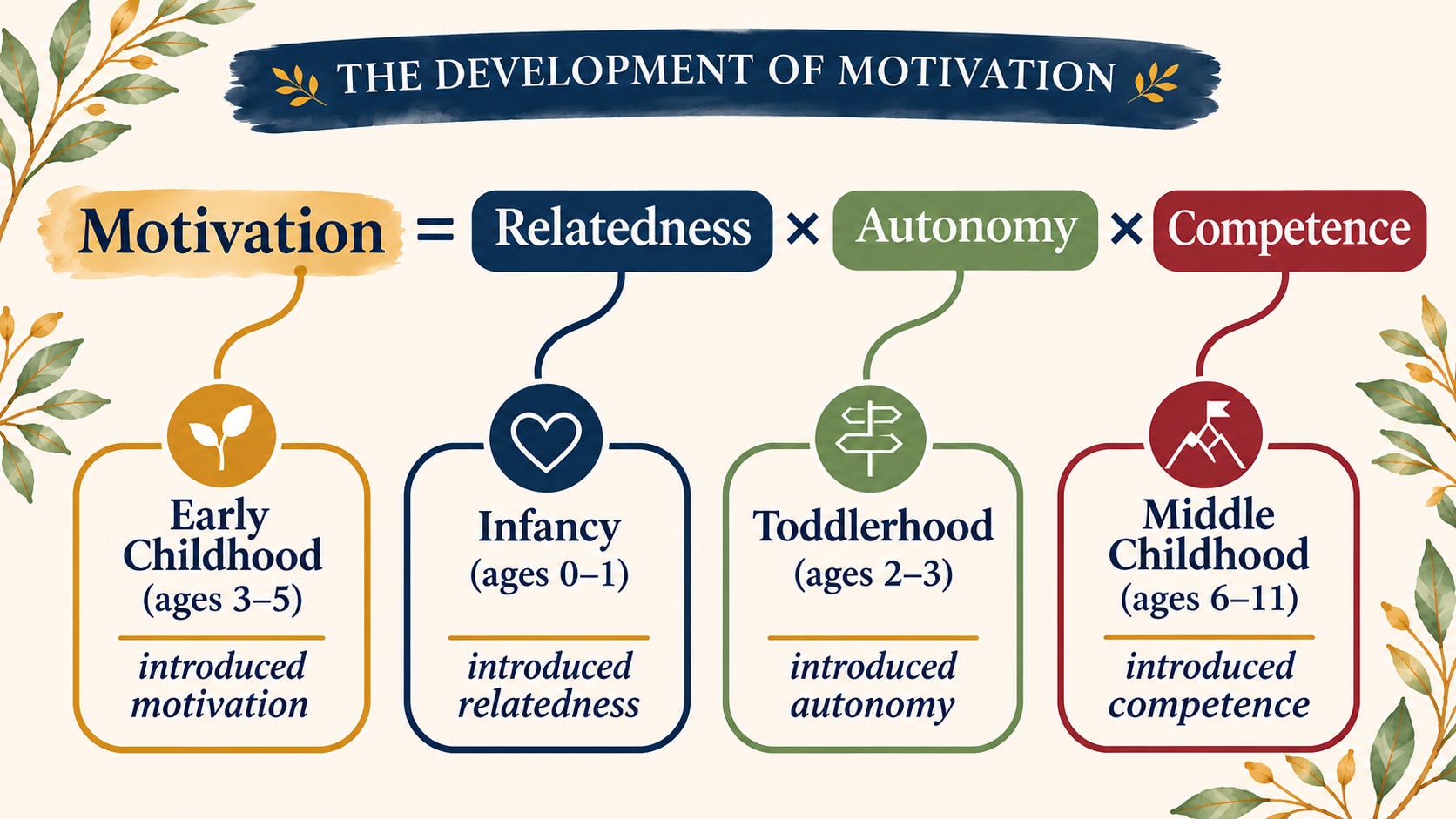
Motivation isn’t simply a matter of willpower. Several factors influence it, including three psychological needs that work together: autonomy, competence, and relatedness. Motivation isn’t a single element. Previous stages of development introduced each one, but continual daily interactions are needed to reinforce it.
Autonomy asks, “Do I have some ownership over what I’m doing?”
Competence asks, “Do I believe I can succeed?”
Relatedness asks, “Do I feel accepted, supported, and valued?”
Children are more willing to take risks and persist through difficulty when they feel connected to the people guiding them. A child who believes a teacher is rooting for them may approach a difficult assignment very differently from a child who believes that teacher dislikes them.
Consider Asher’s attempts to win his teacher’s approval. He arrived early to sharpen pencils, clean erasers, and organize cubbies. He wasn’t just trying to improve his grades. He was trying to feel accepted. Whether or not his teacher actually disliked him, Asher believed that she did. Perception easily becomes someone’s reality.
What we must remember as parents is this: what looks like laziness may actually be discouragement; what looks like defiance may be an attempt to avoid another failure; and what looks like a lack of motivation may be a child who no longer believes their effort will make a difference.
When Your Strengths Don’t Look Like Everyone Else’s
1 Samuel 17 holds a powerful story for every child struggling with comparison and low motivation.
When David volunteered to face Goliath, King Saul reminded him of everything he lacked. He was young. He wasn’t an experienced soldier. And the giant he wanted to fight had been a warrior for years. Then Saul tried to dress David in his own armor. Can you imagine? A young shepherd boy trying to walk around in a king’s battle gear?
David quickly realized it wasn’t going to work and considered his past experiences, his own way of doing things, and why it mattered to his people that he try. He took off the armor, picked up his staff and sling, and went to face Goliath with the skills he’d developed while tending sheep.
He didn’t have Saul’s training or Goliath’s strength. But he had experience protecting his flock, and more importantly, he trusted the God who had helped him through those challenges.
David didn’t have to become someone else to be useful to God, and neither do our children.
Let us not try so hard to help our children fit into someone else’s armor that we overlook the strengths God has already developed and is developing in them, and give them a little lattidue to do it their own way.
The Hope
If your child is struggling, please don’t assume that today’s difficulties determine tomorrow’s possibilities. A disappointing report card doesn’t tell us everything about a child’s intelligence, potential, or future. Neither does a season of discouragement.
Sometimes children need additional instruction or support. Sometimes they need help developing persistence and learning to tolerate frustration. And sometimes, as Asher’s story illustrates, we need to look more closely at the elements necessary for motivation to take hold.
The goal isn’t to remove every obstacle or guarantee that our children always succeed. Industry isn’t built by making everything easy. It’s built through meaningful opportunities to become capable. And when we understand what’s interfering with those opportunities, we have a much better chance of helping our children move forward.
The Rest of the Story
(Note: This story is a fictional adaptation of my son’s fourth-grade year. Don’t miss the God-sized ending that comes in tomorrow’s article about fifth grade! It still brings me to tears, even 2 years later.)