


Numb to Emotion (from THE LOST HEART SONG)
By the time they entered the small bistro, Evie was grateful for the rain. It matched her mood.
As the drinks and appetizers arrived, Evie sighed heavily before Noa could even ask the question.
“I don’t know, Noa. I can’t tell you how I feel because I don’t know.”
Noa’s eyebrows rose to her hairline. “I do love that you can read my mind, but maybe that’s part of the problem. You do so much up here,” Noa said, tapping Evie’s temple, “and not enough in here,” she said, tapping her chest.
Evie’s mother had died an unexpected and tragic death nearly ten years ago, and she was tired of having the same conversation over and over with well-meaning friends and family urging her to process her feelings.
“Fine, Noa. What should I feel?” Evie asked with exasperation.
Noa said nothing but offered an empathetic smile as she reached her hand across the table.
Evie rolled her eyes, “I don’t know. I guess I’m annoyed. The whole situation is just… inefficient. The Dean’s committee handled that situation with Samantha all wrong, which is frustrating.”
Noa listened patiently.
“I don’t know what you want me to say. I just need to fix it.” Evie said forcefully, slamming her coffee mug down little too hard.

How we learned to dismiss emotions
Evie wasn’t trying to be difficult, nor was she avoiding the conversation because she didn’t care. She simply didn’t know how to answer the question anymore.
Somewhere along the way, “How do you feel?” stopped being a safe place to go, so she did what many of us learn to do instead. She stopped feeling and started thinking. Psychology calls it intellectualization. It’s a defense mechanism in which we reason through problems while completely avoiding the uncomfortable and distressing emotions.
Thinking is not the problem. In fact, reflection, reasoning, and problem-solving are important parts of emotional maturity. But when thinking becomes a way to avoid feeling, it can create emotional disconnection.
For many of us, this pattern began in childhood through phrases like:
“It’s not that big of a deal.” (minimizing)
“I just need to move on/get it together.” (self-correction)
“No point in dwelling on it. What’s the plan?” (solution-jumping)
“Everything happens for a reason.” (rapid spiritual bypass)
Those phrases may have helped us survive hard moments. They may have given us language when we didn’t know what else to say. But over time, if we continually explain emotions away before we feel them, something subtle can begin to happen.
We don’t necessarily shut down our emotions all at once. We learn to step around them.
That can sound like:
“I don’t even know how I feel about it.”
“I haven’t really thought about it.”
“I’m just kind of… whatever about it.”
What started as protection from painful feelings can become a pattern. Not for everyone. Not every time. But often enough that many of us eventually confuse emotional disconnection with emotional strength.
Before long, we may forget what it feels like to truly feel. It’s not because we are cold, calloused, or uncaring, but because our brain learned to override the uncomfortable signals our body was sending.
How This Shows Up in Our Parenting
The same way Evie learned to move past her emotions after her mother’s death is often the same way we unintentionally teach our children to move past theirs.
If this is how we learned to handle emotion, it is often how we instinctively guide our children through theirs. When their emotions feel big, overwhelming, or inconvenient, we reach for what feels familiar:
“You’re fine.”
“Let’s not make this a big deal.”
“You’ll get over it.”
“It’ll all work out.”
We try to move them through it quickly, because that’s what we learned to do with ourselves.
But emotions are not problems to solve; they are signals to process.
And when those signals are consistently redirected, minimized, or bypassed, the brain adapts to learn: feelings aren’t helpful here. Over time, the brain becomes efficient at this pattern, shifting toward cognitive control: thinking, analyzing, problem-solving. Basically, the prefrontal cortex steps in to override signals it no longer trusts.
So instead of learning how to feel and integrate emotion, a child learns how to override it. This pattern of intellectualization doesn’t create resilience. It creates distance from themselves, others, and eventually, from God.
Research on emotional suppression shows that when we push emotions down, we don’t eliminate them; we simply reduce their expression–but the body continues to carry the load. Heart rate increases. Stress hormones remain active. The system stays engaged, even when we appear “fine.”
The signals don’t stop; we just stop registering them as clearly.
Scripture’s Example of Processing Emotion
For so long, we’ve been taught to distrust what we feel, but when you look closely at Scripture, you don’t see God asking people to silence their emotions. You see Him welcoming emotions.
God Moves Toward Emotion, Not Away From It
In Genesis 3, we so often focus on the shame, fear, and hiding that we miss the deeper beauty of how God reached out to reconnect with His creation, even in the messy middle of their feelings.
And what does God do? He asks, “Where are you?” Not “Why did you do that?” Not “Fix yourself and come back.” Not “Get over it.” God’s first response to human emotion wasn’t correction; it was pursuit.
Emotion is the Path, Not the Problem
Throughout the Psalms, David doesn’t suppress, fix, or bypass emotion. He names the emotion fully, and stays in it long enough to be transformed.
Look at Psalm 77. David says he cries out to God in his day of trouble, lifting his hands all night long (v2). He was grieving (v10), and yet refused to be comforted (v2)! He wasn’t looking for emotional reprieve; he was looking for God (v7-9), and he found Him in the midst of his pain (v13-15)!
David brought raw, dysregulated emotion, and then remembered who God was, reoriented toward truth, and anchored in God’s wondrous power. David didn’t renew his mind instead of feeling; He renewed his mind by staying present with God in what he was feeling, and God transformed it!
Jesus Didn’t Suppress His Emotion, He Aligned It
Jesus told the disciples in Matthew 26:38, “My soul is deeply grieved, to the point of death,” and then promptly went into the garden, fell on his face, and prayed to God. He felt his feelings. Then he told the truth about what he wanted: “My Father, if it is possible, let this cup pass from Me…” (v39)
That’s not regulated language, controlled emotion, or minimized distress. That is full emotional expression.
And then he cried out: “Not my will, but Yours be done.” That’s honest emotional expression, followed by the transforming peace of God, which surpasses all understanding.
Yet Too Often We Hide Our Emotions and Disconnect Them from God
If emotions are one of the primary ways we experience need, dependence, longing, and conviction, then what happens when we stop feeling? It means we don’t just disconnect from our emotions. We begin to lose awareness of our need for God.
Matthew 11:28 invites us to come to God in our weariness, and Psalm 34:18 reminds us that he is close to the brokenhearted. If our hearts are numbed, we don’t experience that closeness.
That’s why emotional numbing isn’t just a problem for our mental, emotional, and physical health. It’s a relational barrier. Not because God moved away, but because we’ve lost awareness of the very signals that draw us toward Him.
One Small Step Back Toward Feeling, Starting This Week
If emotion dismissing, intellectualizing, and numbing feel familiar, don’t rush to fix it. You didn’t learn this overnight, and reconnection will take time.
Here’s how to start.
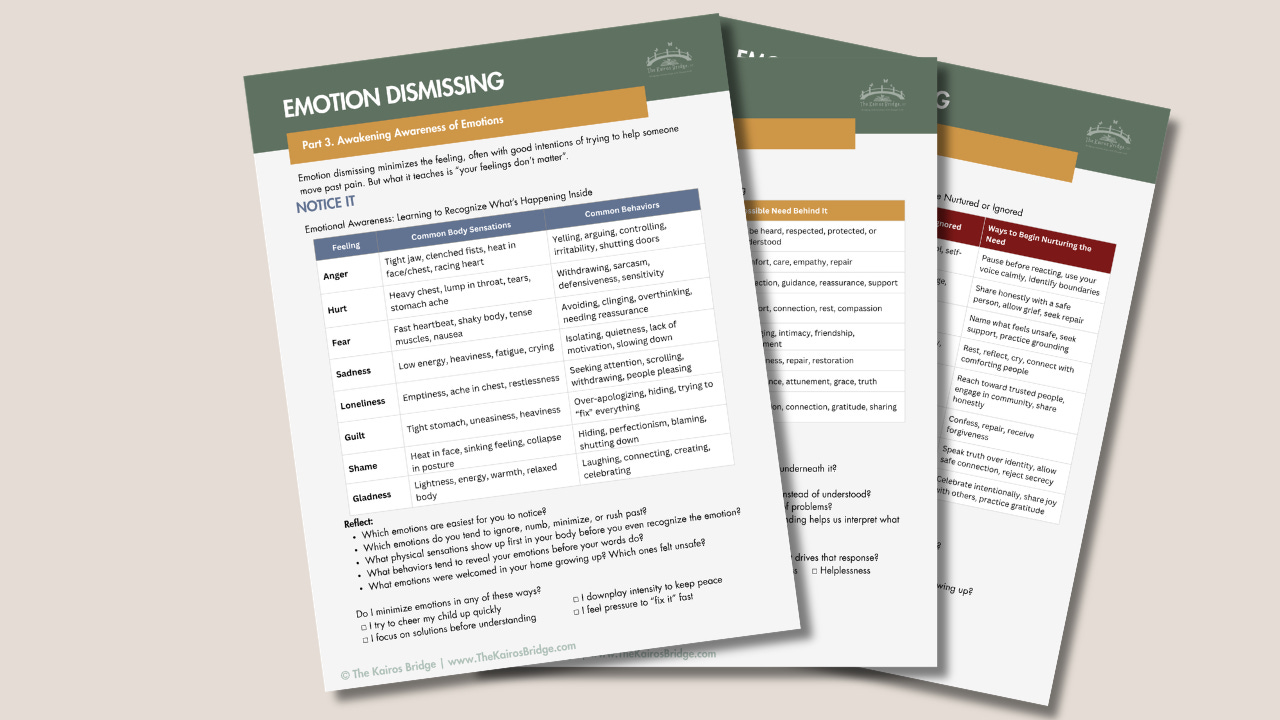
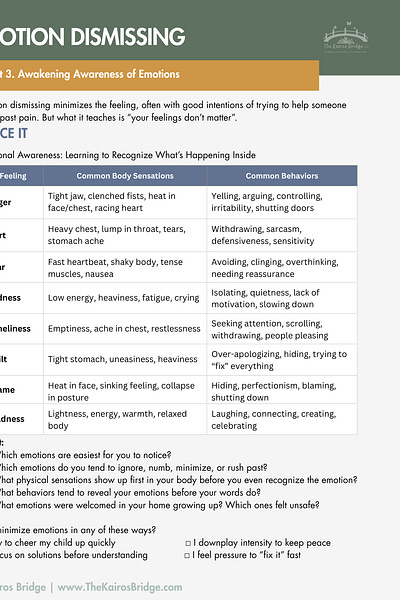
Notice It: When asked how you’re feeling, do you answer with a feeling or an explanation?
Name It: Instead of “solving” the feeling, pause and ask “What might be underneath this feeling? What’s the signal?” You don’t have to act on it. Just sit with it. You don’t have to name it perfectly. “I don’t know, but something feels off,” is a good first step toward emotional awareness.
Nurture It: God, our creator, supplies all of our needs according to His glorious riches (Philippians 4:19). That includes emotions. Sometimes it’s through prayer or Scripture study. Other times, He brings trusted friends to help us process. God knows exactly what we need. Ask Him for wisdom and then ask Him to provide.
This week’s parenting guide, Awakening Our Awareness of Feelings, is a helpful resource to walk you through this process for yourself and with your kids. It also includes deeper answers to how to nurture healthy emotional processing. It’s free to everyone, so grab your copy here!
If you missed Part 1 of the Emotional Awareness series, check it out here and Part 2 on Emotion Dismissing can be found here.
The 16-week Scripture Study, Song of the Heart, is a great place to start recognizing Emotions. Grab it here


!
My daughter did not make the cheerleading team this week. I hugged her and thinking of my wife's wisdom she has given me in parenting my daughters, I simply said the following. "I am not going to tell you that this was in the plan. Or good things are coming. I know this stinks, and I am sorry. It's going to stink for a few days, but it will pass. Please let me know what I can do to make this easier." She said thank you and hugged me. I remember as a teenager thinking how big some problems seemed at the time. She'll see that in time as well. I just have to be the thermostat in the room and not the thermometer. I cannot let the environment dictate my moods or feelings. I have to be the safe harbor in the storm.